
Absolute Price Oscillator (APO): Complete Guide for Algorithmic Trading
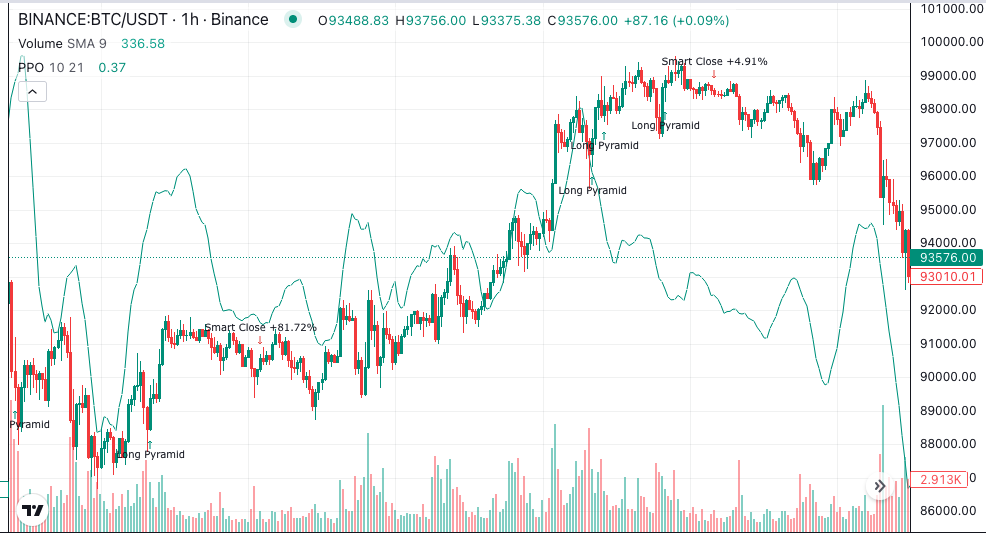
The Absolute Price Oscillator is one of the clearest momentum indicators available to algorithmic traders, measuring the difference between two exponential moving averages to identify trend direction and strength. Used by systematic traders across equities and crypto markets, the APO cuts through price noise and delivers a direct signal about whether bullish or bearish momentum is in control.
What Is the Absolute Price Oscillator?
The Absolute Price Oscillator is a momentum indicator that calculates the difference between a short-period exponential moving average (EMA) and a long-period exponential moving average. Unlike the MACD — which plots the EMA difference and adds a signal line — the APO focuses purely on the raw EMA spread, making it slightly simpler to interpret and easier to calibrate for specific markets and timeframes.
When the Absolute Price Oscillator is above zero, the short EMA is above the long EMA — upward momentum is in control. When it is below zero, the longer average has taken over, signalling that selling pressure dominates.
How Is the Absolute Price Oscillator Calculated?
The APO is calculated by subtracting the long-period EMA from the short-period EMA. Common default settings use a 12-period fast EMA and a 26-period slow EMA, though these can be adjusted for different markets and timeframes. The result is a single line that oscillates above and below a zero baseline — no additional signal line is applied.
A rising APO indicates the gap between the two averages is widening — momentum is building. A falling APO means the averages are converging or the short EMA is crossing below the long — momentum is fading or reversing. For a deeper look at how EMAs work, Investopedia’s guide to exponential moving averages is a useful reference.
How to Read Absolute Price Oscillator Signals?
The Absolute Price Oscillator generates signals in three primary ways:
- Zero-line crossovers: When the APO crosses above zero, short-term momentum has overtaken the longer-term trend — a potential buy signal. A cross below zero suggests selling pressure is dominating.
- Divergence: If price makes a new high but the APO fails to confirm it, momentum may be weakening — a warning sign for existing long positions.
- Magnitude: The further the APO moves from zero, the stronger the prevailing momentum. Extreme readings can signal an overextended move and a potential mean reversion opportunity.
Like all momentum oscillators, the APO works best in trending markets. In sideways or ranging conditions, zero-line crossovers can produce false signals — which is why combining it with a trend filter such as the Average Directional Index (ADX) is a common approach.
What Are the Best Absolute Price Oscillator Trading Strategies?
Trend-Following with Zero-Line Crossovers
The simplest APO strategy enters a long position when the oscillator crosses above zero and exits when it crosses back below. On higher timeframes such as the 4-hour or daily chart, this approach captures major trending moves while filtering out short-term noise. Adding an ADX filter above 25 helps confirm that a real trend is in place before entering.
Momentum Divergence Exits
The APO works well as an exit signal even when combined with other entry indicators. If a position is open and the APO begins to turn back toward zero while price continues higher, it signals that the momentum driving the move is fading. Closing part of the position at this point — rather than waiting for a full reversal — is a disciplined way to protect profits without exiting too early.
Multi-Timeframe Confirmation
Using the APO on both a higher timeframe (daily or 4-hour) and a lower timeframe (1-hour or 15-minute) lets traders align entries with the dominant trend. Only take long signals on the lower timeframe when the higher timeframe APO is already above zero. This filters out counter-trend trades and improves the overall win rate of the strategy.
What Are Common Absolute Price Oscillator Mistakes to Avoid?
- Trading crossovers in ranging markets: The APO will whipsaw repeatedly when price moves sideways. Always confirm with a trend indicator before acting on a zero-line cross.
- Using default settings without testing: The 12/26 defaults are designed for daily stock charts. On crypto’s 4-hour or 1-hour timeframes, shorter periods such as 8/21 often produce more timely signals.
- Ignoring divergence: Many traders watch only for crossovers and miss divergence, which can be an earlier and more reliable warning of a momentum shift.
- Treating APO as a standalone system: Like all single indicators, the APO produces false signals in isolation. It performs best as part of a multi-indicator strategy with clear entry and exit rules.
How to Build Absolute Price Oscillator Strategies in Arrow Algo?
In Arrow Algo’s visual block builder, adding the Absolute Price Oscillator to your strategy takes seconds. Drag the APO block onto your canvas, connect it to your price data source, and set your fast and slow EMA periods. From there, wire the APO output directly into condition blocks — trigger a buy when the APO crosses above zero, and a sell when it crosses below.
Combining the APO with other blocks — ADX for trend confirmation, RSI for overbought or oversold checks — is straightforward in the drag-and-drop interface. There is no code to write and no formulas to manage manually. The blocks handle all calculations, leaving you to focus entirely on strategy logic and rules.
What Are the Key Takeaways?
- The Absolute Price Oscillator measures the difference between a short and long EMA, delivering a clear read on momentum direction
- Above zero means short-term momentum is bullish; below zero means bearish momentum is in control
- Zero-line crossovers and divergence are the two primary signal types to watch
- Default 12/26 settings may need adjustment for crypto timeframes — test shorter periods on higher-frequency charts
- Always combine with a trend filter to avoid false signals in ranging conditions
- Arrow Algo’s visual builder lets you add and configure the APO block without writing any code
Educational disclaimer: This content is for educational purposes only and does not constitute financial advice. Trading involves significant risk and you should only trade with capital you can afford to lose. Past performance is not indicative of future results.
Disclaimer: The information provided in this article is for educational purposes only and does not constitute financial advice. Trading involves significant risk and you should only trade with capital you can afford to lose. Past performance is not indicative of future results. Always conduct your own research before making any trading decisions.
Ready to build your own automated trading strategies without writing a single line of code? Start for free at Arrow Algo and join thousands of traders who’ve made the switch to systematic trading.