
Average Directional Movement Index Rating (ADXR): Complete Guide for Algorithmic Trading
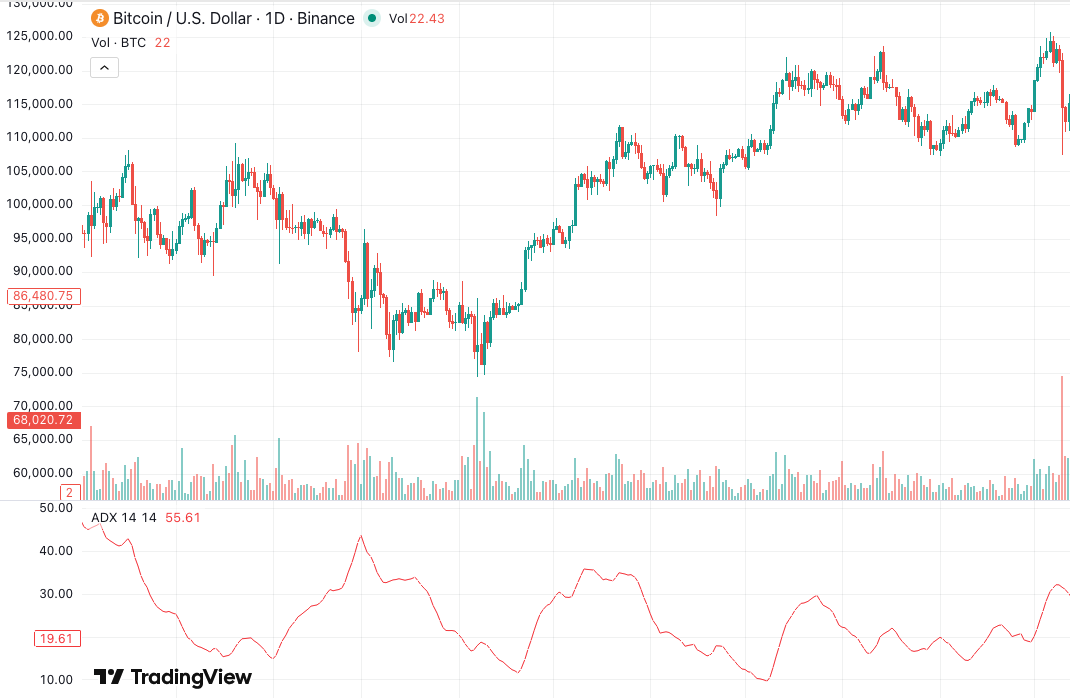
The Average Directional Movement Index Rating (ADXR) is a smoothed, lagged version of the ADX indicator, designed to measure trend strength with fewer false signals. Where ADX reacts to each new price move, ADXR applies an extra averaging step to produce a more stable reading. This makes it particularly valuable for systematic traders who need confirmation that a trend has genuine momentum before entering a position.
What Is the Average Directional Movement Index Rating?
The Average Directional Movement Index Rating (ADXR) is a trend strength indicator that measures how strongly a market is trending, without indicating direction. It was developed by J. Welles Wilder Jr. — the same analyst behind the RSI and ATR — as part of his Directional Movement System, first published in his 1978 book New Concepts in Technical Trading Systems.
Unlike ADX, which updates with every new period, ADXR averages the current ADX reading with the ADX value from n periods ago. This additional smoothing makes the indicator less sensitive to short-term noise. The result is a cleaner signal at the cost of some immediacy — a trade-off that suits strategies focused on confirming sustained trends rather than catching early entries.
How Is the ADXR Calculated?
ADXR is built on the same components as ADX, computed in three steps:
- Calculate the Directional Movement lines: The +DI and −DI lines measure upward and downward price movement relative to the previous period’s range. Both are smoothed over a default 14-period window.
- Calculate ADX: ADX comes from the smoothed ratio of +DI and −DI. It produces a value between 0 and 100 representing trend strength, regardless of direction.
- Apply the ADXR formula: ADXR = (Current ADX + ADX from n periods ago) ÷ 2. The default lookback is 14 periods, so the indicator averages today’s ADX with the reading from 14 periods prior.
In Arrow Algo’s no-code visual block builder, the ADXR block handles this computation automatically. You set your preferred period, connect it to your strategy logic, and the platform calculates everything in real time.
How to Read ADXR Signals?
The indicator uses the same scale and thresholds as ADX:
- Below 20: Weak or absent trend — the market is likely ranging or consolidating. Trend-following strategies tend to underperform at this level.
- 20–25: Transitional zone — a trend may be developing but is not yet confirmed.
- Above 25: Trend is gaining strength — the typical activation threshold for trend-following entries.
- Above 40–50: Strong, established trend — though the move may be mature and closer to exhaustion.
Because ADXR is smoother than ADX, it crosses the 25 threshold more slowly. But that cross carries more weight — it is less likely to be a false positive. Always read the indicator alongside the +DI and −DI lines. When +DI is above −DI, the trend is upward. When −DI is above +DI, the trend is downward. ADXR tells you how strong the trend is; the DI lines tell you which way it is going.
What Are the Best ADXR Trading Strategies?
Using ADXR as a Trend Entry Filter
The most common use of ADXR in systematic trading is as a filter. It blocks entry signals from trend-following indicators — such as EMA crossovers or MACD signals — unless the reading is above 25. This prevents entering trending strategies in sideways markets, where false breakouts are common. In Arrow Algo, you connect an ADXR condition block set to “greater than 25” in series with your primary entry signal. A trade only opens when both conditions are satisfied.
Monitoring Trend Strength Over Time with ADXR
Comparing the current ADXR reading to the previous period shows whether a trend is accelerating or fading. A rising reading suggests the trend is strengthening. A falling one suggests momentum may be running out. Strategies can tighten trailing stop conditions as the indicator begins declining — protecting profits when trend strength wanes, without exiting while it is still accelerating.
Regime Detection: Switching Strategies Based on ADXR
One of the most powerful applications of ADXR in algo trading is market regime detection. When the reading falls below 20, a strategy can switch from trend-following logic to a mean-reversion approach. When it rises back above 25, it switches back to trend mode. This adaptive behaviour is built entirely with condition blocks in Arrow Algo’s drag-and-drop builder. It allows a single strategy to handle both trending and ranging conditions without manual intervention.
What Are Common ADXR Mistakes to Avoid?
- Confusing ADXR with ADX: Because the indicator is more lagged, it crosses key thresholds later than ADX. Using ADXR for early-entry timing is counterproductive — its value is in trend confirmation, not in capturing precise turning points.
- Ignoring the directional lines: ADXR measures trend strength, not direction. Always pair it with the +DI and −DI lines, or with a directional indicator such as an EMA, to avoid entering trades against the prevailing trend.
- Extending the lookback period too far: Increasing the period beyond the default 14 adds further lag. This can make the indicator too slow to be useful in faster-moving markets. Start with 14 and adjust based on backtested results.
- Treating ADXR as a standalone signal: Like all trend strength indicators, it works best as part of a multi-condition strategy rather than as a single trigger for entries and exits.
How to Build ADXR Strategies in Arrow Algo?
Arrow Algo includes ADXR as a native indicator block within its no-code visual builder. No programming is required — you drag blocks onto the canvas, set your parameters, and connect them with logic conditions.
A typical setup combines three blocks: an EMA crossover block generates a directional signal, an ADXR condition block confirms trend strength is above 25, and a DI comparison block verifies that +DI is above −DI. All three connect to your entry block — a trade only fires when all three conditions are met. You can then run a full backtest across years of historical exchange data, adjust the threshold or period, and see immediately how each change affects performance.
Explore the full indicator library and start building at Arrow Algo. For further reference, Investopedia’s ADXR guide covers the indicator’s origins and calculation in detail.
What Are the Key Takeaways?
- ADXR is the Average Directional Movement Index Rating — a smoothed version of ADX, calculated as the average of the current ADX and the ADX from n periods ago
- Values above 25 indicate a trending market; below 20 suggests sideways or choppy conditions
- The indicator is more stable than ADX but more lagged — best for trend confirmation, not early-entry timing
- Always pair ADXR with the +DI and −DI lines to determine trend direction, not just strength
- Common applications: trend entry filter, trend strength monitoring, and regime-based strategy switching
- Available as a native block in Arrow Algo’s no-code visual builder — no programming required
Educational disclaimer: This content is for educational purposes only and does not constitute financial advice. Trading involves significant risk and you should only trade with capital you can afford to lose. Past performance is not indicative of future results.
Disclaimer: The information provided in this article is for educational purposes only and does not constitute financial advice. Trading involves significant risk and you should only trade with capital you can afford to lose. Past performance is not indicative of future results. Always conduct your own research before making any trading decisions.
Ready to build your own automated trading strategies without writing a single line of code? Start for free at Arrow Algo and join thousands of traders who’ve made the switch to systematic trading.