
Breakout Trading: Capture Big Moves Early
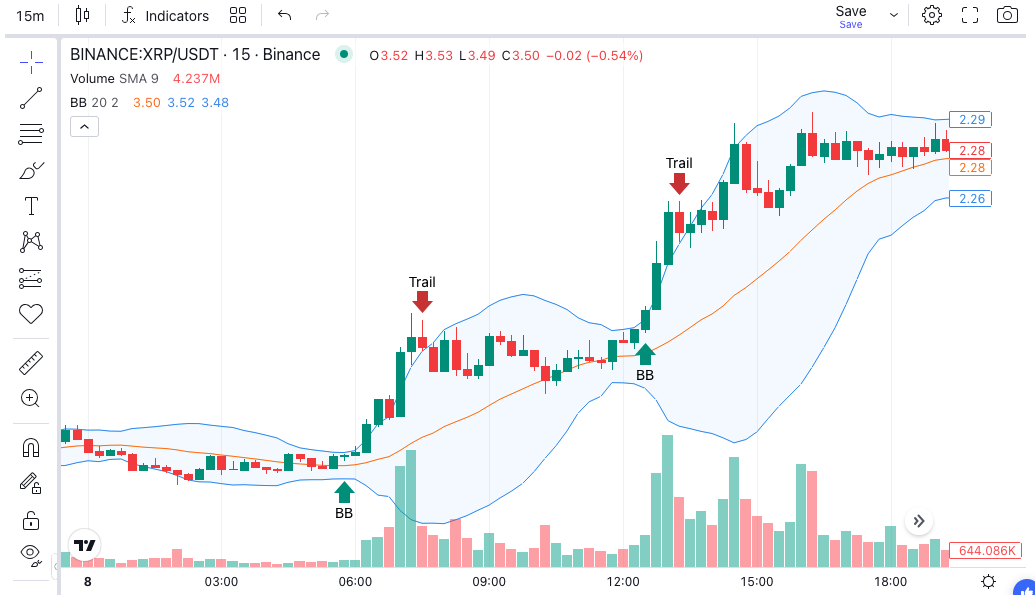
Breakout trading is a strategy that aims to enter a position at the exact moment price moves beyond a defined support or resistance level, capturing the beginning of a new directional move. For algorithmic traders, breakout detection is one of the most reliable pattern types to automate because the entry rules are objective and rule-based by nature.
What Is Breakout Trading?
Breakout trading is a systematic approach where traders enter positions when price breaks through a significant level of support or resistance. The core idea is that when price has been contained within a range, the eventual break of that range signals a surge of buying or selling pressure that can drive price sharply in one direction. Rather than trying to predict which way the market will move, breakout traders wait for the market to show its hand and then follow the momentum.
Breakouts can occur from horizontal ranges, chart patterns like triangles and wedges, or from indicator-based levels such as Donchian Channel boundaries or Bollinger Band extremes. What they all share is a period of consolidation followed by an expansion in volatility and directional commitment.
Why Does Breakout Trading Matter for Systematic Traders?
Breakout trading matters because it removes one of the hardest decisions in trading: timing. Instead of guessing when a move will start, you define the level in advance and let the market trigger your entry. This makes it ideal for automation. An algorithm does not get impatient waiting for a breakout, does not second-guess the signal, and executes instantly when conditions are met.
Many of the most successful trend-following strategies in history, including the famous Turtle Trading system, were built on breakout principles. The reason is simple: breakouts capture the start of trends, and trends are where the largest profits are made.
What Are the Most Common Types of Breakouts?
Range breakouts: Price consolidates between a horizontal support and resistance level, then breaks through one side. The longer the consolidation, the more significant the breakout tends to be. Donchian Channels are a classic tool for detecting these, triggering a buy when price hits a new 20-period high or a sell on a new 20-period low.
Volatility breakouts: These use indicators like Bollinger Bands or Keltner Channels to define a volatility envelope around price. When price closes outside the envelope, it signals an expansion in volatility that often precedes a sustained directional move. The Bollinger Band squeeze, where the bands narrow before expanding, is a well-known setup.
Pattern breakouts: Triangles, flags, and wedges all represent consolidation patterns with converging boundaries. A break above the upper boundary or below the lower boundary triggers the entry. These can be automated by tracking swing highs and swing lows to define the pattern edges.
How Do You Filter False Breakouts?
False breakouts are the primary challenge. Price breaks a level, triggers entries, then reverses back into the range. Systematic traders use several filters to reduce these:
Volume confirmation: A genuine breakout is usually accompanied by a significant increase in volume. Using OBV or a simple volume spike filter helps distinguish real breakouts from low-conviction probes.
Close-based confirmation: Rather than entering the moment price touches a level, wait for a candle to close beyond the level. This simple filter eliminates many intrabar wicks that temporarily pierce resistance before reversing.
ATR-based buffer: Add a buffer above resistance equal to a fraction of the Average True Range. Instead of buying at the exact breakout level, you require price to move a meaningful distance beyond it, filtering out marginal breaks.
Retest entries: Some traders wait for the initial breakout, then enter on the pullback that retests the broken level as new support. This reduces the risk of entering at the worst price but occasionally misses breakouts that never pull back.
How Does Position Sizing Work in Breakout Strategies?
Because breakouts can fail, position sizing and stop-loss placement are critical. A common approach is to place the stop just inside the broken range. If you buy a breakout above $100, your stop might sit at $98, just below the former resistance. Your position size is then calculated based on this stop distance and your maximum risk per trade.
This approach means breakout strategies often have a lower win rate but a higher reward-to-risk ratio. You may get stopped out on several false breakouts, but the genuine breakouts that develop into trends can produce outsized returns that more than compensate for the small losses.
How to Apply Breakout Trading in Arrow Algo
Arrow Algo’s visual block builder makes breakout strategies straightforward to build. Start with a Donchian Channel block or Bollinger Band block to define your breakout levels. Connect the upper and lower bands to comparison blocks that check whether the current candle’s close exceeds the level. Add a volume condition block to filter for above-average volume on the breakout bar.
For false breakout filtering, add an ATR block and use a math block to create a buffer above the breakout level. Connect everything to your entry and exit logic visually. Backtest across multiple timeframes and pairs using live exchange data to find the settings that work best for your chosen market. The entire process uses drag-and-drop blocks with no coding required.
What Are the Key Takeaways?
- Breakout trading captures the start of new trends by entering when price moves beyond defined support or resistance levels
- The strategy is inherently rule-based, making it one of the easiest pattern types to automate
- False breakouts are the main risk and can be filtered using volume, close-based confirmation, or ATR buffers
- Breakout strategies typically have lower win rates but higher reward-to-risk ratios, making proper position sizing essential
- Donchian Channels, Bollinger Bands, and Keltner Channels are the most common tools for detecting breakouts
- Build and backtest visual breakout strategies in Arrow Algo’s no-code block builder using live exchange data
Educational disclaimer: This content is for educational purposes only and does not constitute financial advice. Trading involves significant risk and you should only trade with capital you can afford to lose. Past performance is not indicative of future results.
Disclaimer: The information provided in this article is for educational purposes only and does not constitute financial advice. Trading involves significant risk and you should only trade with capital you can afford to lose. Past performance is not indicative of future results. Always conduct your own research before making any trading decisions.
Ready to build your own automated trading strategies without writing a single line of code? Start for free at Arrow Algo and join thousands of traders who’ve made the switch to systematic trading.