
Chaikin Money Flow (CMF): Complete Guide for Algorithmic Trading
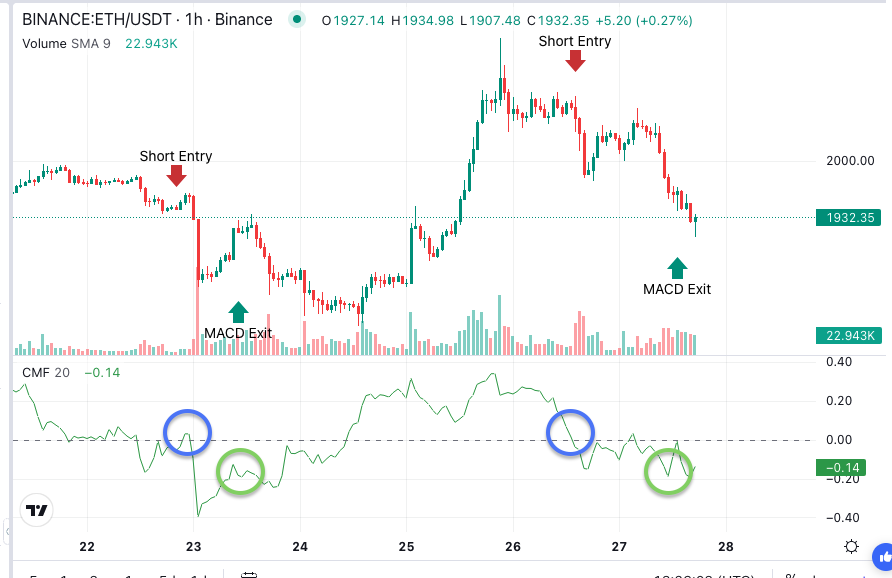
Chaikin Money Flow (CMF) is a volume-weighted oscillator developed by Marc Chaikin. It measures the degree of accumulation or distribution in a market over a set period. By combining where price closes within each candle’s range with the volume traded on that bar, CMF gives you a direct reading of whether buyers or sellers are in control — not just of price, but of the underlying money flow driving it.
What Is Chaikin Money Flow?
Chaikin Money Flow is a momentum indicator that oscillates between -1 and +1. Positive readings indicate net buying pressure — more volume is flowing into the asset than out of it. Negative readings indicate net selling pressure. The further the reading is from zero in either direction, the stronger the conviction behind the move. CMF is distinct from the Chaikin Oscillator (adosc), which is already available in Arrow Algo. The Chaikin Oscillator measures the difference between two EMAs of the Accumulation/Distribution Line. CMF is a separate calculation that directly sums money flow volume over a period and normalises it by total volume. The two indicators share a creator but behave differently and suit different strategy types.
How Does CMF Calculate Buying and Selling Pressure?
CMF uses a three-step calculation. First, it calculates the Money Flow Multiplier for each bar. This measures where the close sits within the bar’s high-low range. A close near the top of the range produces a multiplier close to +1. In contrast, a close near the bottom produces a multiplier close to -1. A close at the midpoint produces zero. Second, it multiplies the Money Flow Multiplier by that bar’s volume to produce Money Flow Volume. A strong close on high volume produces a large positive value. A weak close on high volume produces a large negative value. Third, it sums the Money Flow Volume values over the chosen period and divides by the total volume over the same period. The result is a single value between -1 and +1 that represents the net directional bias of money flow over that window. The default period is 20 bars.
What Do CMF Readings Tell You?
The zero line is the key reference point. CMF above zero means buying pressure has dominated the period. CMF below zero means selling pressure has dominated. Sustained readings in one direction — rather than brief crossings — are more meaningful signals. Standard thresholds used by most traders:
- Above +0.25: strong accumulation. Sustained buying pressure at this level is a bullish confirmation signal.
- Between 0 and +0.25: mild buying pressure. The trend is positive but lacks strong conviction.
- Between -0.25 and 0: mild selling pressure. Caution is warranted for long positions.
- Below -0.25: strong distribution. Sustained readings here confirm active selling pressure.
Divergence between CMF and price is one of the most useful signals. Price making a new high while CMF makes a lower high suggests the rally lacks volume backing. This is an early warning that the move may be running out of fuel before it shows in price.
What Are the Most Effective CMF Trading Strategies?
Zero line crossover confirmation: use a price-based entry signal — such as an EMA crossover or breakout — and require CMF to be above zero before allowing long entries. This filters out breakouts that happen on weak or declining volume. Connect an EMA crossover block and a CMF condition block to an AND gate. The strategy only enters when both fire simultaneously. Threshold filter: raise the bar by requiring CMF to be above +0.1 or +0.15 before a long entry triggers. This removes signals during periods of low conviction. It reduces trade frequency but increases the average quality of entries by ensuring there is genuine buying pressure behind each signal. Divergence detection: pair CMF with a price high/low detection block. When price makes a new high but CMF does not, flag the divergence as a potential reversal warning. Use this to tighten stop-losses on existing positions or to require a higher confirmation threshold before adding to a long. For a broader view of how volume indicators connect to order flow analysis, the order flow trading guide covers the underlying principles.
What Are the Common CMF Mistakes to Avoid?
Confusing CMF with the Chaikin Oscillator (adosc): they share a creator but measure different things. The Chaikin Oscillator measures momentum in the Accumulation/Distribution Line. CMF measures normalised money flow volume directly. Using one when you intend the other will produce different signals and different results. Treating brief zero line crossings as strong signals: CMF crosses zero frequently in choppy markets. A single bar above zero is not a meaningful signal. Look for sustained readings — several consecutive bars — above or below the threshold level before acting on the signal. Using CMF as a standalone entry trigger: CMF is a confirmation tool. A positive CMF reading with no supporting price signal does not tell you when to enter — only that conditions are supportive. Pair it with a directional trigger. Ignoring the period setting: a short period (such as 5 or 10) makes CMF very sensitive and produces frequent, noisy signals. A longer period (such as 20 or 21) smooths the output but makes it slower to react. Match the period to your strategy’s timeframe.
How to Use CMF in Arrow Algo’s Visual Builder
In Arrow Algo, the CMF block takes four inputs: high, low, close, and volume. Connect each from your data watcher block. Set the time period in the block properties — 20 is the standard starting point.
- Drag the CMF block onto your canvas and connect high, low, close, and volume inputs
- Add a condition block and set it to check whether the CMF output is above zero (or above your chosen threshold such as +0.1)
- Connect that condition to an AND gate alongside your main entry signal
- Run a backtest to compare performance with and without the CMF filter active
The CMF filter works particularly well on trend-following strategies where you want to avoid entering during weak or distribution-phase moves. Combine it with ATR for volatility confirmation or with RSI for momentum alignment across multiple dimensions.
Key Takeaways
- Chaikin Money Flow (CMF) oscillates between -1 and +1, measuring net buying or selling pressure over a set period
- It is distinct from the Chaikin Oscillator (adosc) — different calculation, different signals, different use cases
- Readings above +0.25 signal strong accumulation; readings below -0.25 signal strong distribution
- The zero line crossover is the primary signal; sustained readings in one direction carry more weight than brief crossings
- Divergence between CMF and price is an early warning of a weakening move — one of its most valuable applications
- Use CMF as a confirmation filter alongside a directional trigger, not as a standalone entry signal
Disclaimer: This content is for educational purposes only and does not constitute financial advice. Trading involves significant risk and you should only trade with capital you can afford to lose. Past performance is not indicative of future results. Always conduct your own research before making any trading decisions. Ready to build your own automated trading strategies without writing a single line of code? Start for free at Arrow Algo and join thousands of traders who’ve made the switch to systematic trading.