
Chande Momentum Oscillator (CMO): Complete Guide for Algorithmic Trading
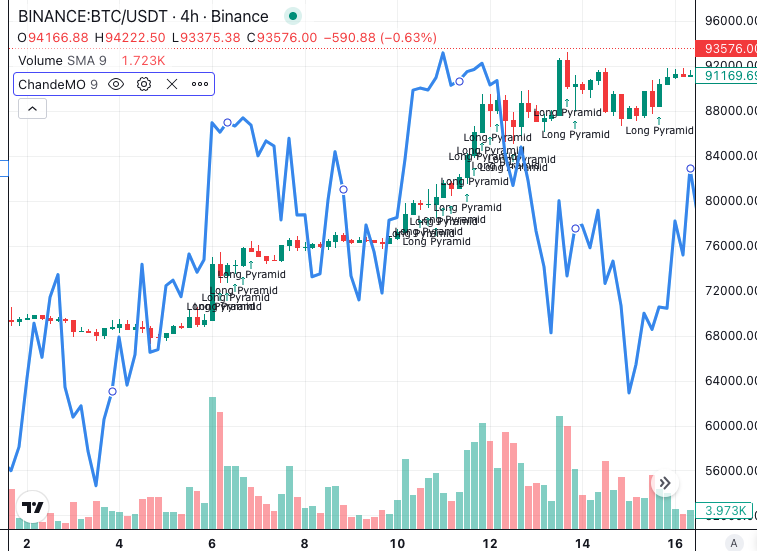
The Chande Momentum Oscillator is a momentum indicator that measures the difference between the sum of recent gains and the sum of recent losses, then expresses the result as a ratio. Developed by Tushar Chande and introduced in his 1994 book The New Technical Trader, the Chande Momentum Oscillator was designed to address a limitation in traditional momentum tools like the RSI — namely, that they can mask the true strength of momentum by normalising values too aggressively.
What Is the Chande Momentum Oscillator?
The Chande Momentum Oscillator is a bounded technical indicator that oscillates between -100 and +100, providing a symmetrical view of both bullish and bearish momentum. Unlike the RSI, which only oscillates between 0 and 100, the Chande Momentum Oscillator gives equal weight to upward and downward price movement. This makes it particularly useful for identifying the true strength of a trend and spotting momentum shifts before they become obvious on a price chart.
Readings above zero indicate that upward momentum dominates, while readings below zero signal that downward momentum is stronger. The further the Chande Momentum Oscillator moves from zero in either direction, the more powerful the prevailing momentum. According to Investopedia, this symmetrical design makes the CMO one of the most transparent momentum tools available.
How Is the Chande Momentum Oscillator Calculated?
The Chande Momentum Oscillator calculation is straightforward and happens automatically when you use the indicator block in a visual strategy builder:
- Calculate gains and losses: For each bar in your lookback period (typically 14 periods), record whether the close was higher or lower than the previous close. Sum all the gains separately from all the losses.
- Apply the formula: Subtract the sum of losses from the sum of gains, then divide by the total of gains plus losses combined. Multiply by 100 to get the oscillator value.
If every bar in the period closed higher, the Chande Momentum Oscillator would read +100. If every bar closed lower, it would read -100. A reading near zero means gains and losses are roughly equal — the market is indecisive.
The key insight from Tushar Chande’s design is that using both gains and losses in the denominator prevents the indicator from being artificially compressed during volatile periods. This is what distinguishes the Chande Momentum Oscillator from the RSI, which uses a smoothed average that can dampen extreme readings.
How to Read Chande Momentum Oscillator Signals?
The Chande Momentum Oscillator generates signals through several mechanisms:
Overbought and oversold zones: Readings above +50 indicate strong bullish momentum and potential overbought conditions. Readings below -50 indicate strong bearish momentum and potential oversold conditions. These thresholds are more meaningful than the 70/30 levels used by RSI because the CMO’s symmetrical scale provides a clearer picture of momentum extremes.
Zero-line crossovers: When the Chande Momentum Oscillator crosses above zero, bullish momentum is taking control. When it crosses below zero, bearish momentum dominates. These crossovers work well as trend confirmation signals, particularly on higher timeframes like the 4-hour or daily chart.
Divergence: When price makes a new high but the Chande Momentum Oscillator makes a lower high, bearish divergence warns of weakening momentum. The reverse — price making a new low while CMO makes a higher low — suggests bullish divergence and a potential reversal.
Trend strength: Sustained readings above +25 or below -25 indicate a healthy trend. When the Chande Momentum Oscillator fluctuates rapidly around zero, the market lacks directional conviction and is likely range-bound.
What Are the Best Chande Momentum Oscillator Trading Strategies?
1. Trend confirmation with zero-line crossovers: Use the Chande Momentum Oscillator crossing above zero as a buy signal and crossing below zero as a sell signal. Pair this with a trend filter like the 200-period SMA — only take long signals when price is above the SMA and short signals when below. This filters out choppy signals in sideways markets.
2. Oversold bounce strategy: When the Chande Momentum Oscillator drops below -50 and then turns upward (crossing back above -50), enter a long position. This catches momentum reversals from extreme selling. Add Bollinger Bands as a secondary confirmation — if price is also touching the lower band, the reversal signal is stronger.
3. Divergence-based reversals: Scan for bearish divergence (price higher high, CMO lower high above +50) to exit long positions or enter shorts. Use bullish divergence (price lower low, CMO higher low below -50) to enter longs. The Chande Momentum Oscillator’s symmetrical scale makes divergences easier to spot than on asymmetric indicators.
What Are Common Chande Momentum Oscillator Mistakes to Avoid?
- Using default settings without testing: The standard 14-period lookback works well for daily charts, but shorter timeframes often benefit from 9 or 10 periods. Always backtest different settings for your specific market and timeframe.
- Trading overbought/oversold in strong trends: During a powerful uptrend, the Chande Momentum Oscillator can remain above +50 for extended periods. Selling just because the indicator is overbought will put you against the trend. Use overbought/oversold signals primarily in ranging markets.
- Ignoring the zero line: Many traders focus only on the extreme levels and overlook the zero-line crossover, which is one of the most reliable signals the Chande Momentum Oscillator produces.
- Using it in isolation: Like any momentum indicator, the CMO performs best when combined with trend-following tools or volume indicators like the OBV.
How to Build Chande Momentum Oscillator Strategies in Arrow Algo?
Arrow Algo includes the Chande Momentum Oscillator as a ready-to-use indicator block. Drag the CMO block onto your canvas, connect it to any supported trading pair, and set your preferred lookback period. The block outputs the oscillator value, which you can feed directly into condition blocks.
For a zero-line crossover strategy, connect the CMO output to a condition block checking if the value crosses above zero (buy) or below zero (sell). For an oversold bounce strategy, set conditions for the CMO dropping below -50 and then rising back above it. Arrow Algo’s MCP integration can also help you configure multi-indicator setups that combine the Chande Momentum Oscillator with trend filters and volume confirmation.
Backtest your Chande Momentum Oscillator strategy against live exchange data from Binance, Coinbase, or HyperLiquid to validate performance across different market conditions before risking real capital.
What Are the Key Takeaways?
- The Chande Momentum Oscillator oscillates between -100 and +100, giving a symmetrical view of momentum
- It was designed by Tushar Chande to provide more transparent momentum readings than the RSI
- Readings above +50 signal overbought conditions; below -50 signal oversold
- Zero-line crossovers are reliable trend confirmation signals on higher timeframes
- Combine the Chande Momentum Oscillator with trend filters like the 200 SMA for best results
- Arrow Algo’s visual builder lets you drag, connect, and backtest CMO strategies without writing any code
Educational disclaimer: This content is for educational purposes only and does not constitute financial advice. Trading involves significant risk and you should only trade with capital you can afford to lose. Past performance is not indicative of future results.
Disclaimer: The information provided in this article is for educational purposes only and does not constitute financial advice. Trading involves significant risk and you should only trade with capital you can afford to lose. Past performance is not indicative of future results. Always conduct your own research before making any trading decisions.
Ready to build your own automated trading strategies without writing a single line of code? Start for free at Arrow Algo and join thousands of traders who’ve made the switch to systematic trading.