
Chandelier Exit (CE): Complete Guide for Algorithmic Trading
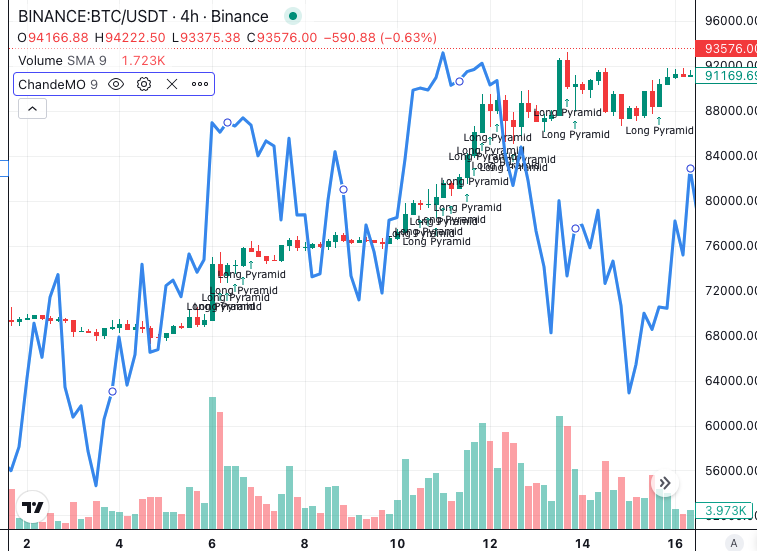
The Chandelier Exit is one of the few indicators built specifically to solve a persistent problem in trend trading: knowing when to get out. Where most indicators tell you when to enter, the Chandelier Exit (CE) focuses on the exit side — using market volatility to set a trailing stop that expands with uncertainty and tightens as conditions stabilise.
What Is the Chandelier Exit?
The Chandelier Exit is a volatility-based trailing stop indicator developed by Charles Le Beau. It calculates a dynamic stop level that moves with price, anchored to recent highs or lows and adjusted by the Average True Range (ATR). When price crosses back through the CE line, the strategy signals an exit — or a reversal, depending on how the strategy is built.
The CE earns its name from the image of a chandelier hanging from the ceiling of price action. The stop hangs down from the highest high of the move, swinging further away when volatility rises and pulling closer as it falls.
What Does the Chandelier Exit Measure?
The CE calculates two lines: one for long positions and one for short positions.
- Long CE: Highest High over N periods minus (Multiplier times ATR)
- Short CE: Lowest Low over N periods plus (Multiplier times ATR)
The default settings are a 22-period lookback and a multiplier of 3.0. These can be adjusted for different assets and timeframes — tighter settings suit lower-volatility instruments, wider settings suit more volatile ones.
The ATR is the key component. When market volatility rises, the ATR expands, which pushes the CE stop further from price. This gives the strategy more room to breathe during choppy conditions. When volatility contracts, the ATR falls, and the CE tightens — locking in more of the move.
In Arrow Algo, the CE block outputs this stop level directly. You connect it to your exit logic without calculating ATR separately.
How to Interpret Chandelier Exit Signals
The CE generates two primary conditions:
- Price crosses below the Long CE: Exit signal for a long position. The trend has reversed far enough from its high to suggest the move is over.
- Price crosses above the Short CE: Exit signal for a short position. The trend has recovered far enough from its low to close the short.
Many traders use the CE as both an exit and an entry. When price crosses below the Long CE, they exit the long and consider entering short. When price crosses above the Short CE, they close the short and consider going long. This creates a continuous reversal system.
The CE is less useful during ranging, sideways markets. When price lacks a clear directional trend, the CE may generate repeated false crosses. Combining it with a trend filter — such as an EMA or ADX — helps avoid low-quality signals. You can read more about trailing stop behaviour in our post on trailing stops in algorithmic trading.
What Are the Best Chandelier Exit Trading Strategies?
1. Volatility-Adjusted Trailing Stop
The most straightforward CE application: use it as a dynamic trailing stop for an open long or short position. Once in a trade, the CE follows price at a distance set by the ATR. It locks in profits as price moves in your favour and triggers the exit when the move reverses by more than the volatility-adjusted threshold.
2. Trend Regime Filter
Use the CE to determine market regime. When price is above the Long CE, the strategy is in uptrend mode — only take long signals. When price is below the Short CE, the strategy is in downtrend mode — only take short signals. This keeps you aligned with the dominant direction and avoids counter-trend entries.
3. CE Crossover Reversal System
Build a full reversal strategy using CE crosses as both exit and entry triggers. Price crossing below Long CE closes any long and opens a short. Price crossing above Short CE closes the short and opens a long. This approach works well in strongly trending markets but requires a volatility or momentum filter to reduce whipsaws in ranging conditions.
What Are Common Chandelier Exit Mistakes to Avoid?
- Setting the multiplier too low: A multiplier below 2.0 on a volatile asset will produce a stop too close to price. Normal intraday swings trigger exits, removing you from valid trends early.
- Not calibrating per asset: A 22-period / 3x ATR setting is a starting point, not a universal rule. Backtest the CE on the specific asset and timeframe before applying it live.
- Using CE alone for entries: CE is primarily an exit and trend-filter tool. Using it for entries without a supporting directional signal increases false starts in sideways markets.
- Ignoring the lookback period: The lookback controls how recent the highest high or lowest low is. A short lookback is more responsive but more susceptible to noise. A longer lookback gives cleaner signals but reacts more slowly.
How to Build Chandelier Exit Strategies in Arrow Algo
Arrow Algo includes a CE block in its visual builder. Drag it onto the canvas, set your period and multiplier, and connect the output to your strategy’s exit logic. No coding required.
A basic trailing stop setup on the canvas looks like this:
- Add a CE block — period 22, multiplier 3.0
- Add a Crossover block — triggers when price crosses below the Long CE output
- Connect the crossover output to a close long order block
- Add an EMA block — use as a trend filter, only running the strategy in uptrend conditions
- Connect both the EMA condition and entry signal to an AND gate before the entry order block
For a reversal system, duplicate the setup for the Short CE and mirror the logic for short entries. The entire strategy is visual — you backtest it against live exchange data before deploying. Refer to the Investopedia Chandelier Exit reference for further background on the indicator’s history and parameters. Chuck Le Beau’s original work is documented at Traders Laboratory for those who want the source material.
What Are the Key Takeaways?
- The Chandelier Exit is a volatility-based trailing stop that adjusts with ATR — wider in volatile markets, tighter when conditions calm
- Long CE: Highest High minus (multiplier × ATR) — signals exit when price drops through it
- Short CE: Lowest Low plus (multiplier × ATR) — signals exit when price rises through it
- CE works best as a trailing stop or trend filter, not as a standalone entry signal
- Avoid tight multipliers on volatile assets — normal price swings will trigger premature exits
- In Arrow Algo, connect the CE block to a crossover block for automatic exit triggers — no programming required
Disclaimer: This content is for educational purposes only and does not constitute financial advice. Trading involves significant risk and you should only trade with capital you can afford to lose. Past performance is not indicative of future results. Always conduct your own research before making any trading decisions.
Ready to build your own automated trading strategies without writing a single line of code? Start for free at Arrow Algo and join thousands of traders who’ve made the switch to systematic trading.