
Crypto Market Cycles: Build Strategies That Adapt
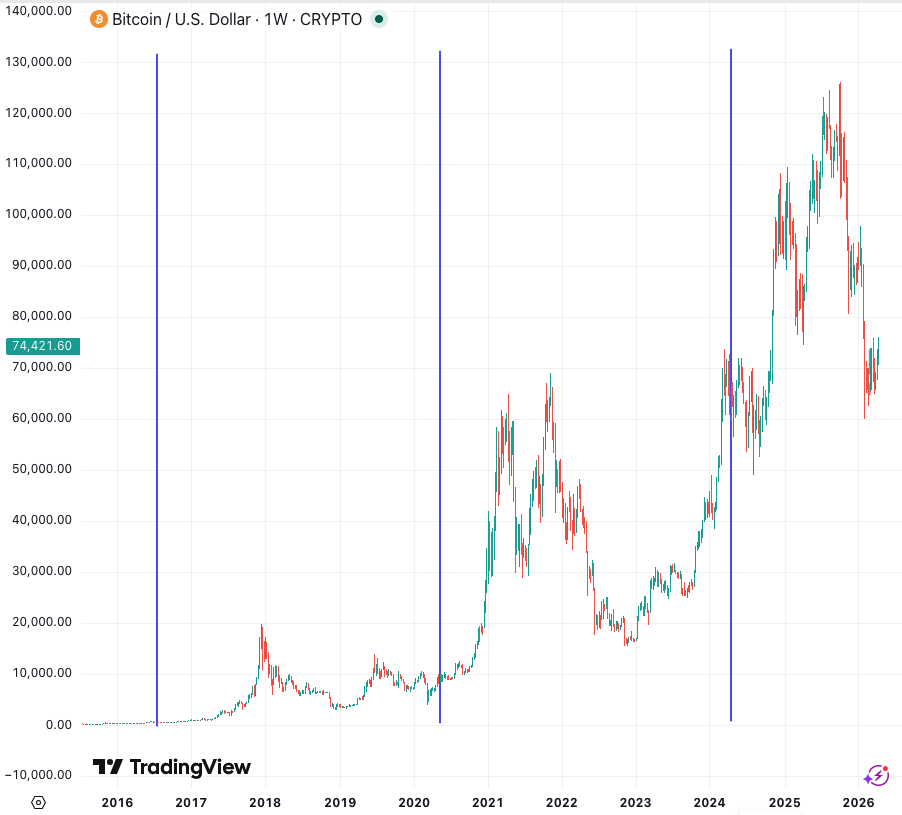
Understanding crypto market cycles is one of the most overlooked edges in algorithmic trading. Most traders focus on individual signals — a moving average cross, an RSI threshold — without considering the broader cycle phase their strategy is operating in. Strategies built for a bull market bleed capital in a bear market. Strategies tuned for ranging conditions fail in a strong trend. Cycle awareness changes that entirely.
What Are Crypto Market Cycles?
Crypto market cycles are the repeating patterns of price expansion and contraction that play out across months and years in cryptocurrency markets. Each cycle tends to move through four phases: accumulation, uptrend, distribution, and downtrend. These phases are not perfectly regular or predictable, but they share enough structural characteristics to inform how systematic traders build and filter their strategies.
Unlike traditional equity markets, crypto cycles have a unique structural driver: the Bitcoin halving. Approximately every four years, the Bitcoin protocol automatically cuts the rate at which new coins enter circulation in half — a supply reduction that has historically preceded significant bull market runs. The 2020 halving preceded a rally from roughly $10,000 to $69,000. The 2024 halving set the conditions for the current cycle. Understanding where you sit in that cycle directly shapes which strategy logic is appropriate right now.
Why Crypto Market Cycles Matter for Algorithmic Traders
The same strategy produces very different results depending on the current market phase. A trend-following strategy using EMA crossovers performs well in an uptrend. It generates whipsaw losses during accumulation and distribution, when price moves sideways without direction. A mean reversion strategy does the opposite — it thrives in ranging conditions and fails badly in a sustained trend.
Systematic traders who ignore cycle phases end up with strategies that perform brilliantly in backtests covering a bull market, then fail the moment conditions shift. Cycle-aware strategies adapt. They either switch between approaches depending on the current phase, or they apply filters that reduce activity when the current environment does not match the strategy’s logic. The result is more consistent performance across different market conditions.
What Are the Four Phases of a Crypto Market Cycle?
Accumulation
After a bear market, price bottoms out and begins moving sideways. Volume is low. Most retail participants have exited. Experienced and institutional buyers accumulate positions quietly at depressed prices. Trend-strength indicators like the ADX (Average Directional Index) — which measures how strongly price is trending on a scale of 0 to 100 — show low readings below 20. The Fear and Greed Index — a sentiment gauge running from 0 (extreme fear) to 100 (extreme greed) — sits in fear territory. Mean reversion strategies tend to perform best in this phase.
Uptrend
Price breaks higher with expanding volume. Trend-following strategies come into their own. Moving averages slope upward. Momentum builds and new participants enter the market. This phase can last 12–24 months in crypto cycles. Breakout strategies and trend-following algorithms capture the bulk of their profits here. The current market — with Bitcoin approaching all-time highs and institutional ETF flows accelerating — shows many characteristics of a sustained uptrend phase.
Distribution
Price stalls near a major top. Large holders begin selling into retail buying pressure. Volatility increases. The Fear and Greed Index reaches extreme greed. Price oscillates without making new highs. This is the most dangerous phase for algo traders — trend-following strategies generate false signals, and continuation trades reverse sharply. Tighter stop-losses and reduced position sizes protect capital during distribution.
Downtrend
Price falls consistently — often 70–90% from the cycle peak in crypto markets. Sentiment shifts to fear. Volume contracts. Short strategies and inverse momentum approaches can work, but crypto bear markets are faster and more violent than the preceding bull runs. Many systematic traders reduce exposure significantly or rotate capital to stablecoins during this phase to preserve gains from the uptrend.
How Do You Detect the Current Cycle Phase?
No single indicator identifies cycle phases in real time with certainty, but a combination of tools provides reliable context. ADX measures trend strength: readings above 25 indicate a trending market (uptrend or downtrend); readings below 20 suggest accumulation or distribution. The 200-day moving average provides macro context: price consistently above it signals bull market conditions; price below signals bear market territory.
On-chain metrics add another dimension. Bitcoin’s MVRV ratio — the Market Value to Realised Value ratio, which compares the current market cap to the total value of all coins at the price they last moved — historically flags cycle extremes. MVRV above 3.5 has preceded major tops in past cycles. MVRV below 1.0 has historically marked accumulation zones. Volume trends also reveal cycle shifts: expanding volume on up-days and contracting volume on down-days confirms uptrend health, while the reverse pattern warns of distribution.
How to Apply Crypto Market Cycles in Arrow Algo
Arrow Algo’s visual block builder lets you build cycle-aware strategies without writing any code. The simplest approach uses an ADX block as a regime filter. When ADX reads above 25, the strategy activates trend-following logic — for example, an EMA crossover entry. When ADX drops below 20, the strategy switches to mean reversion — entering on RSI extremes and targeting a return to the midpoint.
A 200-period moving average block works as an effective macro filter. Connect it to a condition block that only allows long entries when price sits above the 200-period MA. This single filter removes most bear market false signals from a trend-following strategy with minimal impact on bull market performance — one of the highest-return single adjustments you can make to a basic trend system.
Arrow Algo’s backtesting engine lets you test these filters across multiple years of exchange data immediately. You can compare the same strategy with and without the cycle filter side by side — seeing exactly how the filter changes drawdown, win rate, and overall return across different phases of the market. For more on detecting market conditions within a strategy, see our guide on Market Regime Detection. For an academic overview of market cycle theory, Investopedia’s guide to market cycles covers the foundational concepts clearly.
What Are the Key Takeaways?
- Crypto market cycles move through four phases: accumulation, uptrend, distribution, and downtrend.
- The Bitcoin halving — a supply reduction event approximately every four years — is a key structural driver of crypto cycle timing.
- Trend-following strategies work best in uptrends. Mean reversion works best in accumulation and ranging conditions.
- ADX and the 200-day moving average are practical tools for detecting cycle phase without complex indicators.
- Arrow Algo’s visual block builder lets you add cycle-aware filters directly to any strategy — no programming required.
Educational disclaimer: This content is for educational purposes only and does not constitute financial advice. Trading involves significant risk and you should only trade with capital you can afford to lose. Past performance is not indicative of future results.
Disclaimer: The information provided in this article is for educational purposes only and does not constitute financial advice. Trading involves significant risk and you should only trade with capital you can afford to lose. Past performance is not indicative of future results. Always conduct your own research before making any trading decisions.
Ready to build your own automated trading strategies without writing a single line of code? Start for free at Arrow Algo and join thousands of traders who’ve made the switch to systematic trading.