
Dollar Cost Averaging Strategy: Reduce Timing Risk
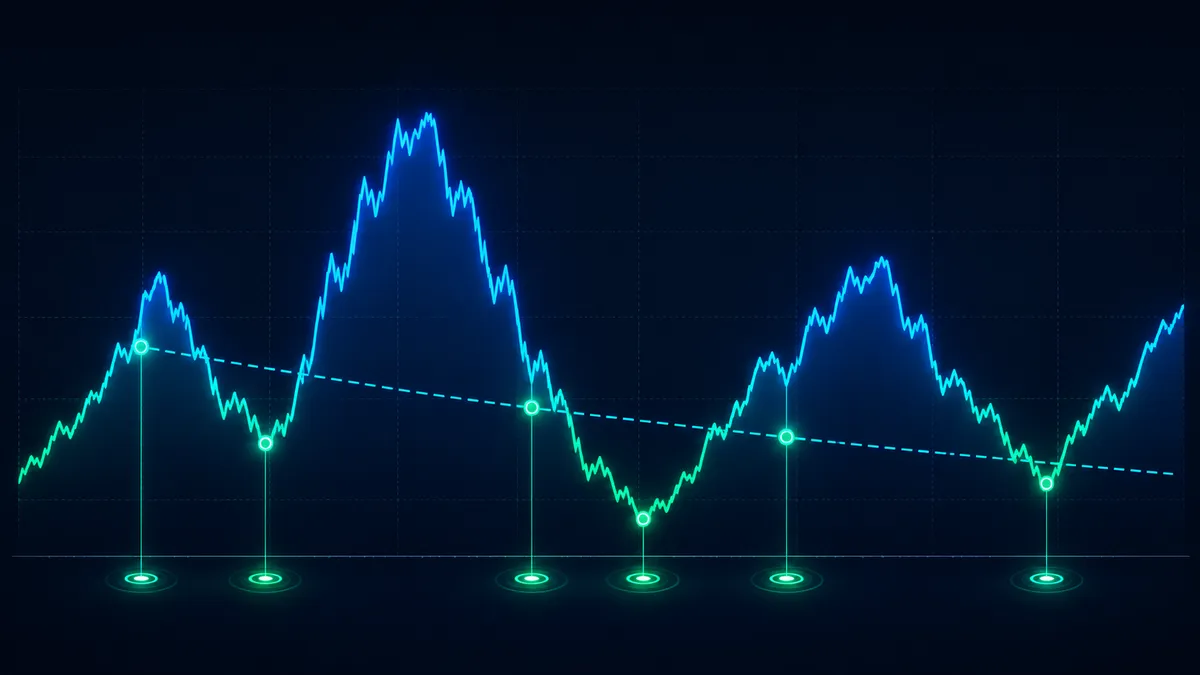
The dollar cost averaging strategy removes one of the hardest decisions in trading: when to buy. Instead of committing a lump sum at a single moment in time, you divide your capital into equal portions and deploy them at regular intervals — regardless of what the price is doing. No prediction required. No timing needed. Just a systematic, repeatable process that runs on a schedule.
What Is Dollar Cost Averaging?
Dollar cost averaging (DCA) is an investment approach where a fixed amount of capital is deployed at fixed time intervals. The price at each interval does not matter — the same amount goes in every time. When prices are low, the fixed amount buys more units. When prices are high, it buys fewer. Over time, the average entry cost settles somewhere between the highs and the lows of the period.
DCA was originally a concept from traditional equity investing, where it was used to smooth out market entry over months or years. In crypto — with its sharply higher volatility and 24/7 market structure — the logic applies even more directly. The same systematic discipline that protects a stock investor from buying at a market top protects a crypto trader from catching the peak of a parabolic move.
Why DCA Works in Volatile Markets
The core appeal of the dollar cost averaging strategy is its relationship with volatility. In a volatile market, timing is extremely difficult — even experienced analysts frequently misjudge short-term price direction. DCA sidesteps this problem entirely. Volatility, rather than being a threat, becomes a slight advantage: the same fixed amount buys more when prices dip, pulling the average cost down over time.
There is also a psychological benefit. Committing a large lump sum at a single price creates a strong emotional anchor to that entry level. If price falls after entry, the psychological pressure to exit can become overwhelming. DCA distributes that anchor across multiple entry points. No single price carries all the weight, which makes it easier to hold a position through normal market fluctuations without reacting emotionally.
For algorithmic traders, the psychological benefit is less relevant — your strategy executes automatically, without emotional input. But the risk distribution benefit is just as real. Spreading entries across time reduces the impact of a single bad entry on overall portfolio performance.
How Does DCA Compare to Lump Sum Investing?
This is the most common question about DCA, and the honest answer is: it depends on the market condition.
In steadily rising markets, lump sum investing tends to outperform DCA. If you invest everything at the start of an uptrend, you benefit from the full move. DCA keeps part of your capital on the sidelines, meaning you miss some of the gain on the portion not yet deployed.
In volatile or sideways markets — which describes much of crypto trading — DCA tends to produce a lower average cost than a single lump sum entry, particularly when the lump sum is timed poorly. The challenge is that no one knows in advance which type of market they are entering. DCA is the strategy that performs acceptably across both scenarios, rather than optimally in one and disastrously in the other.
What Are the Main DCA Strategy Variations?
Standard DCA
The classic form: a fixed dollar amount deployed at a fixed interval. $100 every Monday. $250 every month. The simplicity is the point — there are no decisions to make after the initial setup, which makes it straightforward to automate.
Price-Weighted DCA
A more active variation where the amount deployed varies based on the current price relative to a reference level. When price is below the reference (e.g. a moving average or a prior support), you deploy more. When price is above it, you deploy less. This improves the average cost more aggressively than standard DCA but requires a price signal to govern the amount.
Value Averaging
Rather than investing a fixed amount, value averaging targets a fixed growth in portfolio value per period. If your portfolio grew less than the target, you invest more. If it grew more, you invest less — or even sell a portion. This approach is mathematically efficient at building positions during drawdowns but is more complex to set up and manage.
Common Dollar Cost Averaging Mistakes
- No exit plan: DCA is primarily an entry strategy. Without a defined exit — a price target, a time horizon, or a trailing stop — you accumulate a position with no clear path to realising gains.
- DCA-ing into a broken asset: Regular buying into a declining asset does not fix a fundamentally broken strategy or project. Lower average cost means nothing if the eventual outcome is zero. DCA requires belief in long-term value, not just lower entry prices.
- Ignoring transaction costs: Frequent small purchases can accumulate significant fees, especially on platforms with per-trade charges. Factor costs into your DCA interval — weekly is often more cost-efficient than daily for smaller amounts.
- Deploying all capital too slowly: Spreading a lump sum over an unnecessarily long DCA window (e.g. 24 months of weekly buys) leaves too much capital uninvested for too long. Match the DCA window length to the asset’s typical volatility cycle.
How to Automate Dollar Cost Averaging in Arrow Algo
DCA is one of the most natural strategies to automate, because it requires no signal logic at all — just a time-based trigger and a fixed position size. Arrow Algo’s visual block builder handles this directly:
- Select your asset pair and timeframe. For a weekly DCA, use a weekly candle chart. For daily, use a daily candle. The candle close acts as your natural deployment trigger.
- Set your entry condition to candle open or close — no indicator required. Every bar triggers a buy for your fixed amount.
- Use the fix_number block to define your fixed position size. Connect it directly to your order block.
- For price-weighted DCA, add an EMA or moving average block and compare the current price to it. Use the output to adjust position size: a larger multiplier when price is below the moving average, a smaller one above it.
- Set a take-profit target or a trailing stop to define your exit. Backtest the strategy on Arrow Algo using real exchange data to find the interval and position size that works for your capital and risk tolerance.
The result is a fully automated DCA bot that executes your accumulation plan on schedule, without requiring you to monitor the market or place manual orders. You can also combine DCA entry logic with a trailing stop exit to automate both the entry and the exit of the full strategy. For a deeper look at managing position size across a portfolio of DCA strategies, the position sizing guide covers the key frameworks.
Key Takeaways
- Dollar cost averaging deploys a fixed amount at fixed intervals, removing the need to time the market
- Volatility becomes a mild advantage under DCA — lower prices buy more units, pulling down the average cost
- Lump sum outperforms in rising markets; DCA outperforms in volatile or uncertain ones
- Three main variations: standard DCA, price-weighted DCA, and value averaging
- Always pair DCA entry logic with a defined exit — price target, time horizon, or trailing stop
- Arrow Algo automates DCA with no code: time-based triggers, fixed position size, optional price-weighted multiplier
Disclaimer: This content is for educational purposes only and does not constitute financial advice. Trading involves significant risk and you should only trade with capital you can afford to lose. Past performance is not indicative of future results. Always conduct your own research before making any trading decisions.
Ready to build your own automated trading strategies without writing a single line of code? Start for free at Arrow Algo and join thousands of traders who’ve made the switch to systematic trading.