
Elder Force Index (EFI): Complete Guide for Algorithmic Trading
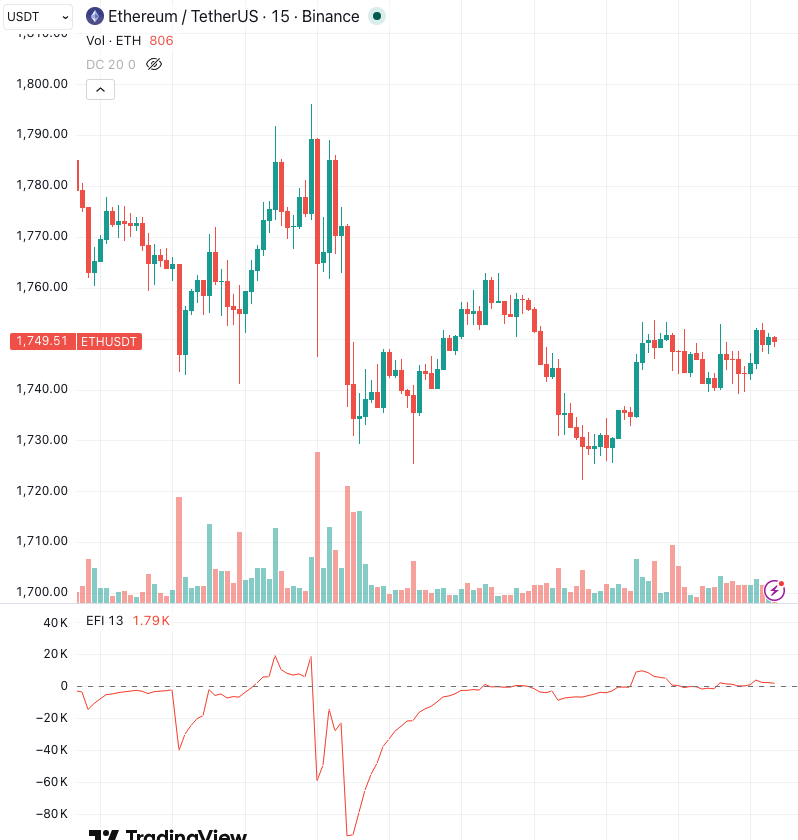
The Elder Force Index (EFI) is a volume-weighted momentum indicator developed by Dr. Alexander Elder, author of Trading for a Living. By multiplying the change in price by the volume behind that move, EFI produces a single value that reflects both the direction and the power of a price movement — not just where price went, but how much force drove it there.
What Is the Elder Force Index?
The Elder Force Index answers a question that price-only indicators cannot: was this move driven by conviction or by thin air? A price rise on high volume produces a large positive EFI reading. The same price rise on near-zero volume produces a value close to zero. The EFI cuts through surface-level price action to reveal the actual energy behind each move.
Arrow Algo applies a smoothing period to the raw EFI calculation, outputting an exponential moving average of the raw values. The time period property controls the length of that smoothing. Shorter periods (2–3) produce a sensitive, fast-reacting signal. Longer periods (13–26) smooth the noise and reveal the broader force trend. The raw single-bar calculation is the foundation. The smoothed output is what you connect to your strategy logic.
How Does EFI Measure Market Force?
The raw Elder Force Index for each bar multiplies two values together: the change in closing price from the previous bar, and the volume on the current bar.
A large positive close-to-close move on heavy volume produces a strongly positive reading. A large decline on heavy volume produces a strongly negative reading. Low volume on either side produces values near zero, regardless of how far price moved. The smoothed EFI then applies an exponential average over the chosen period to reduce noise.
This structure makes EFI sensitive to two things simultaneously: trend direction and participation. A breakout with rising EFI tells you buyers are engaged. A breakout with flat or falling EFI is a warning — price moved but the crowd did not follow.
What Does the EFI Output Tell You?
The EFI oscillates around zero with no fixed upper or lower bound. Its absolute value varies by asset and timeframe. Context matters more than the raw number.
- EFI rising above zero: buying force is strengthening. Suitable conditions for long entries if supported by a directional signal.
- EFI falling below zero: selling force is strengthening. Caution for long positions; suitable conditions for short entries.
- EFI approaching zero from either direction: force is weakening. A potential exhaustion signal — watch for reversal.
- EFI making a lower high while price makes a higher high: bearish divergence. The rally is losing force even as price advances.
- EFI making a higher low while price makes a lower low: bullish divergence. Selling force is weakening into a price low — a potential reversal signal.
What Are the Most Practical EFI Strategy Applications?
Trend entry confirmation: in a trend-following strategy, use EFI as a secondary filter. Require EFI to be above zero before allowing long entries. This ensures you only enter when volume is supporting the directional move rather than fading it. Connect EFI to a condition block set to “greater than 0” and feed it into an AND gate alongside your main entry signal.
Pullback entry timing: during an established uptrend, EFI often dips briefly below zero during normal pullbacks before recovering. Use an EFI crossover from negative to positive — after a pullback — as your entry trigger. This catches the resumption of trend force at a better price than chasing the initial breakout.
Divergence-based exits: EFI divergence is a reliable early warning for trend exhaustion. When your strategy holds a long position and EFI starts making lower highs while price makes new highs, tighten your stop-loss. The force behind the move is fading. For a broader view of volume-based confirmation tools, the Chaikin Money Flow guide covers a related approach to measuring buying and selling pressure.
What Should You Watch Out For With EFI?
Scale sensitivity: EFI values depend on the asset price and volume levels. A reading of 500,000 on Bitcoin means something different from the same reading on a low-cap altcoin. Never apply fixed absolute thresholds across different assets. Use relative comparisons — is EFI higher or lower than its recent average — rather than fixed cut-off values.
Short period noise: a period of 2 or 3 makes EFI extremely reactive. In choppy markets it will fire false signals frequently. Use a longer period (13 or 21) for daily and 4-hour strategies. Reserve short periods for deliberate high-frequency approaches with tight risk controls.
Volume data quality: EFI depends entirely on accurate volume data. Spot markets generally have reliable volume. Some derivative markets or low-liquidity pairs can have inconsistent volume reporting. Always confirm that your data source provides clean volume figures for the pair you are trading.
Using EFI without a directional signal: a large positive EFI reading does not tell you the trend is up — only that a recent move had strong force behind it. That move could be upward or a brief spike. Always pair EFI with a trend or momentum signal to establish direction before using EFI as confirmation.
How to Build EFI Strategies in Arrow Algo
In Arrow Algo’s visual block builder, the EFI block sits in the indicator section. It takes two inputs: close and volume. Both connect from your data watcher block. The time period property in the block settings controls the EMA smoothing length.
- Drag the EFI block onto your canvas
- Connect the close and volume outputs from your data watcher to the EFI inputs
- Set the time period — start with 13 for a balanced signal on most timeframes
- Add a condition block to check whether EFI is above zero
- Connect the EFI condition to an AND gate alongside your directional entry signal
- Run a backtest and compare results with and without the EFI filter active
EFI works particularly well in combination with trend indicators. Pair it with an EMA crossover for direction and ATR for volatility context. All connections happen through drag-and-drop on the canvas — no code required.
Key Takeaways
- The Elder Force Index (EFI) multiplies price change by volume to measure the actual force behind each move
- Arrow Algo outputs a smoothed EFI using an EMA over the chosen time period
- Values above zero indicate buying force; values below zero indicate selling force
- Divergence between EFI and price is a reliable early warning of trend exhaustion
- Always use EFI as a confirmation filter alongside a directional trigger — not as a standalone signal
- Use relative comparisons rather than fixed thresholds; EFI scale varies by asset and volume levels
Disclaimer: This content is for educational purposes only and does not constitute financial advice. Trading involves significant risk and you should only trade with capital you can afford to lose. Past performance is not indicative of future results. Always conduct your own research before making any trading decisions.
Ready to build your own automated trading strategies without writing a single line of code? Start for free at Arrow Algo and join thousands of traders who’ve made the switch to systematic trading.