
Fair Value Gap (FVG): Complete Guide for Algorithmic Trading
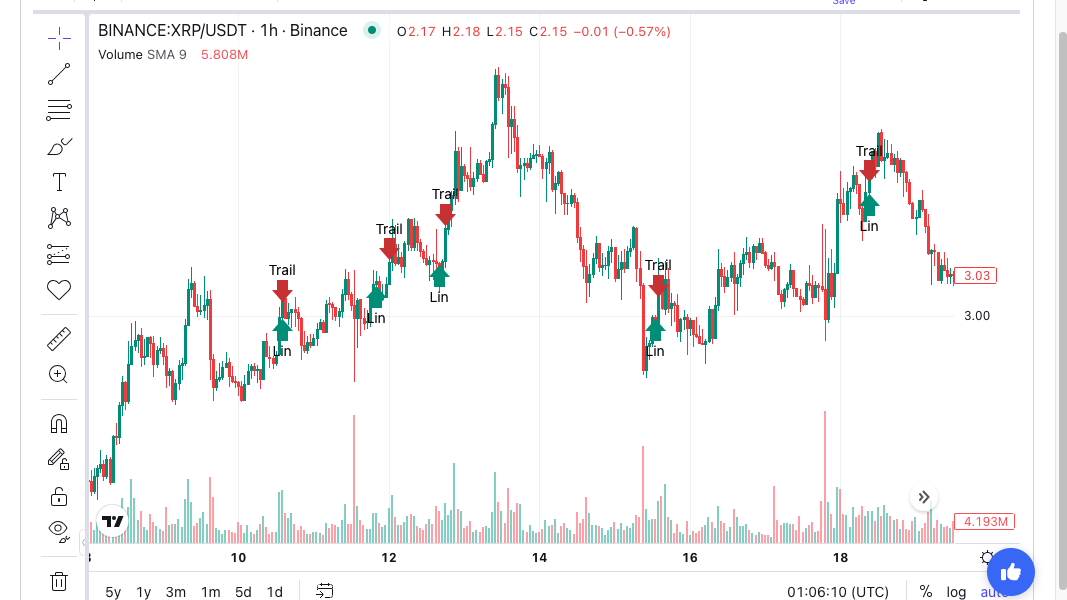
The Fair Value Gap (FVG) is a price action concept that has become one of the most discussed tools in modern technical analysis. It identifies a zone of price inefficiency — an area where price moved so quickly that buyers and sellers never had the chance to transact fairly. These imbalance zones frequently act as magnets, drawing price back to fill or retest them before the original move continues. Algorithmic traders use Fair Value Gaps to identify high-probability entry zones within systematic strategies, and Arrow Algo includes a native FVG block to make this straightforward to build without any code.
What Is the Fair Value Gap?
A Fair Value Gap forms when three consecutive candles create a visible price imbalance. The gap itself is the space between the high of the first candle and the low of the third candle in the sequence, where the middle candle represents a strong, fast-moving impulse.
There are two types:
- Bullish FVG: Forms during a sharp upward move. The gap sits between the high of candle one and the low of candle three. Price returning to this zone is treated as a potential buying opportunity.
- Bearish FVG: Forms during a sharp downward move. The gap sits between the low of candle one and the high of candle three. A bounce back into this zone is treated as a potential selling opportunity.
The concept originates from the Smart Money Concepts (SMC) framework, which studies the behaviour of institutional participants. Its edge as a systematic signal has made it popular beyond SMC traders — it is now widely used in rules-based algorithmic strategies. For more context on how institutions leave footprints in price data, see our guide on order flow trading.
What Does the Fair Value Gap Measure?
The Fair Value Gap measures price inefficiency. When price moves aggressively in one direction, it skips over areas where buyers and sellers were not able to transact at fair value. These unfilled zones represent supply-demand imbalances that the market has yet to resolve.
Markets tend toward efficiency over time. Price will often return to these imbalance zones to allow fair-value transactions to take place. This “filling” behaviour is the core of FVG-based strategies.
Gap size matters. A larger gap indicates a more aggressive, potentially institutional-driven move. Smaller gaps are more common and may fill quickly without providing a clean trading opportunity.
How to Read Fair Value Gap Signals
Interpreting FVG signals involves three stages: identifying the gap, waiting for a retracement, and confirming the entry:
- Gap identification: Look for a strong three-candle sequence. The gap is the price range not covered by candles one and three.
- Entry signal: When price retraces into a bullish FVG, it can signal a buying opportunity. When price retraces into a bearish FVG, it can signal a selling opportunity.
- Confirmation: Stronger signals appear when the FVG aligns with a key structural level, a trend direction, or another tool such as a moving average or volume spike.
- Invalidation: If price closes fully through the far edge of the FVG and continues moving, the gap has been filled and the signal is invalidated.
Higher timeframe FVGs — on the 4-hour or daily chart — carry more significance than lower timeframe gaps. Gaps on lower timeframes are more frequent and tend to fill faster, making them better suited to short-term systematic strategies.
What Are the Best Fair Value Gap Trading Strategies?
FVG retracement entry: Identify a FVG during a trending move. When price retraces into the gap zone, enter in the direction of the original trend. This approach keeps strategies trend-aligned rather than counter-trend. It is one of the most widely backtested FVG applications.
FVG with order block confluence: Combine FVG zones with order blocks — areas where institutional accumulation or distribution is believed to have occurred. When an FVG overlaps an order block, the confluence increases the reliability of the signal. Arrow Algo includes both blocks natively, so combining them requires no code.
FVG gap-fill mean reversion: In ranging or consolidating conditions, price frequently creates a gap through a fast impulse move and then retraces to fill it. A systematic trader can set rules to enter toward the fill target when a gap forms during a ranging phase, using the far edge of the gap as the profit target.
What Are Common Fair Value Gap Mistakes to Avoid?
- Trading every gap: Not every FVG leads to a clean retracement. Gaps in low-liquidity conditions or against a strong trend are lower quality. Apply a filter — trend direction, volume, or market structure — before taking the signal.
- Ignoring timeframe context: A small gap on a 1-minute chart carries far less significance than one on the daily chart. Always read the FVG in the context of the broader trend and timeframe.
- Assuming every gap fills: Some gaps never fill, particularly in strongly trending markets. Treat gap-fill as a probabilistic target, not a guarantee.
- Setting entry rules too precisely: Requiring price to touch an exact midpoint of the gap can result in missed trades. Allow some tolerance around the zone.
- Ignoring market structure: FVGs work best when they form at meaningful structural points — after a break of structure or at a clear swing high or low. Gaps that form in the middle of noise are less reliable.
How to Build Fair Value Gap Strategies in Arrow Algo
Arrow Algo includes a native FVG block in its visual builder. It detects Fair Value Gaps automatically on your chosen timeframe and outputs a signal you can connect directly to entry, exit, or filter logic — no coding required.
Here is a basic FVG retracement setup in Arrow Algo’s drag-and-drop canvas:
- Add the FVG block to your canvas and set your target timeframe.
- Connect the bullish FVG output to an entry condition block. This fires when price retraces into a bullish gap zone.
- Add a trend filter — connect an EMA block and set a condition that price must be above the EMA before an entry fires. This keeps trades trend-aligned.
- Set your exit condition — a take-profit at the far edge of the gap, or a stop-loss below the bottom of the FVG.
- Run a backtest in Arrow Algo to assess how the strategy performed across different market conditions before taking it live.
You can also combine the FVG block with the Order Block block for confluence-based strategies, all from the same visual canvas. For more on building structured entry logic using price levels and zones, see our post on support and resistance trading.
What Are the Key Takeaways?
- A Fair Value Gap is a price imbalance zone created by a strong three-candle impulse move.
- Price often returns to FVG zones, making them useful for entries and confirmation signals.
- Bullish FVGs form during upward moves; bearish FVGs form during downward moves.
- Higher timeframe FVGs carry more weight than lower timeframe gaps.
- Combining FVGs with trend filters, volume, and order blocks improves signal quality.
- Not every gap fills — treat FVGs as probabilistic zones, not guaranteed targets.
- Arrow Algo’s native FVG block lets you build and backtest FVG strategies without any coding.
Disclaimer: This content is for educational purposes only and does not constitute financial advice. Trading involves significant risk and you should only trade with capital you can afford to lose. Past performance is not indicative of future results. Always conduct your own research before making any trading decisions.
Ready to build your own automated trading strategies without writing a single line of code? Start for free at Arrow Algo and join thousands of traders who’ve made the switch to systematic trading.