
Forecast Oscillator (FOSC): Complete Guide for Algorithmic Trading
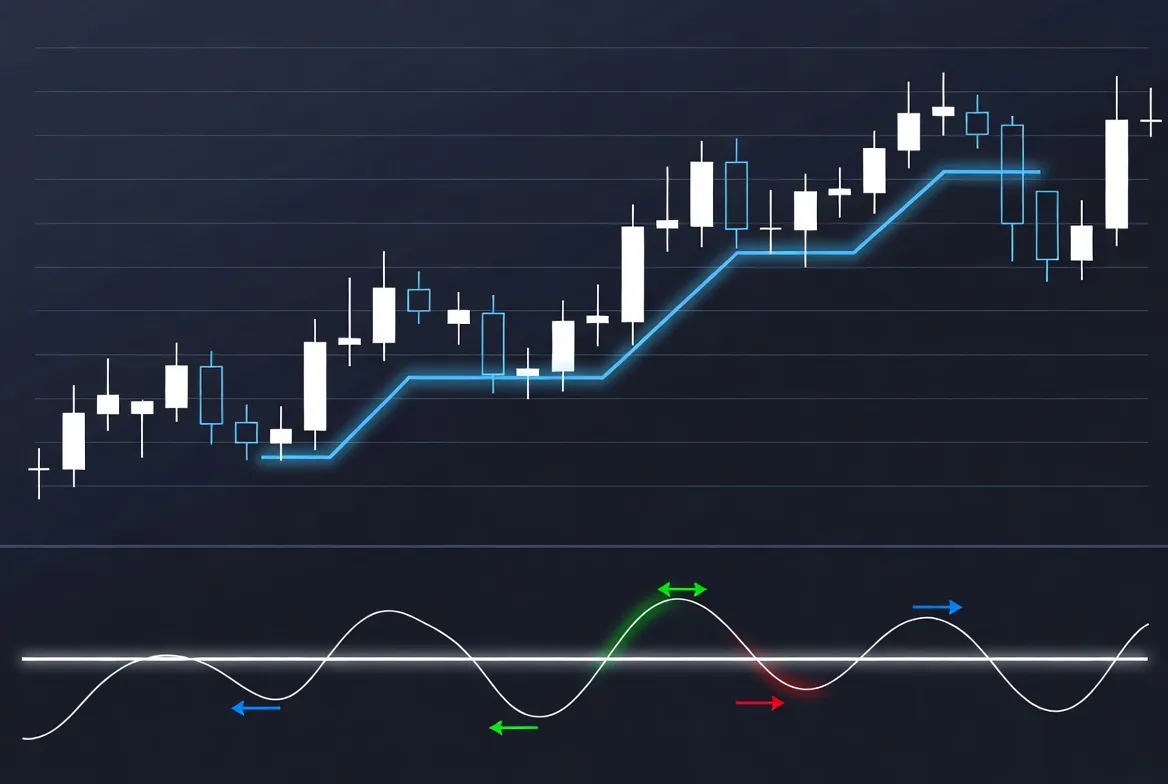
The Forecast Oscillator (FOSC) is a momentum indicator that measures how far price has deviated from its linear regression forecast — the statistically expected value based on recent price history. Developed by Tushar Chande, the Forecast Oscillator gives traders a precise, percentage-based view of whether price is running ahead of or falling behind its own trend. Unlike oscillators that compare price to a fixed moving average, FOSC uses the linear regression line as its benchmark. That distinction makes the Forecast Oscillator one of the most analytically rigorous tools available for confirming trend strength and detecting reversals.
What Is the Forecast Oscillator?
The Forecast Oscillator is a percentage-based indicator that expresses the difference between the current closing price and the value predicted by a linear regression line over a defined lookback period. A linear regression line is the statistically best-fit straight line through a series of price points — it represents the most likely “expected” price at any given bar given recent price history. When FOSC is positive, price sits above its expected value. The market is running ahead of the trend. When FOSC is negative, price sits below its expected value. The market is lagging behind the trend. For background on the linear regression line itself, see our complete Linear Regression indicator guide.
How Is the Forecast Oscillator Calculated?
FOSC calculates in two steps. First, compute the linear regression forecast value for the current bar — the price the regression line predicts based on the selected lookback period, typically 14 bars. Second, measure the percentage difference between the actual closing price and that forecast value. A positive result means price closed above the regression line. A negative result means price closed below it. The magnitude of the reading tells you how far above or below the expected value price has moved. A reading of +2 means price sits 2% above its regression forecast. A reading of –2 means price sits 2% below. Investopedia’s linear regression reference covers the underlying statistical concept in full for traders who want to explore the mathematics behind the forecast value.
How to Read Forecast Oscillator Signals?
FOSC uses a zero line as its central reference point. Read it through these conditions.
- FOSC above zero: Price trades above its regression forecast. The current trend is strong enough to push price beyond its expected value. This supports long positions in an established uptrend.
- FOSC below zero: Price trades below its regression forecast. Selling pressure has pushed price below the expected trend value. This supports short positions or caution on long entries.
- FOSC crossing above zero: Price moves from below to above its forecast value. A potential trend reversal to the upside. Use as a confirmation signal alongside price structure.
- FOSC crossing below zero: Price moves from above to below its forecast value. A potential trend reversal to the downside or the start of a corrective phase.
- FOSC divergence: Price makes a new high but FOSC makes a lower high. Trend strength is fading. This is a bearish divergence signal. The reverse — price makes a new low but FOSC makes a higher low — signals a potential bullish reversal.
What Are the Best Forecast Oscillator Trading Strategies?
Zero-line crossover entries: Buy when FOSC crosses above zero while price is in an established uptrend. Sell or exit when FOSC crosses below zero. The zero-line crossover signals that price has reclaimed its statistically expected trend value — a more robust entry trigger than a simple moving average crossover because it uses regression rather than a lagged average as the baseline.
Divergence reversals: When price makes a higher high but FOSC fails to confirm with its own new high, selling pressure is building beneath the surface. Use this bearish divergence as an exit signal or a trigger to watch for a short entry. Bullish divergences — new price lows without new FOSC lows — flag potential bottoms before price confirms.
Trend strength confirmation: When FOSC holds consistently above zero across multiple bars, the trend has genuine momentum. Enter pullbacks within that uptrend with higher confidence. If FOSC keeps dipping below zero during a supposed uptrend, the trend lacks the strength to sustain clean long entries.
FOSC and price action combination: Combine FOSC with a support/resistance level. When price bounces off a key support and FOSC simultaneously crosses above zero, the signal has both a technical and statistical basis for a long entry. This dual confirmation improves trade quality significantly.
What Are Common Forecast Oscillator Mistakes to Avoid?
Expecting fixed overbought and oversold thresholds: FOSC does not have universal overbought or oversold levels. A reading of +3 on a volatile asset like a crypto altcoin may be routine, while the same reading on a stable large-cap may indicate an extreme extension. Calibrate thresholds per asset through backtesting rather than applying fixed numbers.
Using FOSC in isolation: FOSC measures deviation from a regression line. It does not assess volume, market structure, or broader trend context. Always combine it with a trend direction filter and a volume or price structure confirmation before acting on a crossover.
Ignoring the lookback period’s effect: A short lookback makes FOSC highly sensitive and prone to noise. A long lookback makes it slow to react to real trend changes. The default of 14 bars suits many crypto timeframes, but test the period for the specific asset and timeframe you trade.
Confusing FOSC with the Time Series Forecast: FOSC and the TSF (Time Series Forecast) both involve linear regression, but they measure different things. TSF gives the projected price value; FOSC measures the percentage deviation from that value. They complement each other but serve distinct analytical purposes.
How to Build Forecast Oscillator Strategies in Arrow Algo?
Arrow Algo includes the Forecast Oscillator block in its visual indicator library. Add it to your strategy canvas and set the lookback period in the block settings. The standard starting point is 14 bars on a 4-hour or daily chart for most major crypto pairs.
To build a zero-line crossover strategy, add a crossover block that compares the FOSC output against a fixed value of zero. Set the long entry to trigger when FOSC crosses from negative to positive. Set the short entry or exit to trigger when FOSC crosses from positive to negative. Add a trend direction filter — such as a simple moving average slope condition — to ensure crossover entries only fire in the confirmed trend direction. This prevents FOSC crossovers during sideways conditions from generating false signals.
To build a divergence detection setup, combine the FOSC block with a price high/low reference block. Use a comparison block to check whether the latest FOSC peak is lower than the prior FOSC peak while the latest price peak is higher. When both conditions hold simultaneously, trigger an alert or exit block. Arrow Algo’s visual builder connects all of this logic through simple block links — no code at any stage.
What Are the Key Takeaways?
- The Forecast Oscillator measures the percentage difference between the closing price and its linear regression forecast value
- Positive FOSC means price is above its expected trend value; negative FOSC means price is below it
- Zero-line crossovers and divergences are the two primary FOSC signals
- FOSC has no universal overbought/oversold thresholds — calibrate readings per asset through backtesting
- Always combine FOSC with a trend filter and price structure context for higher-confidence signals
- FOSC and TSF are related but distinct — TSF gives projected price; FOSC measures deviation from that projection
- Arrow Algo’s visual builder lets you build full FOSC crossover and divergence strategies without any code
Educational disclaimer: This content is for educational purposes only and does not constitute financial advice. Trading involves significant risk and you should only trade with capital you can afford to lose. Past performance is not indicative of future results.
Disclaimer: The information provided in this article is for educational purposes only and does not constitute financial advice. Trading involves significant risk and you should only trade with capital you can afford to lose. Past performance is not indicative of future results. Always conduct your own research before making any trading decisions.
Ready to build your own automated trading strategies without writing a single line of code? Start for free at Arrow Algo and join thousands of traders who’ve made the switch to systematic trading.