
Funding Rate Trading Strategy: How to Build It in Arrow Algo
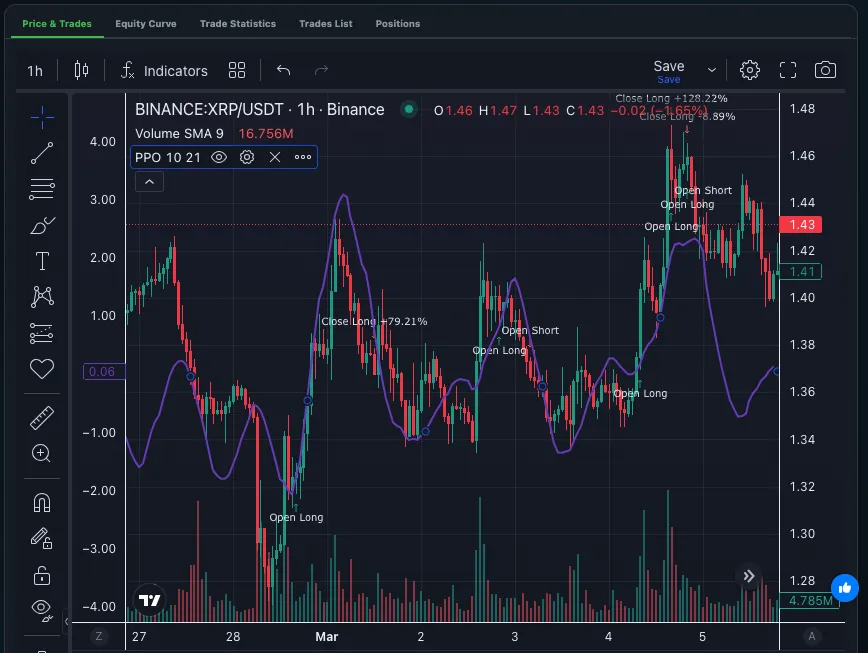
A funding rate trading strategy reads the cost of leverage as a sentiment gauge. On perpetual futures, longs and shorts pay each other a small periodic fee to keep the contract’s price pinned to spot. That fee is public data, it updates constantly, and it tells you which side of the market is crowded. Crowded trades are fragile trades. This guide turns that observation into a rule set you can automate.
If the mechanics of perpetual funding are new to you, start with our explainer on crypto funding rates. This post assumes the basics and focuses on the strategy.
What Does the Funding Rate Actually Tell You?
When the funding rate is positive, longs pay shorts. Demand for long leverage is outrunning demand for short exposure. When it is negative, shorts pay longs, and bears are the crowded side.
Most of the time funding hovers near a small positive baseline. On Binance, the standard baseline is 0.01% every eight hours. The signal is not the baseline. The signal is the extremes. Funding at several times its normal level means one side is paying heavily for the privilege of staying in a crowded trade.
This week gave a live demonstration. Shorts were crowded after a volatile Fed-hike stretch. When Bitcoin pushed higher on Monday, roughly $650 million of those shorts were liquidated. Their forced buying amplified the rally. Extreme funding flagged the fuel before the fire.
Three Ways to Trade Funding
The contrarian fade. When funding reaches an extreme, trade against the crowd. Deeply negative funding plus a price base is a long setup. The crowded shorts become your buyers when they cover. Extremely positive funding after a long run-up is the mirror short setup, or at minimum an exit warning.
The squeeze filter. Keep your normal trend or breakout strategy, but only take longs when funding shows shorts are crowded. You are aligning your entries with potential squeeze fuel. This filter would have favoured longs into Monday’s move.
The overheating exit. Use funding as a take-profit trigger rather than an entry signal. Ride a trend while funding stays normal. When it spikes to an extreme, the move has become consensus, and you scale out before the crowd unwinds.
Setting the Thresholds
Do not hardcode a single magic number. Funding regimes differ by exchange and by pair. A practical approach is to compare the current rate against its own recent average. Funding at three times its 30-day norm is extreme whatever the raw value. Data aggregators such as Coinglass are useful for eyeballing what “extreme” has meant historically for your market.
Where Funding Rate Strategies Go Wrong
The classic error is fading extremes too early. Funding can stay extreme for days while price keeps trending. A contrarian entry needs price confirmation — a reclaim of a level, a reversal structure — not just an ugly funding print.
The second error is ignoring funding as a cost. If your strategy holds leveraged longs while funding is heavily positive, you are the crowd, and you are paying for it. Backtest results that ignore funding payments flatter every perp strategy.
The third is treating funding as a standalone system. It measures positioning, not direction. It works best combined with a trend or level-based trigger, never alone.
Building the Funding Rate Strategy in Arrow Algo
Arrow Algo’s visual builder has a dedicated Funding Rate block that streams the live rate for your chosen perpetual pair. No spreadsheets, no data wrangling, no code.
Drag the Funding Rate block onto the canvas. Feed it into a condition block that checks the rate against your threshold — for example, funding below a deeply negative level. Combine that with a second condition on price, such as an EMA reclaim or a breakout close, using an AND condition block. Both must agree before the strategy signals a long.
For the overheating exit, wire a separate condition that triggers when funding rises above your upper extreme, and route it to your exit logic. Backtest the whole graph on live exchange data from Binance or HyperLiquid, compare it against the same strategy without the funding filter, and let the numbers decide whether the filter earns its place.
Key Takeaways for Funding Rate Traders
- Funding rates reveal which side of the perp market is crowded and paying for it.
- Extremes matter, baselines do not. Judge funding against its own recent history.
- Fade extremes only with price confirmation, or use funding as a filter and exit trigger for an existing strategy.
- Crowded shorts plus a breakout is squeeze fuel — Monday’s $650M short liquidation was the pattern in action.
- Always account for funding as a cost in backtests of leveraged strategies.
- Arrow Algo’s Funding Rate block lets you build and backtest all of this with drag-and-drop visual blocks.
Disclaimer: This content is for educational purposes only and does not constitute financial advice. Trading involves significant risk and you should only trade with capital you can afford to lose. Past performance is not indicative of future results. Always conduct your own research before making any trading decisions.
Ready to build your own automated trading strategies without writing a single line of code? Start for free at Arrow Algo and join thousands of traders who've made the switch to systematic trading.