
Klinger Volume Oscillator (KVO): Complete Guide for Algorithmic Trading
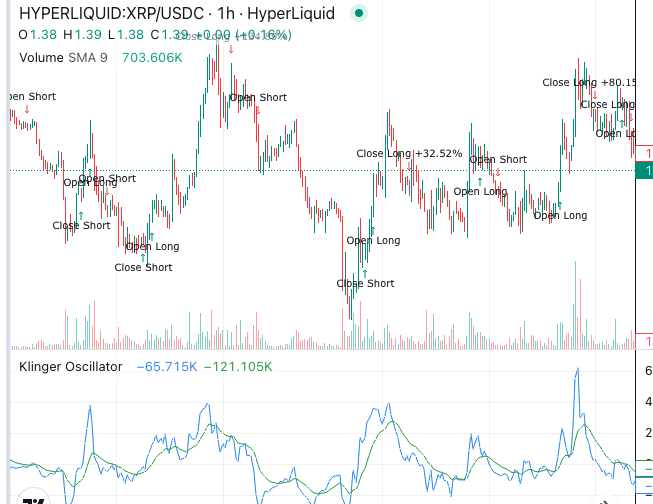
The Klinger Volume Oscillator is one of the most powerful volume-based indicators available to algorithmic traders, yet it remains underused compared to simpler tools like OBV or basic volume bars. Developed by Stephen Klinger, this indicator combines price direction with trading volume to forecast potential trend reversals before they become obvious on a price chart.
What Is the Klinger Volume Oscillator?
The Klinger Volume Oscillator is a volume-based technical indicator that combines price movement direction with trading volume to forecast potential market reversals. Stephen Klinger introduced it in the 1990s with a specific goal: to capture both the short-term and long-term flow of money into and out of an asset. Unlike simpler volume tools that only track whether volume is rising or falling, the KVO measures the difference between buying pressure and selling pressure over two different time periods. It produces an oscillator line that swings above and below zero, along with a signal line that generates crossover-based entry and exit points. Think of it as a more sophisticated version of On Balance Volume (OBV). While OBV simply adds or subtracts each day’s volume based on price direction, the KVO weighs volume by the magnitude and direction of price movement, producing a more nuanced reading of market sentiment.
How Is the Klinger Volume Oscillator Calculated?
The Klinger Volume Oscillator follows a multi-step process that you do not need to calculate manually — Arrow Algo handles it automatically. Here is what happens behind the scenes in plain English. First, the indicator determines the trend direction for each period. It calculates the typical price by averaging the high, low, and close. If today’s typical price is higher than yesterday’s, the trend is up. If it is lower, the trend is down. Next, it calculates something called Volume Force. This combines the trend direction with the actual trading volume and the ratio of the price range to the cumulative price movement. In simple terms, Volume Force is high when large volume accompanies strong directional price moves, and low when volume is weak or price is choppy. The indicator then applies two exponential moving averages to the Volume Force — a faster one using 34 periods and a slower one using 55 periods. The KVO line itself is the difference between these two averages. Finally, a 13-period exponential moving average of the KVO line creates the signal line, which generates the crossover signals that traders act on.
How to Read Klinger Volume Oscillator Signals?
The Klinger Volume Oscillator generates three primary types of signals that algorithmic traders can build strategies around. Signal line crossovers are the most common trading signal. When the KVO crosses above its signal line, buying pressure is accelerating and a bullish move may follow. When it crosses below the signal line, selling pressure is gaining control and prices may decline. Zero line crossovers carry broader significance. When the KVO moves above zero, it confirms that the overall volume trend favours buyers over the medium term. A move below zero confirms that sellers dominate. The strongest trades occur when both a signal line crossover and a zero line position agree on direction. Divergences are often the most valuable signals. When price makes a new high but the KVO makes a lower high, volume is not confirming the price move — a bearish reversal may be approaching. The opposite pattern, where price makes a lower low but the indicator makes a higher low, suggests a bullish reversal. Divergences frequently appear before major turning points and give systematic traders an early warning that the Accumulation Distribution Line and other volume tools may confirm shortly after.
What Are the Best Klinger Volume Oscillator Trading Strategies?
Signal line crossover strategy. This is the simplest approach. Enter a long position when the Klinger Volume Oscillator crosses above its signal line, and exit when it crosses below. Add a filter by only taking long signals when the oscillator is also above zero, and only taking short signals when it is below zero. This filter eliminates many false signals in choppy markets. Divergence reversal strategy. Watch for bearish divergences at resistance levels and bullish divergences at support levels. When price tests a key level and the Klinger Volume Oscillator diverges, the probability of a reversal increases significantly. This strategy works best on higher timeframes like the 4-hour or daily chart, where divergences carry more weight. Trend confirmation with moving averages. Use a 50-period exponential moving average as a trend filter. Only take long Klinger Volume Oscillator signals when price trades above the 50 EMA, and only take short signals when price trades below it. This keeps you aligned with the dominant trend and prevents the oscillator from generating losing trades during strong trends in the opposite direction. Combining the Klinger Volume Oscillator with a trend indicator and a momentum tool creates a robust three-layer confirmation system. Volume confirms the move, trend confirms the direction, and momentum confirms the timing. According to Investopedia’s analysis of the Klinger Oscillator, this multi-indicator approach significantly reduces false signals compared to using any single tool alone.
What Are Common Klinger Volume Oscillator Mistakes to Avoid?
Using it in isolation. The Klinger Volume Oscillator works best as a confirmation tool, not a standalone signal generator. Always pair it with price action analysis or another indicator to validate trade entries. Ignoring divergences. Many traders focus only on crossovers and miss the divergence signals. Divergences between the Klinger Volume Oscillator and price often precede the largest moves and give you more time to prepare your entry. Overtrading minor crossovers. In ranging or choppy markets, the oscillator and signal line can cross back and forth rapidly, generating a string of losing trades. Use the zero line filter or a trend filter to avoid this trap. Never adjusting the default settings. The standard 34/55/13 parameters work well for many assets, but different markets and timeframes may respond better to adjusted settings. Always backtest your chosen parameters against historical data before trading live. Confusing it with simpler volume indicators. The Klinger Volume Oscillator captures information that basic volume bars and OBV cannot. Do not treat it as interchangeable with those tools — it measures something fundamentally different about the relationship between volume and price direction.
How to Build Klinger Volume Oscillator Strategies in Arrow Algo?
Arrow Algo’s no-code visual block builder includes the Klinger Volume Oscillator as a ready-made indicator block. You do not need to understand the underlying mathematics or write a single line of code to start using it. Drag the KVO block onto your strategy blueprint and connect it to your preferred data source — any supported exchange and trading pair. The block automatically calculates the oscillator line and signal line based on your chosen parameters. Use condition blocks to define your crossover logic. For example, set a condition that triggers a buy when the Klinger Volume Oscillator crosses above its signal line, and another condition that triggers a sell when it crosses below. Add a zero line filter with a second condition block to strengthen your signals. Combine the Klinger Volume Oscillator block with other indicator blocks like moving averages or RSI to build the multi-layer confirmation strategies described above. Then backtest your complete strategy against real exchange data to see exactly how it would have performed — all without writing any code.
What Are the Key Takeaways?
- The Klinger Volume Oscillator measures the difference between buying and selling pressure by combining volume with price direction
- Signal line crossovers generate entry and exit signals, while zero line crossovers confirm the broader trend
- Divergences between the oscillator and price often precede major reversals and are among the most valuable signals
- Always use the Klinger Volume Oscillator alongside a trend filter or momentum indicator to reduce false signals
- Avoid overtrading minor crossovers in choppy markets — use the zero line position as a filter
- Arrow Algo’s visual builder lets you drag, drop, and backtest Klinger Volume Oscillator strategies with zero coding
Educational disclaimer: This content is for educational purposes only and does not constitute financial advice. Trading involves significant risk and you should only trade with capital you can afford to lose. Past performance is not indicative of future results.
Disclaimer: The information provided in this article is for educational purposes only and does not constitute financial advice. Trading involves significant risk and you should only trade with capital you can afford to lose. Past performance is not indicative of future results. Always conduct your own research before making any trading decisions. Ready to build your own automated trading strategies without writing a single line of code? Start for free at Arrow Algo and join thousands of traders who’ve made the switch to systematic trading.