
Laguerre Filter: Complete Guide for Algorithmic Trading
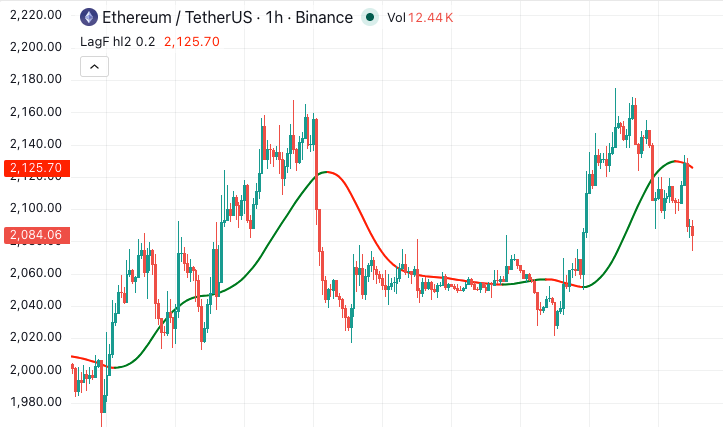
The Laguerre Filter is one of the most sophisticated trend-smoothing indicators available to algorithmic traders — offering the rare combination of low lag and high noise reduction that most standard moving averages struggle to deliver simultaneously. Developed by engineer and trading systems researcher John Ehlers, the Laguerre Filter applies digital signal processing mathematics to price data, producing a smooth trend line that adapts to market conditions more cleanly than a traditional EMA or SMA.
What Is the Laguerre Filter?
The Laguerre Filter is a trend-following indicator that smooths price data using a four-stage filtering process based on mathematical structures called Laguerre polynomials — equations originally developed for signal processing in engineering. In trading, this approach reduces random price noise while preserving the underlying trend signal with minimal delay.
John Ehlers introduced the Laguerre Filter in his 2004 book Cybernetic Analysis for Stocks and Futures, arguing that most traditional technical indicators suffer from a fundamental trade-off: make them faster and you get more false signals; make them slower and you get too much lag. The Laguerre Filter was designed to break this trade-off by applying feedback-based smoothing across four filter stages simultaneously.
The key parameter controlling the Laguerre Filter is gamma (γ), the damping factor, which typically ranges from 0.5 to 0.8. A lower gamma value (e.g. 0.5) produces a more responsive filter with less lag but more sensitivity to short-term price noise. A higher gamma value (e.g. 0.8) creates a smoother, slower filter better suited to capturing sustained trends while filtering out market chop.
How Is the Laguerre Filter Calculated?
The Laguerre Filter is calculated by passing price data through four sequential filter stages, each influenced by the previous candle’s output and the gamma parameter. Each stage takes the current price and blends it with a weighted version of the prior output — the degree of blending is controlled by gamma.
The four stages produce intermediate values — L0 through L3 — which are then combined into a single weighted average to produce the final filter line. The weighting gives more emphasis to the earlier stages (most responsive to recent price) and less to the later ones (which add smoothing depth).
What makes this mathematically elegant is that the four-stage structure smooths out random noise at multiple frequency levels simultaneously — something a single-stage moving average cannot do. The result is a price line that cuts through market noise more effectively than a traditional EMA or weighted moving average. For background on how smoothing methods compare, Investopedia’s guide to simple vs. exponential moving averages provides useful context.
How to Read Laguerre Filter Signals?
Reading the Laguerre Filter is straightforward once you understand what the filter line represents:
- Price above the filter line → the market is in an uptrend. Bullish bias.
- Price below the filter line → the market is in a downtrend. Bearish bias.
- Price crossing above the filter line → potential buy signal (trend reversal to the upside, or a pullback entry in an established uptrend).
- Price crossing below the filter line → potential sell signal (trend reversal or exit signal for longs).
- Filter line changing direction → momentum shift. The filter turning from falling to rising suggests the downtrend is losing energy, and vice versa.
The gamma parameter significantly affects signal sensitivity. At gamma = 0.5, the Laguerre Filter generates more frequent crossovers, making it more suitable for shorter-term strategies on lower timeframes. At gamma = 0.75–0.8, signals are rarer but tend to reflect stronger, more sustained trend moves — better suited to swing strategies on the 4H or daily chart.
Because the Laguerre Filter is a trend indicator rather than an oscillator, it works best in trending markets. In sideways or range-bound conditions, crossover signals can produce false positives at a higher rate. Most systematic traders combine the Laguerre Filter with a volatility or trend-strength filter to confirm a genuine trend is in place before entering.
What Are the Best Laguerre Filter Trading Strategies?
1. Trend-Following Crossover Strategy
The most direct application: buy when price crosses above the Laguerre Filter line and sell when it crosses below. Apply this on the 4H or daily chart with gamma set between 0.6 and 0.75. This approach works particularly well for assets with persistent directional trends — Bitcoin’s major bull and bear phases have historically been well-captured by a Laguerre crossover system on the daily timeframe.
2. Filter Slope Change Strategy
Rather than waiting for a price crossover, this approach enters when the filter line itself changes direction — from falling to rising (buy) or rising to falling (sell). This provides slightly earlier entries on momentum shifts, though it benefits from volume confirmation to avoid premature signals in slow-moving markets.
3. Laguerre Filter + RSI Confirmation
Combine the Laguerre Filter for trend direction with the Relative Strength Index (RSI) for entry timing. For example: only take long entries when price crosses above the Laguerre Filter AND the RSI is rising from below 50 (confirming fresh upward momentum rather than an overbought bounce). This dual-confirmation approach significantly reduces false entries compared to using the filter alone.
What Are Common Laguerre Filter Mistakes to Avoid?
- Using one gamma value across all assets and timeframes. Different markets have different volatility profiles. A gamma that works for BTC on the 4H may produce excessive false signals on a 15-minute chart for a more volatile altcoin. Always calibrate gamma through backtesting on the specific asset and timeframe you are trading.
- Treating every crossover as a high-quality signal. In choppy markets, the Laguerre Filter generates frequent, low-quality crossovers. Adding a trend-strength filter — such as confirming ADX (Average Directional Index, a 0-to-100 scale measuring trend strength) is above 25 before entering — helps eliminate low-probability signals.
- Ignoring the broader trend context. A Laguerre Filter crossover on a 1-hour chart that runs against the direction of the daily filter should be treated with caution. Multi-timeframe alignment significantly improves signal quality.
- Using the Laguerre Filter alone for exits. The filter is better suited to entry timing than exits in fast-moving markets. Combining it with a trailing stop or ATR-based exit rule typically produces better overall results.
How to Build Laguerre Filter Strategies in Arrow Algo?
Arrow Algo includes the Laguerre Filter as a built-in indicator block in the visual block library. To build a no-code Laguerre Filter strategy using the drag-and-drop builder:
- Add the Laguerre Filter block to your strategy canvas. Set the gamma parameter (start with 0.7 for a balanced setting) and connect it to your price input — typically the candle close.
- Add a comparison block to detect when price crosses above or below the filter line — this becomes your entry signal.
- Wire in a confirmation block if desired — for example, connecting an RSI block and requiring RSI to be below 50 for short entries adds a useful filter against overbought false signals.
- Connect exit blocks — a trailing stop, ATR-based exit, or a reverse Laguerre crossover works well as the exit condition.
- Run a backtest across your chosen date range and compare performance at different gamma values (0.5, 0.6, 0.7, 0.8) to identify the optimal setting for your market and timeframe.
The no-code drag-and-drop environment means you can iterate through configurations, test them against real exchange data, and refine the gamma parameter — all without writing a single line of code. The Laguerre Filter is particularly well-suited to crypto markets on the 4H and daily timeframes, where its noise-reduction properties help cut through the high volatility that characterises digital assets.
What Are the Key Takeaways?
- The Laguerre Filter is a trend-smoothing indicator developed by John Ehlers using digital signal processing mathematics.
- It uses a four-stage filtering process controlled by the gamma parameter to reduce noise while minimising lag.
- Lower gamma (0.5–0.6) = faster and more responsive. Higher gamma (0.7–0.8) = smoother and more selective.
- Core signals: price above/below the filter line, crossovers, and filter direction changes.
- Works best in trending markets — pair with ADX or a volume filter to avoid whipsaws in choppy conditions.
- Build no-code Laguerre Filter strategies on Arrow Algo using the visual block library — drag in the block, set gamma, connect comparison and exit blocks, and backtest on live exchange data.
Educational disclaimer: This content is for educational purposes only and does not constitute financial advice. Trading involves significant risk and you should only trade with capital you can afford to lose. Past performance is not indicative of future results.
Disclaimer: The information provided in this article is for educational purposes only and does not constitute financial advice. Trading involves significant risk and you should only trade with capital you can afford to lose. Past performance is not indicative of future results. Always conduct your own research before making any trading decisions.
Ready to build your own automated trading strategies without writing a single line of code? Start for free at Arrow Algo and join thousands of traders who’ve made the switch to systematic trading.