
Market Facilitation Index (MarketFI): Complete Guide for Algorithmic Trading
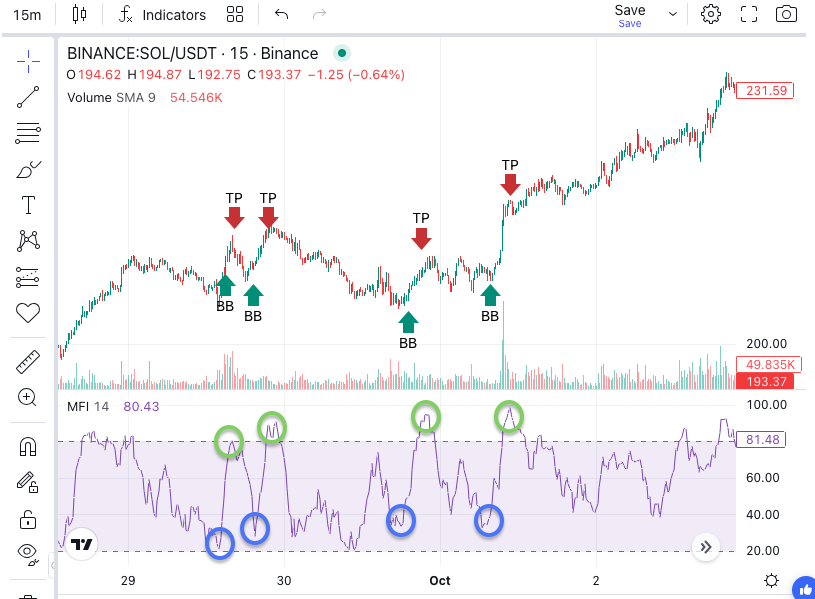
The Market Facilitation Index (MarketFI) is a volume-based indicator that measures how efficiently price is moving relative to the trading activity behind it. Developed by Bill Williams as part of his Chaos Trading framework, MarketFI answers a simple but powerful question: how much price movement are you getting per unit of volume? When the market is moving efficiently, price covers a lot of ground on relatively low volume. When it is struggling, price barely moves despite heavy trading activity. Understanding the difference is what MarketFI is built for.
What Is the Market Facilitation Index?
The Market Facilitation Index is a technical indicator that compares a candle’s price range to its volume. It measures the market’s willingness to move. A high MarketFI reading means the market is facilitating movement — price is traveling efficiently. A low reading means the market is resisting movement — buyers and sellers are battling without much net progress.
MarketFI is not a standalone buy or sell signal. It is most useful when read in combination with whether volume is increasing or decreasing. That combination produces four distinct market conditions. Each tells systematic traders something specific about the likely next move.
Bill Williams used the indicator as part of his broader Chaos Trading approach, which treats markets as nonlinear systems rather than simple cause-and-effect mechanisms. MarketFI gives traders a window into the underlying energy of a candle beyond what price action alone can reveal.
How Is the Market Facilitation Index Calculated?
The calculation is straightforward. Take the difference between the candle’s high and low to get the price range. Then divide that range by the candle’s volume.
A larger range with lower volume produces a high MarketFI value. The market is moving efficiently — a small number of participants are driving meaningful price change. A narrow range with high volume produces a low MarketFI value. The market is absorbing a lot of activity without going anywhere. That absorption often signals a battle between buyers and sellers — and a breakout is frequently not far away.
In Arrow Algo, the marketfi block handles this calculation automatically. You feed it high, low, and volume inputs. It returns the MarketFI value for each candle, ready to use in your strategy logic.
How to Read Market Facilitation Index Signals?
The four MarketFI conditions come from comparing the current candle’s MarketFI value and volume to the previous candle. Each combination has a name and a distinct interpretation.
Green (MarketFI up, Volume up): The market is facilitating movement with growing participation. Price is traveling further with more volume backing it. This is the strongest confirmation signal — the trend has momentum and participation. Systematic strategies typically trade in the direction of the current bar in this condition.
Fake (MarketFI up, Volume down): Price is covering more ground but on declining volume. The move may not be sustained. Fewer participants are behind the range expansion. This can signal a false breakout or a move running out of fuel. Treat these bars with caution, especially on breakout entries.
Squat (MarketFI down, Volume up): This is the most important signal for anticipating breakouts. A lot of volume is entering the market but price is barely moving. Bulls and bears are fighting each other. One side will eventually win. The result is typically a sharp directional move. Systematic traders watch squat bars closely — a breakout in either direction is likely to follow.
Fade (MarketFI down, Volume down): Both price movement and volume are declining. The market is disinterested. Momentum is fading. There is no follow-through in either direction. This is typically a period to stay out or reduce exposure. Trend-following strategies may pause entries during extended fade conditions.
What Are the Best Market Facilitation Index Trading Strategies?
Breakout confirmation after squat bars: A squat condition signals a buildup of opposing forces. When the next candle breaks decisively in one direction with rising volume, MarketFI confirms the breakout has genuine participation. Combining a squat detection block with a breakout condition block in Arrow Algo creates a high-conviction entry filter.
Trend strength validation: Using MarketFI to confirm whether a trending move has genuine follow-through is a practical application for systematic traders. A trend strategy that only enters on green conditions — MarketFI rising with volume rising — filters out moves that look strong but lack participation. This reduces false entries during low-liquidity periods or after large news candles.
Volume efficiency filters: Adding MarketFI as an auxiliary filter to an existing momentum or trend strategy can improve trade quality without changing the core logic. If MarketFI is in a fade condition when a momentum signal fires, the strategy skips the trade. This type of confirmation layer is easy to add using Arrow Algo’s visual block builder. For more on volume-based confirmation, see our Volume Oscillator guide.
What Are Common Market Facilitation Index Mistakes to Avoid?
Using MarketFI without volume: The four-condition framework requires comparing both MarketFI and volume changes simultaneously. Using the MarketFI value in isolation removes most of its analytical power. The ratio alone tells you efficiency — but it does not tell you whether that efficiency is increasing or decreasing.
Treating every squat as an immediate entry: A squat bar signals tension is building. It does not tell you which direction the resolution will come. Entering a long immediately on a squat without a directional confirmation is jumping in before the move has declared itself. Wait for the breakout candle to show a clear direction with volume backing it.
Applying MarketFI to low-volume markets: MarketFI relies on meaningful volume data to produce accurate readings. In thin markets or during periods of very low participation, the values become noisy and unreliable. Apply this indicator during active trading sessions with sufficient volume history.
Over-relying on it as a primary signal: MarketFI is best used as a confirmation or filter tool. Using it as the sole entry trigger ignores price action, trend direction, and broader context. The strongest setups combine MarketFI conditions with at least one other independent signal. Learn more about combining signals in our guide on trading indicator fundamentals.
How to Build Market Facilitation Index Strategies in Arrow Algo?
Arrow Algo includes the marketfi block as a native indicator in the visual builder. You do not need to calculate anything manually. Drag the block into your strategy canvas, connect it to high, low, and volume data sources, and it outputs the MarketFI value for each candle.
To build the four-condition framework visually, use a comparison block to check whether the current MarketFI value is above or below the previous candle’s value. Do the same for volume. Combine those two comparisons using AND logic blocks to identify green, fake, squat, or fade conditions. Arrow Algo’s drag-and-drop interface makes wiring these conditions together straightforward — no code required.
A practical starting point is a squat-to-breakout strategy. Use the MarketFI comparison to detect a squat bar. Then add a next-candle breakout condition — price closing above the squat bar’s high with rising volume. Wire those conditions together with an AND block. Add a stop-loss below the squat bar’s low and a target based on the range. Backtest it across multiple timeframes and pairs using Arrow Algo’s built-in backtesting engine to see how it performs before going live.
What Are the Key Takeaways?
- The Market Facilitation Index measures price range divided by volume — it quantifies how efficiently the market is moving.
- The four conditions (green, fake, squat, fade) come from comparing MarketFI and volume changes simultaneously.
- Squat bars — high volume with little price movement — are the most valuable signal for anticipating breakouts.
- Green bars confirm trend participation; fade bars signal disinterest and are best avoided.
- MarketFI works best as a confirmation filter alongside a directional signal, not as a standalone trigger.
- In Arrow Algo, the marketfi block handles all calculations. Build the four-condition logic visually using comparison and AND blocks.
Educational disclaimer: This content is for educational purposes only and does not constitute financial advice. Trading involves significant risk and you should only trade with capital you can afford to lose. Past performance is not indicative of future results.
Disclaimer: The information provided in this article is for educational purposes only and does not constitute financial advice. Trading involves significant risk and you should only trade with capital you can afford to lose. Past performance is not indicative of future results. Always conduct your own research before making any trading decisions.
Ready to build your own automated trading strategies without writing a single line of code? Start for free at Arrow Algo and join thousands of traders who’ve made the switch to systematic trading.