
Mass Index: Complete Guide for Algorithmic Trading
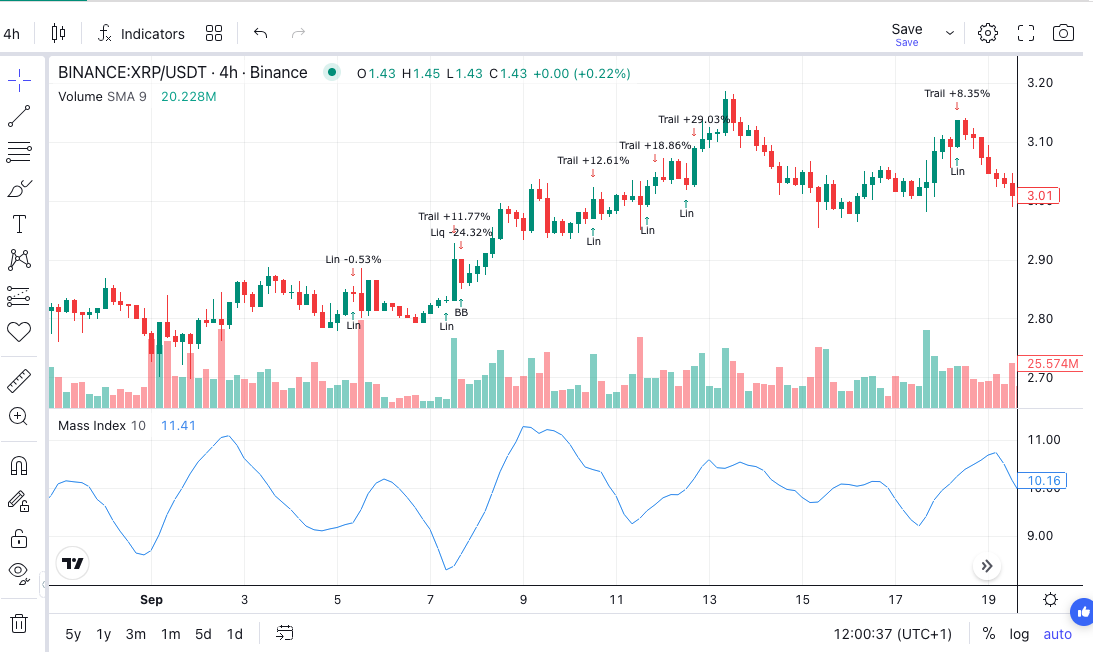
Most traders focus on trend direction. The Mass Index focuses on something more valuable: when trends are about to reverse. This volatility indicator spots exhaustion points that other tools miss entirely.
What Is the Mass Index?
The Mass Index is a volatility indicator that identifies potential trend reversals by measuring changes in the trading range. Donald Dorsey created it in the 1990s. It takes a unique approach to market analysis.
Unlike momentum oscillators, the Mass Index doesn’t tell you direction. It tells you when a reversal is brewing. The indicator tracks the widening and narrowing of the price range between highs and lows.
When the range narrows significantly after widening, it creates a “reversal bulge.” This pattern signals trend exhaustion. The market compresses before a potential breakout in the opposite direction.
The classic Mass Index signal is simple. It rises above 27, then drops back below 26.5. This reversal bulge suggests a trend change is imminent.
The Mass Index focuses on range volatility rather than price direction. It works equally well in uptrends and downtrends. You just need another indicator to tell you which way the reversal will go.
How Is It Calculated?
The calculation involves several smoothing steps. The concept is straightforward once you break it down.
First, calculate the range for each period. Subtract the low from the high. A wider range means more volatility. A narrower range means compression.
Next, apply a 9-period exponential moving average to that range. This smooths out the daily fluctuations. Call this the single EMA.
Then apply another 9-period EMA to the first EMA. This creates a double-smoothed value. Call this the double EMA.
Now divide the single EMA by the double EMA. This ratio shows whether the range expands or contracts relative to its smoothed values.
Finally, sum these ratios over 25 periods. That cumulative sum gives you the Mass Index value.
The double smoothing prevents false signals from single-day spikes. The ratio calculation amplifies range changes. The summation creates clear threshold levels for trading signals.
In Arrow Algo, the indicator block handles all the math behind the scenes. You connect it to your price data and set your thresholds.
How to Read Mass Index Signals?
Reading this indicator comes down to one key pattern. The reversal bulge is your primary signal.
A reversal bulge occurs when the indicator rises above 27. Then it falls back below 26.5. Both thresholds must cross for a valid signal.
When you see this pattern, expect a trend reversal. The indicator alone doesn’t reveal direction. You need a directional indicator to confirm long or short.
In normal conditions, the value typically hovers around 25. Values below 26.5 suggest stable trends. Values above 27 indicate range expansion and potential exhaustion.
The indicator treats bullish and bearish reversals the same way. A reversal bulge during an uptrend suggests a top. The same pattern during a downtrend suggests a bottom.
Some traders watch for failed reversal bulges too. The value rises above 27 but doesn’t drop below 26.5. The trend may continue with renewed strength. This can serve as a continuation signal.
The key is patience. Wait for both threshold crosses before acting. Premature entries based on partial signals lead to whipsaws.
What Are the Best Mass Index Trading Strategies?
This indicator works best when combined with directional tools. Here are three proven strategies.
Strategy 1: Reversal Bulge with EMA Crossover
Pair the Mass Index reversal bulge with moving average crosses. When the Mass Index rises above 27 then drops below 26.5, check your EMAs.
If the fast EMA crosses below the slow EMA, go short. If the fast EMA crosses above the slow EMA, go long. The reversal bulge confirms the turning point. The EMA crossover tells you direction.
A 9-period and 21-period EMA work well together. The shorter timeframe matches the Mass Index’s 9-period smoothing.
Strategy 2: Mass Index with RSI Divergence
Divergence adds powerful confirmation. Look for price making a new high while RSI doesn’t follow. That’s bearish divergence.
Bearish divergence plus a Mass Index reversal bulge gives a strong short signal. Bullish divergence with a reversal bulge gives a strong long signal.
The RSI shows momentum fading. The Mass Index confirms range compression. Together they signal high-probability reversals.
Strategy 3: Mass Index as a Trend Filter
Instead of trading reversals, use the Mass Index to avoid them. Only take trend-following trades when the Mass Index stays below 26.5.
This keeps you out of the market during potential turning points. If the Mass Index rises above 27, close your trend positions. Wait for it to drop below 26.5 before re-entering.
This defensive approach protects your capital during volatile reversal periods.
What Are Common Mistakes to Avoid?
Trading without directional confirmation. The indicator tells you a change is coming. It doesn’t tell you which way. Always pair it with an EMA, MACD, or trend indicator.
Changing the threshold levels. Some traders experiment with 26/25 or 28/27. Dorsey calibrated the original 27/26.5 levels to the 25-period lookback. Changing thresholds without changing periods creates mismatched signals.
Over-optimizing the lookback period. The 25-period summation is central to the design. Shortening it adds noise. Lengthening it adds lag. The Mass Index works best with its original settings.
Expecting instant reversals. A reversal bulge signals potential, not certainty. The actual reversal might take several bars to develop. Use appropriate stop losses and give trades room to breathe.
Ignoring market context. A reversal bulge during a powerful trend might signal a pullback, not a full reversal. Check higher timeframes and nearby support or resistance levels for context.
How to Build Reversal Strategies in Arrow Algo?
Arrow Algo makes building reversal detection strategies simple. The visual block builder lets you drag and drop indicators to create complete trading systems.
Start by adding a Mass Index block to your canvas. Connect it to your price data source. Arrow Algo handles the calculation automatically.
Add condition blocks to detect the reversal bulge pattern. Create one condition for the Mass Index crossing above 27. Create another for crossing below 26.5.
Drag an EMA block onto the canvas for trend direction. Or add an RSI block for divergence confirmation. Connect these blocks to build your entry logic.
Arrow Algo’s AI assistant can also help. Describe your reversal strategy in plain English. The AI configures the blocks and connections for you.
Once built, backtest your strategy on historical data from major exchanges. Test across different market conditions. Validate your signals before risking real capital. For more on volatility-based indicators, explore our Bollinger Bands guide.
Learn more about the Mass Index and its history from Investopedia and StockCharts.
What Are the Key Takeaways?
- This indicator identifies potential reversals by tracking range expansion and contraction
- The reversal bulge pattern (above 27, then below 26.5) is your primary trading signal
- Always combine its signals with directional indicators like EMAs or RSI
- Stick with the standard 27/26.5 thresholds and 25-period lookback
- Use the Mass Index as either a reversal signal or a trend filter
- Build and backtest reversal strategies in Arrow Algo’s no-code visual platform
Educational disclaimer: This content is for educational purposes only and does not constitute financial advice. Trading involves significant risk and you should only trade with capital you can afford to lose. Past performance is not indicative of future results.
Disclaimer: The information provided in this article is for educational purposes only and does not constitute financial advice. Trading involves significant risk and you should only trade with capital you can afford to lose. Past performance is not indicative of future results. Always conduct your own research before making any trading decisions.
Ready to build your own automated trading strategies without writing a single line of code? Start for free at Arrow Algo and join thousands of traders who’ve made the switch to systematic trading.