
Mean Deviation (MD): Complete Guide for Algorithmic Trading
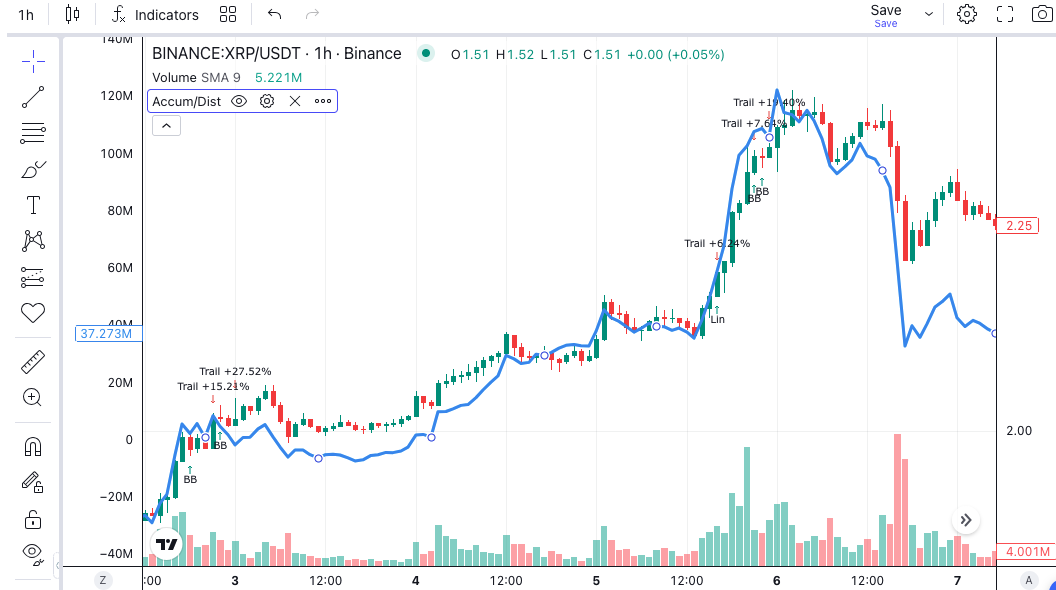
The Mean Deviation (MD) is a statistical indicator that measures the average absolute distance between price and its mean over a defined lookback period. It belongs to the volatility family of indicators — not because it tracks direction, but because it quantifies how much price is dispersing from its average. Algorithmic traders use MD to set dynamic entry thresholds, identify volatility regimes, and size adaptive stops.
What Is the Mean Deviation?
Mean Deviation is a measure of statistical dispersion. It answers one practical question: how far, on average, has price been straying from its mean over the lookback window?
Unlike Variance or Standard Deviation — which square each deviation before averaging — MD takes the absolute value of each deviation without squaring. This makes it less sensitive to extreme outliers and produces a reading expressed in the same units as price. On Bitcoin at $70,000, an MD of $800 means price has deviated from its mean by an average of $800 over the lookback period. No normalisation required.
A rising MD signals expanding volatility. A low or falling MD signals consolidation, with price clustering tightly around its mean.
How Is the Mean Deviation Calculated?
The calculation follows three steps:
- Calculate the simple average (mean) of price over N periods
- For each period, find the absolute difference between that period’s price and the mean
- Average all those absolute differences
The default lookback is typically 14 periods, but this is worth adjusting to match the rhythm of your strategy. Shorter periods make MD more reactive. Longer periods smooth out short-term noise and reflect the broader volatility regime.
How to Read Mean Deviation Signals
MD does not produce buy or sell signals on its own. It produces context. Here is what different readings imply:
- Low MD (tight dispersion): Price is hugging its mean. The market is consolidating. These periods often precede breakouts as energy builds
- Rising MD (expanding dispersion): Price is pulling away from its average with increasing force. A directional move is underway — trend-following logic operates well in this environment
- High MD (extended dispersion): Price has moved far from its mean. Mean-reversion setups become more probable as the market has extended into historically difficult-to-sustain territory
- Falling MD after a high reading: Dispersion is compressing after an extended move. Trend-following systems may interpret this as momentum fading
The key principle: MD tells you the volatility environment. Always combine it with a directional indicator before acting.
What Are the Best Mean Deviation Trading Strategies?
Dynamic Mean Reversion Thresholds
When price moves more than a defined multiple of MD away from its mean — say 2× or 2.5× — the strategy treats this as an overextension and looks for a reversal signal. Because the threshold scales with current volatility, it adapts naturally across different market conditions, unlike fixed-pip or fixed-percentage levels that misfire in quiet markets and give back too much in volatile ones.
Volatility Regime Filter
Comparing the current MD to its own N-period average identifies whether the market is in a high- or low-volatility regime. A trend-following strategy might activate only when MD is above its historical average — confirming enough energy exists to sustain a trend. During low-MD periods, the strategy sits out and avoids being chopped up in slow, ranging conditions.
Adaptive Stop Distance
Fixed stop losses struggle in dynamic markets. Using MD as a stop-distance multiplier creates stops that adjust to current volatility automatically. When MD is high, stops widen to give trades room. When MD is low, stops tighten to protect gains. The approach is conceptually similar to ATR-based stops but uses a different statistical basis that some systematic traders prefer for its directness.
Common Mean Deviation Mistakes to Avoid
- Using MD as a direction signal: A rising MD does not indicate which way price is moving — only that it is moving further from its average. Always pair with a trend or momentum indicator before trading
- Leaving the lookback at default: A 5-period MD and a 50-period MD tell completely different stories. Choose the period that matches your strategy’s timeframe, not a generic default
- Fading every high-MD reading in a trend: During a strong trend, MD can stay elevated for extended periods. High MD during a trend is a feature, not a reversal signal — confirm momentum is weakening before using it as a fade
- Cross-asset comparison: MD is expressed in absolute price units. Comparing a BTC reading to an ADA reading is meaningless. Use MD relative to the same asset’s own history only
How to Build Mean Deviation Strategies in Arrow Algo
Arrow Algo includes MD as a native block in the visual builder. No code required at any stage. To incorporate MD into a strategy:
- Add the MD block to your canvas and connect your price source (typically close)
- Set the lookback period in the block’s settings panel to match your strategy timeframe
- Connect the MD output to a comparison block — for example, checking whether price minus the mean exceeds 2× MD
- Route the comparison output into a condition block to trigger entry or serve as a filter for another signal
- Pair with an EMA, SuperTrend, or trend block to add directional confirmation before the condition fires an order
Once built, run a backtest directly on exchange data from Binance, Coinbase, or HyperLiquid. The backtest engine returns trade-by-trade performance, drawdown curve, win rate, Sharpe ratio, and Profit Factor — giving you evidence to assess whether the MD logic adds genuine edge before going live.
What Are the Key Takeaways?
- Mean Deviation measures the average absolute distance between price and its mean, expressed in the same price units
- Unlike Variance and Standard Deviation, MD does not square the deviations — making it less sensitive to extreme outliers
- Rising MD signals expanding volatility; low or falling MD signals consolidation
- MD is a context indicator — always combine it with a directional signal before placing a trade
- Core applications include dynamic reversion thresholds, volatility regime filters, and adaptive stop distances
- Arrow Algo includes MD as a drag-and-drop block in the visual builder — no programming required
Disclaimer: This content is for educational purposes only and does not constitute financial advice. Trading involves significant risk and you should only trade with capital you can afford to lose. Past performance is not indicative of future results. Always conduct your own research before making any trading decisions.
Ready to build your own automated trading strategies without writing a single line of code? Start for free at Arrow Algo and join thousands of traders who’ve made the switch to systematic trading.