
Negative Volume Index (NVI): Complete Guide for Algorithmic Trading
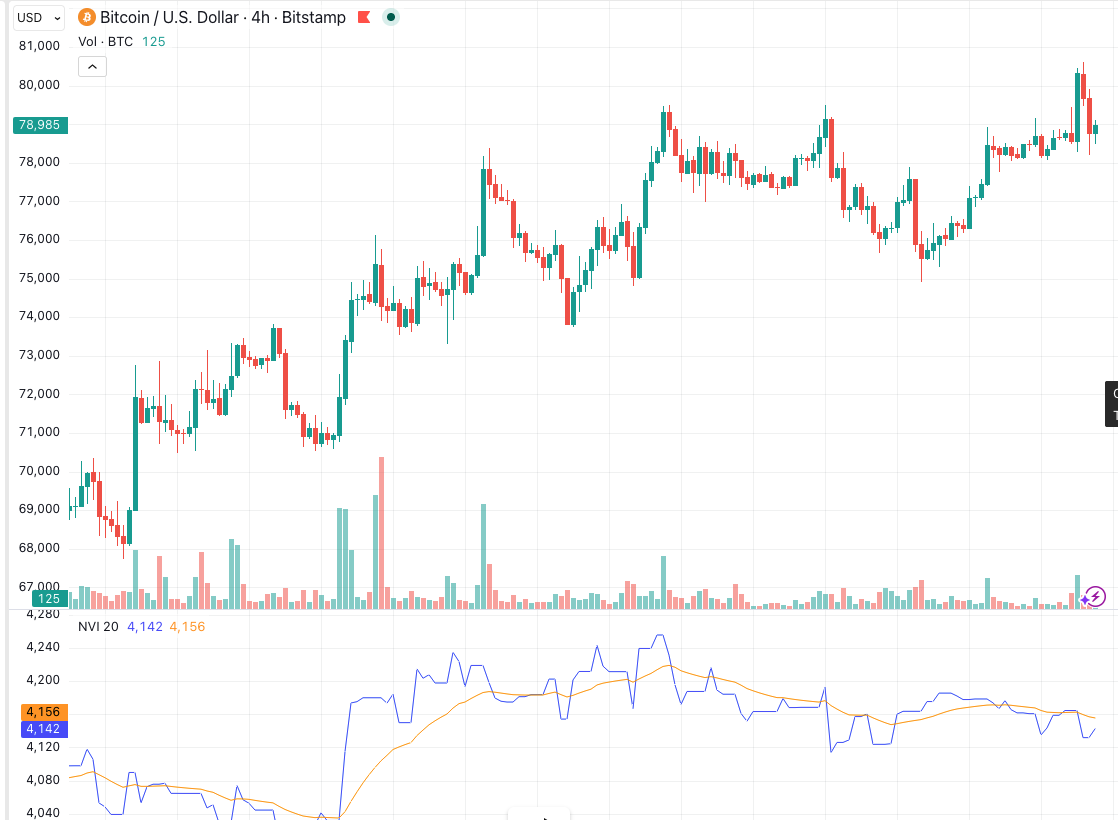
The Negative Volume Index (NVI) is a cumulative volume indicator that tracks price behaviour on low-volume trading days. It operates on a simple but powerful idea: smart money — the experienced institutional traders who move markets — tends to act quietly. They accumulate and distribute positions when the crowd is not paying attention. The NVI captures that behaviour by updating only when volume falls below the previous session. On noisy, high-volume days, it stays flat.
What Is the Negative Volume Index?
The Negative Volume Index is a running total that changes only on low-volume days. It starts at a base value of 1,000. Each day, it compares today’s volume to yesterday’s. When today’s volume is lower, the NVI adjusts by the percentage change in price. When today’s volume is equal or higher, the NVI holds steady. Over time, this builds a line that reflects price action driven by informed participants during quiet sessions. Most traders apply a 255-day exponential moving average (EMA) — a smoothing line calculated by weighting recent values more heavily — to the NVI as a signal reference. Learn more about how the NVI was developed by Paul Dysart in the 1930s.
How Is the Negative Volume Index Calculated?
Start with a base value of 1,000 on the first bar. On each new bar, compare today’s volume to yesterday’s. If today’s volume is lower, multiply the percentage change in closing price by the current NVI value and add the result. If today’s volume is equal or higher, the NVI carries forward unchanged. Repeat this process every session. The result is a slow-moving cumulative line. Apply a 255-day EMA on top to create a signal reference. When the NVI crosses above or below that EMA, a regime signal fires.
How to Read Negative Volume Index Signals?
The key relationship is the NVI versus its 255-day EMA. When the NVI sits above its EMA, smart money is in accumulation mode — buying quietly during low-activity sessions. This is a bullish regime signal. When the NVI drops below its EMA, smart money may be distributing. That is a bearish signal. The NVI does not generate rapid entry signals. It moves slowly and reflects longer-term positioning trends. Use it as a regime filter — a condition that tells your strategy whether the broader environment favours longs or shorts. The NVI pairs well with faster indicators. Its companion, the Positive Volume Index (PVI), tracks price changes on high-volume days and reflects the behaviour of the wider market crowd. Together, they give a complete picture of volume dynamics.
What Are the Best Negative Volume Index Trading Strategies?
Trend confirmation filter: Use NVI above its 255-day EMA as a required condition for long entries. Combine it with a momentum indicator — such as RSI or MACD — for your actual entry trigger. Your strategy only takes long signals when the NVI confirms a bullish regime. It stands aside when the NVI is below its EMA.
Divergence signals: If price makes a new high but the NVI is declining or flat, that divergence signals weakening smart-money conviction. Use it as a warning. Tighten your stop-loss or reduce position size when divergence appears.
Multi-timeframe regime filter: Apply the NVI on a daily chart as your long-term filter. On shorter timeframes, only take entries that align with the daily NVI direction. This keeps shorter-term trades in sync with the underlying smart-money trend.
What Are Common Negative Volume Index Mistakes to Avoid?
Using it in isolation: The NVI is a slow-moving regime indicator. It does not generate precise entry timing. Always pair it with a faster trigger indicator.
Applying it to illiquid assets: The NVI relies on clean, reliable volume data. On thinly traded assets, volume spikes are noisy and the low-volume signal loses meaning. Stick to major crypto pairs and liquid instruments.
Ignoring the timeframe mismatch: The 255-day EMA is calibrated for daily charts. Applying the same EMA length to hourly charts produces a signal line that reacts over 255 hours — far too fast and far too noisy. Adjust the EMA length to match your timeframe.
Treating high-volume days as non-events: When the NVI stays flat, that is information too. High-volume sessions where price moves sharply but NVI ignores them suggest the move is noise-driven rather than smart-money-driven.
How to Build Negative Volume Index Strategies in Arrow Algo?
Arrow Algo includes the NVI as a built-in indicator block. Open the indicator menu and add the NVI block to your canvas. Set the EMA signal line length in the block settings — 255 is the standard for daily charts. Connect the NVI output to a comparison block. Define the condition: NVI above its EMA equals bullish regime, NVI below equals bearish. Wire that condition into your strategy logic using an AND block alongside your entry trigger. When both conditions are true, the strategy fires. Add exit conditions using a separate block — a stop-loss level, a take-profit target, or an indicator reversal signal. Backtest the full strategy against real exchange data directly inside Arrow Algo. Every connection is visible on the canvas. No code at any step.
What Are the Key Takeaways?
- The Negative Volume Index updates only on low-volume days, isolating smart money behaviour
- NVI above its 255-day EMA signals a bullish regime; below signals bearish
- Use the NVI as a regime filter, not a precise entry trigger
- Combine it with faster indicators like RSI or MACD for complete strategy logic
- Divergence between the NVI and price is a useful early warning signal
- Arrow Algo includes NVI as a built-in block — no code required
Educational disclaimer: This content is for educational purposes only and does not constitute financial advice. Trading involves significant risk and you should only trade with capital you can afford to lose. Past performance is not indicative of future results.
Disclaimer: The information provided in this article is for educational purposes only and does not constitute financial advice. Trading involves significant risk and you should only trade with capital you can afford to lose. Past performance is not indicative of future results. Always conduct your own research before making any trading decisions.
Ready to build your own automated trading strategies without writing a single line of code? Start for free at Arrow Algo and join thousands of traders who’ve made the switch to systematic trading.