
Percentage Price Oscillator (PPO): Complete Guide for Algorithmic Trading
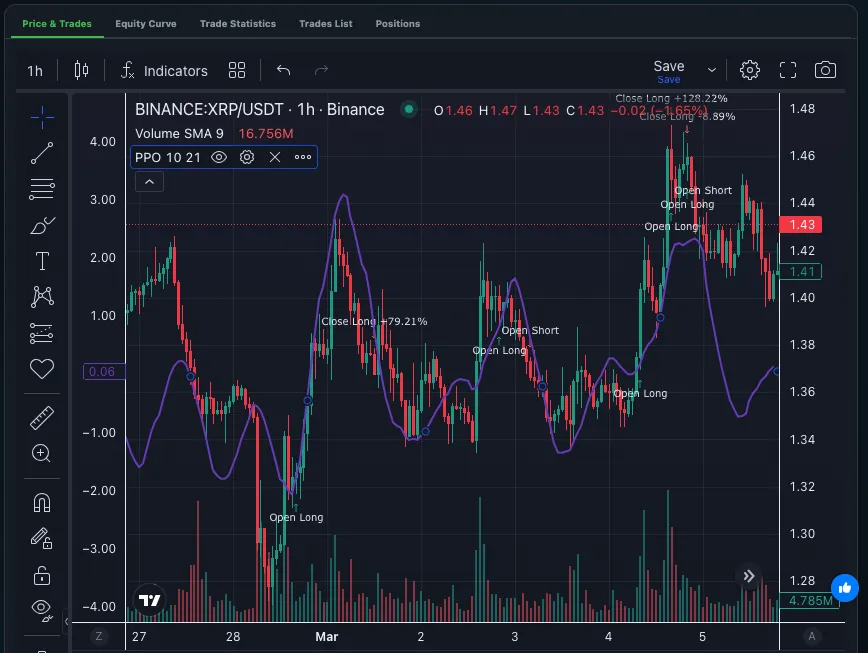
The Percentage Price Oscillator is one of the most versatile momentum tools available to algorithmic traders, yet it remains underused compared to its close relative, the MACD. By expressing the difference between two exponential moving averages as a percentage rather than an absolute value, the Percentage Price Oscillator makes it possible to compare momentum across assets with vastly different price levels — a critical advantage when building multi-asset strategies.
What Is the Percentage Price Oscillator?
The Percentage Price Oscillator is a momentum oscillator that measures the percentage difference between two exponential moving averages (EMAs) of an asset’s price. It was developed as a normalised alternative to the MACD, solving the problem of comparing momentum signals across assets with different price scales. While the MACD shows the raw point difference between two EMAs, the Percentage Price Oscillator converts that difference into a percentage. This means a PPO reading of 2.0 on Bitcoin (trading at $71,000) and a PPO reading of 2.0 on XRP (trading at $1.42) represent equivalent momentum strength — something the MACD cannot offer. The Percentage Price Oscillator consists of three components: the PPO line itself, a signal line (typically a 9-period EMA of the PPO line), and a histogram showing the difference between the two. This structure will feel familiar if you already use the MACD.
How Is the Percentage Price Oscillator Calculated?
The Percentage Price Oscillator calculation is straightforward once you understand exponential moving averages. Here is the formula in plain terms: PPO Line = ((12-period EMA minus 26-period EMA) divided by 26-period EMA) multiplied by 100 Signal Line = 9-period EMA of the PPO Line Histogram = PPO Line minus Signal Line The default periods of 12, 26, and 9 mirror the classic MACD settings. The key difference is the division by the longer EMA and multiplication by 100, which converts the output to a percentage. A PPO reading of 1.5 means the short-term EMA sits 1.5% above the long-term EMA — bullish momentum is present. Shorter-term traders sometimes adjust these periods. Using 5 and 20 for the EMAs creates a faster Percentage Price Oscillator that responds more quickly to price changes, while 20 and 50 produces a smoother, longer-term reading suitable for swing trading or position management.
How to Read Percentage Price Oscillator Signals?
The Percentage Price Oscillator generates several distinct signal types that algorithmic traders can use as building blocks in their strategies: Zero-line crossovers: When the PPO crosses above zero, the short-term EMA has moved above the long-term EMA, confirming bullish momentum. A cross below zero signals bearish momentum. These are the most reliable Percentage Price Oscillator signals for trend identification. Signal line crossovers: When the PPO line crosses above its signal line, it suggests momentum is accelerating to the upside. A cross below the signal line indicates decelerating or reversing momentum. These crossovers occur more frequently than zero-line crosses and are popular for shorter-term entries. Histogram direction: Rising histogram bars (whether above or below zero) indicate strengthening momentum. Falling bars suggest weakening momentum. A histogram reversal from expanding to contracting often provides the earliest warning of a potential trend change. Divergence: When price makes a new high but the Percentage Price Oscillator makes a lower high, bearish divergence is present — momentum is fading despite rising prices. The reverse pattern (price makes a new low, PPO makes a higher low) creates bullish divergence and often precedes reversals.
What Are the Best Percentage Price Oscillator Trading Strategies?
Three Percentage Price Oscillator strategies stand out for algorithmic implementation:
1. Trend Confirmation with Zero-Line Filter
Only take long trades when the PPO is above zero, and only take short trades when it is below zero. This simple filter eliminates a large percentage of false signals by ensuring you trade in the direction of the prevailing trend. Pair this with a signal line crossover for entry timing and you have a complete system.
2. Multi-Asset Momentum Ranking
Because the Percentage Price Oscillator normalises momentum as a percentage, you can directly compare PPO readings across different assets. Rank your watchlist by PPO value each day — assets with the highest PPO have the strongest upward momentum. Rotate capital into the top performers and exit when an asset drops out of the top rankings. This approach works well in crypto markets where assets range from $0.01 to $70,000+.
3. Divergence Reversal Strategy
Monitor for PPO divergence against price at key support and resistance levels. When price tests support and the Percentage Price Oscillator shows bullish divergence (higher low on PPO), enter long with a stop below the support level. This strategy catches momentum shifts before they become visible on the price chart alone.
What Are Common Percentage Price Oscillator Mistakes to Avoid?
Treating PPO identically to MACD: While structurally similar, the Percentage Price Oscillator’s normalised output changes how you interpret magnitude. A PPO of 3.0 is significant regardless of the asset’s price, whereas an MACD of 3.0 means very different things on a $100 stock versus a $70,000 asset. Ignoring the trend context: Signal line crossovers during a strong trend often produce whipsaw signals. The Percentage Price Oscillator works best when combined with a trend filter — such as a longer-period moving average or the ADX — to confirm the market environment before acting on crossover signals. Using default settings blindly: The standard 12/26/9 parameters were designed for daily stock charts. Crypto markets run 24/7 with different volatility profiles. Test alternative settings like 10/21/9 for 4-hour charts or 5/13/5 for scalping on lower timeframes. Overloading with similar indicators: Since the PPO is derived from EMAs, adding a separate MACD or multiple EMAs to the same strategy creates redundant signals. Use the PPO alongside complementary tools like volume indicators or volatility measures instead.
How to Build Percentage Price Oscillator Strategies in Arrow Algo?
Arrow Algo’s no-code visual block builder makes it simple to create Percentage Price Oscillator strategies without writing a single line of code. Drag the PPO indicator block onto your canvas, connect it to your chosen data source, and configure the EMA periods to match your preferred timeframe. From there, add condition blocks to define your entry and exit rules. For example, connect the PPO output to a crossover condition block set to trigger when the PPO line crosses above the signal line. Add a second condition requiring the PPO to be above zero for trend confirmation. Chain these conditions together and connect them to a buy block — your PPO strategy is ready to backtest. One of the most powerful applications in Arrow Algo is building multi-asset PPO scanners. Because the visual builder supports multiple data inputs, you can monitor PPO readings across several trading pairs simultaneously and automatically signal a trade on whichever asset shows the strongest momentum reading.
What Are the Key Takeaways?
- The Percentage Price Oscillator normalises the MACD as a percentage, enabling direct momentum comparison across assets with different price levels
- PPO generates three signal types: zero-line crossovers (trend direction), signal line crossovers (momentum timing), and divergence (reversal warnings)
- The normalised output makes the PPO ideal for multi-asset ranking and rotation strategies in crypto portfolios
- Always combine PPO signals with a trend filter to reduce whipsaw in ranging markets
- Default 12/26/9 settings should be optimised for your specific timeframe and asset using backtesting
- Arrow Algo’s visual block builder lets you drag, connect, and backtest Percentage Price Oscillator strategies with zero coding
Educational disclaimer: This content is for educational purposes only and does not constitute financial advice. Trading involves significant risk and you should only trade with capital you can afford to lose. Past performance is not indicative of future results.
Disclaimer: The information provided in this article is for educational purposes only and does not constitute financial advice. Trading involves significant risk and you should only trade with capital you can afford to lose. Past performance is not indicative of future results. Always conduct your own research before making any trading decisions. Ready to build your own automated trading strategies without writing a single line of code? Start for free at Arrow Algo and join thousands of traders who’ve made the switch to systematic trading.