
Qstick Indicator: Complete Guide for Algorithmic Trading
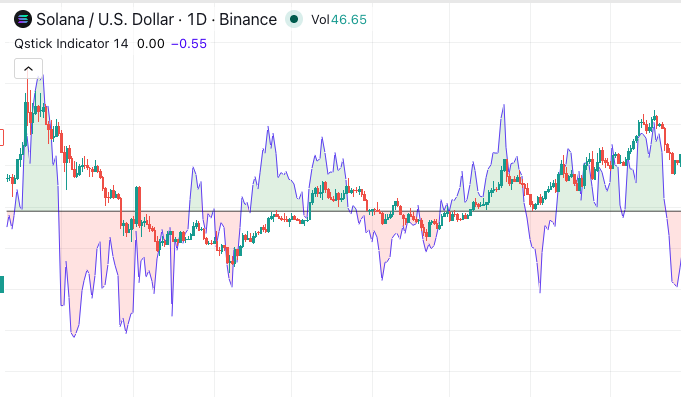
The Qstick indicator is one of the most underused momentum tools in technical analysis — and one of the most direct. Where most indicators wrap price data in multiple layers of calculation, the Qstick indicator cuts straight to a single question: are buyers or sellers consistently winning each candle over the lookback period?
What Is the Qstick Indicator?
The Qstick indicator is a momentum tool that measures the average difference between a candle’s closing price and its opening price over a defined period.
Developed by Richard W. Arms Jr., it applies a simple moving average (SMA) to the close-minus-open value for each candle across a chosen lookback window. The result is a single line that oscillates above and below zero.
When Qstick is positive, prices close above the open consistently. Buyers dominate. When Qstick is negative, prices close below the open consistently. Sellers are in control. The zero line marks the boundary between these two states.
The logic is direct. Each candle tells a story — where the market opened and where it finished. Qstick aggregates those stories into a single smoothed momentum reading. No volume. No volatility adjustment. Just the raw result of each session’s battle between buyers and sellers.
How Is the Qstick Indicator Calculated?
The Qstick calculation has two steps.
First, subtract the open from the close for each candle. A positive result means the candle closed higher than it opened — a bullish session. A negative result means it closed lower — a bearish session.
Second, apply an SMA to that series of close-minus-open values. The default period is typically 5 or 8 candles. Longer periods — 14 to 20 — smooth the line and capture broader trends. Shorter periods — 3 to 5 — respond faster but generate more noise.
The output is a smoothed momentum reading. A positive Qstick value across a 10-candle period means buyers dominated the average session. A negative value means sellers held the edge on average.
How to Read Qstick Indicator Signals?
The zero line is the primary reference point. A Qstick reading above zero signals bullish momentum. A reading below zero signals bearish momentum.
Zero-line crosses are the most actionable signal. A cross from below zero to above zero suggests the market has shifted from seller-dominated to buyer-dominated. The opposite cross signals a shift toward sellers.
Magnitude matters. A Qstick reading of +10 signals stronger bullish pressure than +1. The larger the value, the more decisively buyers closed each candle above the open across the lookback window.
Divergence is the early warning signal. If price makes a new high but Qstick prints a lower high, buying pressure is fading beneath the surface. That divergence often precedes a reversal. Watch for it at key resistance levels. If price makes a new low but Qstick holds a higher low, sellers may be losing grip.
Qstick works best on trending markets. In choppy or sideways conditions, zero-line crosses generate frequent false signals. A trend filter alongside Qstick improves reliability significantly.
What Are the Best Qstick Trading Strategies?
Zero-Line Cross Strategy
Enter long when Qstick crosses above zero and price holds above a key exponential moving average (EMA). This confirms both momentum and trend direction at once. Exit when Qstick crosses back below zero. Add an RSI filter to avoid entering in overbought conditions.
Qstick Divergence Strategy
Watch for divergence between price and Qstick at swing highs and lows. When price reaches a new high but Qstick prints a lower high, enter short after a confirming bearish candle. Set your stop above the recent price peak. Target the previous swing low. This setup catches momentum exhaustion before the crowd recognises it.
Qstick Trend Confirmation Filter
Use Qstick as a direction filter for an existing trend-following strategy. Only take long entries when Qstick is positive. Only take short entries when Qstick is negative. This single rule filters out a meaningful proportion of countertrend trades that erode a strategy’s win rate over time.
What Are Common Qstick Indicator Mistakes to Avoid?
Trading Qstick in isolation. The Qstick indicator measures internal candle momentum. It does not account for volume, volatility, or broader trend direction. Always pair it with a trend filter and at least one additional indicator.
Using too short a period. A period of 2 or 3 makes Qstick extremely reactive. Individual candles dominate the reading and noise overwhelms signal. Start with a period of 5 to 14.
Ignoring the zero line. Traders who focus only on the absolute value of Qstick miss the key signal. Direction relative to zero matters more than magnitude alone.
Skipping divergence analysis. Zero-line crosses are simple but Qstick’s most reliable edge often comes from divergence setups. Build divergence detection into your rules — it catches reversal setups that momentum traders miss.
Applying Qstick to range-bound markets without a filter. In sideways markets, Qstick crosses zero frequently and generates false signals. A regime filter — such as ADX below 20 indicating low trend strength — lets your strategy step aside during choppy conditions. See our guide on the Momentum indicator for a complementary approach to measuring directional strength.
How to Build Qstick Indicator Strategies in Arrow Algo?
Arrow Algo includes the Qstick indicator as a native block in its visual block library. There are no formulas to write and no spreadsheets to maintain.
Add the Qstick block to your blueprint canvas. Connect it to your price data. Set your preferred lookback period in the block’s properties panel. Then use a Condition block to define your entry rules — for example, Qstick crossing above zero while price trades above a 50-period EMA.
For divergence strategies, connect a Lag block to compare the current Qstick reading against a previous peak. Arrow Algo’s drag-and-drop interface handles this logic visually. You see the rule structure on-screen and adjust it without writing a single line of code.
Run a backtest directly against live exchange data to see how the Qstick strategy performed across different market conditions — bull runs, downtrends, and sideways ranges. Adjust the lookback period and refine your filters before going live.
Visit Arrow Algo to build and backtest your first Qstick strategy with no programming required.
What Are the Key Takeaways?
- The Qstick indicator measures the SMA of close-minus-open values. It reveals whether buyers or sellers dominate the average session over the lookback period.
- Positive Qstick readings signal bullish momentum. Negative readings signal bearish momentum.
- The zero-line cross is the primary entry signal. Divergence between price and Qstick is the early warning signal for reversals.
- Pair Qstick with a trend filter — such as an EMA or ADX — to reduce false signals in range-bound markets.
- Use periods between 5 and 14 as a starting point. Longer periods reduce noise. Shorter periods increase responsiveness.
- Arrow Algo lets you build, backtest, and deploy Qstick strategies using a drag-and-drop visual builder — no coding required.
Educational disclaimer: This content is for educational purposes only and does not constitute financial advice. Trading involves significant risk and you should only trade with capital you can afford to lose. Past performance is not indicative of future results.
Disclaimer: The information provided in this article is for educational purposes only and does not constitute financial advice. Trading involves significant risk and you should only trade with capital you can afford to lose. Past performance is not indicative of future results. Always conduct your own research before making any trading decisions.
Ready to build your own automated trading strategies without writing a single line of code? Start for free at Arrow Algo and join thousands of traders who’ve made the switch to systematic trading.