
Stochastic Oscillator Strategy: How to Build It in Arrow Algo
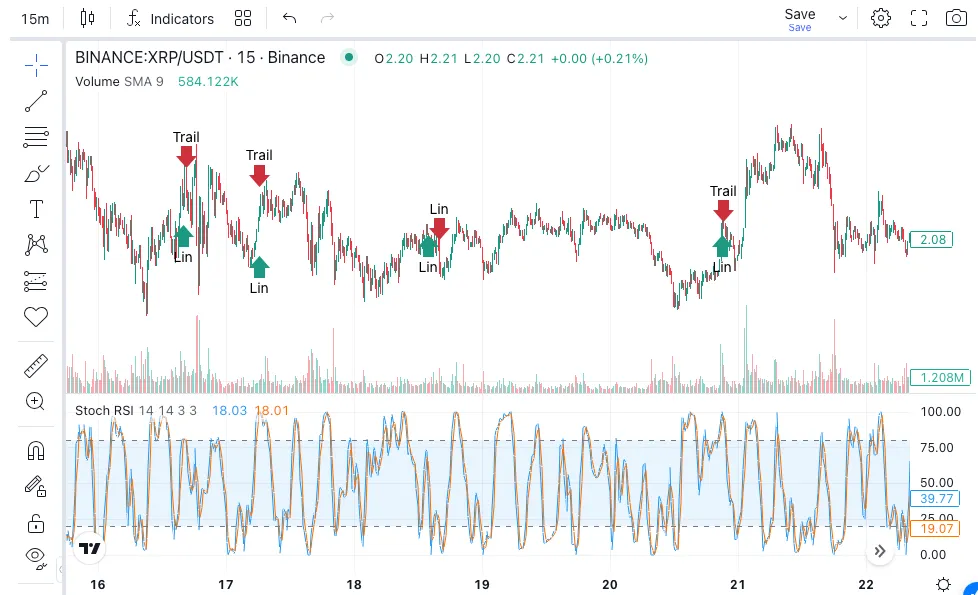
The stochastic oscillator strategy is one of the most widely used systematic approaches in trading — built around identifying moments when price has become overextended in the short term and is likely to reverse. Where most momentum indicators track rate of change, the stochastic tracks where the current close sits relative to the recent high-low range. That positioning is what makes it useful for timing entries in mean-reverting conditions.
What the Stochastic Oscillator Measures
The stochastic oscillator outputs two lines: %K and %D. %K compares the current close to the high-low range over the lookback period (typically 14 bars). %D is a smoothed average of %K — usually a 3-period simple moving average. Both lines move between 0 and 100.
A reading above 80 signals the close is near the top of its recent range — overbought territory. A reading below 20 signals the close is near the bottom — oversold territory. The strategy’s core logic is that these extremes represent temporary imbalances that tend to correct back toward the middle of the range.
Core Entry Rules: The %K/%D Crossover
The primary stochastic oscillator strategy uses %K crossing %D as the entry trigger — but only when both lines are in an extreme zone.
Long entry rule: %K and %D are both below 20. %K crosses above %D from below. This signals the oscillator is reversing from oversold territory — momentum is shifting from sellers to buyers.
Short entry rule: %K and %D are both above 80. %K crosses below %D from above. This signals a reversal from overbought — momentum shifting from buyers to sellers.
The zone requirement matters. A %K/%D crossover that happens at 45 or 55 is a weak signal with no directional edge. The crossover is only significant at the extremes — both lines must be in the oversold or overbought zone at the point of crossing.
Adding the Regime Filter: When the Strategy Works and When It Fails
The stochastic oscillator performs differently in ranging and trending markets. In a ranging market, price oscillates and the overbought/oversold signals fire at genuine turning points. In a trending market, the oscillator can sit in overbought or oversold territory for extended periods — generating entry signals that fight the prevailing trend.
The fix is an ADX filter. ADX below 25 indicates a ranging session — stochastic crossover signals are valid. ADX above 25 indicates a trending session — suppress overbought/oversold entries. In a strong trend, the strategy flips: instead of fading overbought readings, treat them as confirmation of trend strength and look for pullback entries rather than reversals.
This single filter eliminates the majority of losing trades in a stochastic strategy. A crossover from oversold in a strong downtrend is a trap — the regime filter prevents entering it.
Setting Stops and Targets
The stochastic strategy is inherently a reversion strategy. Entries target a return from the extreme zone toward the midpoint of the oscillator — and a corresponding price move toward the middle of the recent range.
Stop loss: place stops beyond the recent swing high (for short entries) or swing low (for long entries). A move through that swing point while the oscillator is in the extreme zone invalidates the reversal thesis — price is extending rather than reverting.
Take profit: the natural target is when the oscillator returns to the 50 level. At 50, the close is in the middle of the recent range and the reversal momentum has been realised. Some traders use a partial exit at 50 and trail the remainder to the opposite extreme — capturing a full range cycle on strong reversions.
Divergence as a Higher-Probability Signal
Stochastic divergence entries are a higher-conviction variant of the base strategy. Bearish divergence forms when price makes a higher high but the stochastic makes a lower high on the same move — the overbought reading is weakening even as price extends. Bullish divergence forms when price makes a lower low but the stochastic makes a higher low — oversold pressure is fading.
Divergence signals require more patience to set up. They are rarer than simple crossovers. When they appear with the regime filter confirming a ranging market, they represent the highest-probability stochastic entries. The divergence tells you the momentum driving the extreme is already decelerating — the reversal is more likely to sustain.
What Can Go Wrong
Entering in a trend without the ADX filter: A stochastic crossover from oversold in a downtrend produces a losing trade more often than not. The asset is oversold because it is in a downtrend — and oversold can get more oversold. Always confirm regime before entering a reversal signal.
Using the wrong lookback period: The standard 14-period setting suits daily timeframes on liquid assets. On shorter timeframes (15-minute, 1-hour), 14 bars becomes too slow and generates lagging signals. On longer timeframes (weekly), it generates signals too infrequently for active management. Calibrate the period to match your trading timeframe and backtest before deploying.
Ignoring volume at the extreme: A stochastic extreme reached on declining volume is a weaker signal. The price has drifted into the zone rather than been pushed there by conviction selling or buying. Low-volume extremes produce less reliable reversions than high-volume exhaustion moves.
How to Build a Stochastic Oscillator Strategy in Arrow Algo
Arrow Algo’s drag-and-drop builder lets you construct the full strategy without writing a line of code.
Add a Stochastic block to your canvas. Set the period, K smoothing, and D smoothing (defaults: 14, 3, 3). Connect the %K and %D outputs. Add condition blocks: one checking %K below 20 AND %D below 20 (oversold zone), another checking %K above 80 AND %D above 80 (overbought zone).
Add a Crossover block connected to %K and %D — it fires when %K crosses %D from below (bullish cross) or above (bearish cross). Wire the crossover output as an AND gate with the zone condition: the entry signal fires only when both the zone AND the crossover are true simultaneously.
Add an ADX block. Add a condition checking ADX below 25. Wire this as a third AND gate input — the entry fires only when zone + crossover + ADX below 25 are all true.
Connect the entry signal to your buy or sell block. Set stop loss to the recent swing low (for longs) or swing high (for shorts) using a Min or Max block over a lookback period. Set take profit to the 50 level on the oscillator, or use a fixed percentage target calibrated from backtest data.
Run a backtest across multiple market conditions in Arrow Algo. Compare performance in ranging sessions versus trending sessions to verify the ADX filter is suppressing the right signals. Adjust the ADX threshold and stochastic period if the win rate diverges significantly between session types.
What Are the Key Takeaways?
- The stochastic oscillator strategy enters when %K crosses %D in the overbought (above 80) or oversold (below 20) zone — fading price extremes
- The ADX filter is essential: only enter reversal signals when ADX is below 25, confirming a ranging market where reversions are most reliable
- Stops go beyond the recent swing point that invalidates the reversal — not at a fixed percentage
- Take profit when the oscillator returns to 50, or trail a portion to the opposite extreme
- Stochastic divergence — price at a new extreme but oscillator weakening — produces higher-conviction entries than simple crossovers
- Arrow Algo’s Stochastic, Crossover, ADX, and condition blocks let you build the complete strategy using drag-and-drop blocks
Disclaimer: This content is for educational purposes only and does not constitute financial advice. Trading involves significant risk and you should only trade with capital you can afford to lose. Past performance is not indicative of future results. Always conduct your own research before making any trading decisions.
Ready to build your own automated trading strategies without writing a single line of code? Start for free at Arrow Algo and join thousands of traders who’ve made the switch to systematic trading.