
Time Series Forecast (TSF): Complete Guide for Algorithmic Trading
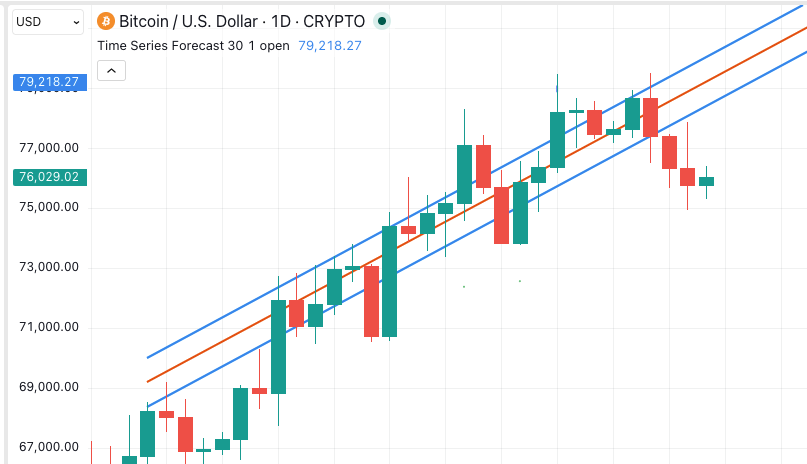
The Time Series Forecast (TSF) is a trend indicator in Arrow Algo that projects where price is heading next using linear regression — a statistical method for drawing the best-fit straight line through recent price data. Unlike a moving average that smooths past values, the TSF looks ahead. It extends the regression line by one period and delivers a forecast, not a reflection.
What Is the Time Series Forecast?
The Time Series Forecast is a trend and momentum indicator that applies linear regression to recent closing prices and extrapolates the result one period into the future. Think of it as drawing a straight trend line through recent price action and reading the next predicted point on that line.
Because it uses a rolling regression window, the TSF updates with each new bar. It responds more quickly to recent price changes than traditional moving averages. This makes it useful for traders who want to capture trends early without lagging far behind current price.
The TSF sits in the same family as the Linear Regression indicator — also available in Arrow Algo. The key difference: Linear Regression plots the value of the regression line at the current bar. The TSF projects that line one bar forward to show where price is predicted to move next.
How Is the Time Series Forecast Calculated?
The TSF calculation runs three steps on a rolling window of recent price bars.
First, it draws a linear regression line through the closing prices within the lookback period. This line minimises the total distance between itself and each data point — the same statistical approach used in standard trend analysis.
Second, it extends that regression line forward by one period. This gives the predicted value for the next bar.
Third, it plots that predicted value as the TSF line on your chart.
The default lookback period is 14 bars. You can adjust this in Arrow Algo depending on your timeframe and strategy style. A shorter period makes the TSF more reactive. A longer period produces a smoother line but a slower response to new price data.
How to Read Time Series Forecast Signals?
The TSF line gives you two primary signals: the direction of the line itself, and the relationship between price and the TSF level.
Direction of the line. A rising TSF shows that the regression trend points upward — the statistical best-fit line through recent price slopes higher. A falling TSF shows a downward trend. Flat movement suggests no clear short-term direction.
Price versus TSF. When price trades above the TSF line, the market outperforms its projected trend — a bullish condition. When price trades below the TSF line, the market underperforms its trend — a bearish condition.
Crossovers. A cross of price above the TSF line is a bullish signal. A cross of price below the TSF line is a bearish signal. These crossover points commonly serve as entry and exit triggers in systematic strategies.
The TSF does not use fixed overbought or oversold thresholds like the RSI (Relative Strength Index — a separate indicator that measures the speed of price changes on a 0–100 scale). You read the TSF through its slope and its relationship to current price, not through absolute value levels.
What Are the Best Time Series Forecast Trading Strategies?
Strategy 1: TSF Crossover Entry
The simplest TSF approach triggers entries when price crosses the TSF line. A long entry fires when price crosses above the TSF. A short entry fires when price crosses below.
This works best in trending markets. During choppy sideways conditions, crossovers generate too many false signals. Pair this with an ADX filter — ADX is an indicator that measures trend strength on a 0–100 scale. Require ADX above 25 before taking crossover signals to confirm you trade only in genuine trends.
Strategy 2: TSF as a Dynamic Stop
The TSF value at each bar shows where the regression trend expects price to sit. Use this as a dynamic stop-loss level rather than a fixed dollar amount.
In a long trade, exit when price drops back below the TSF — that signals the trend you entered on has reversed. In a short trade, cover the position when price closes back above the TSF. This approach keeps your exits tied to current trend conditions rather than arbitrary price levels.
Strategy 3: TSF Slope Filter
Compare the current TSF value to the TSF value from N bars ago. When the TSF sits higher than it was N bars ago, the slope is positive — confirming an uptrend. When it sits lower, the slope is negative — confirming a downtrend.
Use this slope direction as a filter for other entry signals. Only take long signals from your primary indicator when the TSF slope confirms an uptrend. This cuts counter-trend trades and improves overall signal quality.
What Are Common Time Series Forecast Mistakes to Avoid?
Using TSF alone in sideways markets. The TSF performs best when price trends. In consolidating or range-bound conditions, the regression line frequently flips direction. This produces whipsaws — rapid back-to-back signals that cancel each other out. Always confirm trend presence before applying TSF-based strategies.
Setting the lookback period too short. A very short lookback (5 bars or fewer) makes the TSF extremely sensitive to recent candles. Minor moves generate crossover signals. This leads to excessive trade frequency and higher transaction costs that erode profits over time.
Treating the TSF as a guaranteed price target. The TSF projects a statistical trend continuation — not a promise. The market has no obligation to reach the forecasted value. Use the TSF line as a reference and a filter, not as a firm price target.
Ignoring higher timeframe context. A TSF crossover on a 15-minute chart means little if the daily chart shows a strong opposing trend. Always check whether your TSF signal aligns with the broader trend on a higher timeframe before entering a trade.
How to Build Time Series Forecast Strategies in Arrow Algo?
Arrow Algo includes the TSF as a built-in indicator block. You add it to your strategy canvas with a single drag-and-drop action — no code required.
In the block settings, choose your lookback period (default 14) and select your price input (typically close price). The TSF then plots on your chart and becomes available as a signal source in your strategy logic.
To build a basic TSF crossover strategy in Arrow Algo:
- Add a TSF block to your canvas and set your preferred lookback period.
- Add a Crossover detection block. Connect the price source and the TSF output to it.
- Connect the crossover signal to a Buy block for long entries, or a Sell block for short entries.
- Add an ADX filter block to confirm trend strength above 25 before each entry fires.
- Set your exit conditions using a second TSF crossover block or a percentage-based stop-loss block.
You can also combine the TSF with other Arrow Algo indicators — such as the Volume Oscillator for confirmation — all through the same visual block builder interface.
What Are the Key Takeaways?
- The Time Series Forecast (TSF) extends a linear regression line forward by one period to project price direction.
- It responds faster to recent price changes than most moving averages, making it useful for early trend detection.
- Price above the TSF line is bullish. Price below is bearish. Crossovers signal entries and exits.
- The TSF performs best in trending markets. Pair it with an ADX filter to avoid false signals in choppy conditions.
- Avoid very short lookback periods — they produce too many signals and increase transaction costs.
- Arrow Algo lets you build TSF strategies with drag-and-drop blocks, with no code required.
Educational disclaimer: This content is for educational purposes only and does not constitute financial advice. Trading involves significant risk and you should only trade with capital you can afford to lose. Past performance is not indicative of future results.
Disclaimer: The information provided in this article is for educational purposes only and does not constitute financial advice. Trading involves significant risk and you should only trade with capital you can afford to lose. Past performance is not indicative of future results. Always conduct your own research before making any trading decisions.
Ready to build your own automated trading strategies without writing a single line of code? Start for free at Arrow Algo and join thousands of traders who’ve made the switch to systematic trading.