
TRIX: Complete Guide for Algorithmic Trading
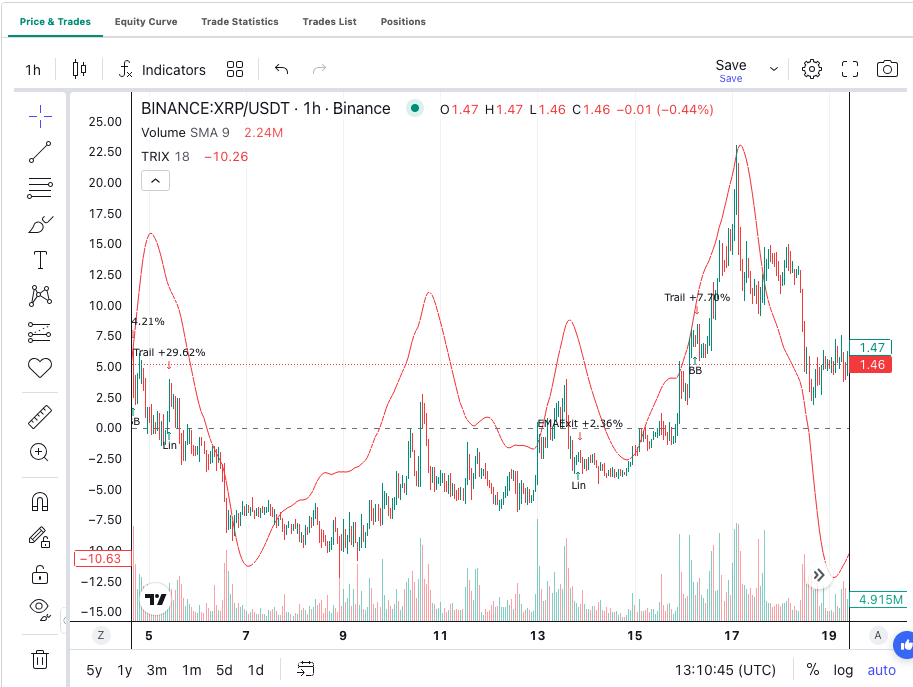
TRIX is one of the most effective noise-filtering indicators available to algorithmic traders, yet it remains surprisingly underused compared to its more popular cousins like MACD and RSI. Built on a triple-smoothed exponential moving average, TRIX strips away the short-term price fluctuations that generate false signals and reveals the true underlying momentum of any asset. In this guide, we will break down how TRIX works, how to read its signals, and how to build automated TRIX strategies using a no-code visual block builder.
What Is TRIX?
Triple Exponential Moving Average is a momentum oscillator that displays the percentage rate of change of a triple exponentially smoothed moving average. Developed by Jack Hutson in the early 1980s and first introduced in Technical Analysis of Stocks and Commodities magazine, TRIX was designed to filter out insignificant price movements and highlight meaningful trends.
What makes Triple Exponential Moving Average stand out from standard moving averages is its triple smoothing process. By applying an exponential moving average (EMA) three times in succession, TRIX removes much of the short-term noise that plagues single or double smoothed indicators. The result is a cleaner oscillator that centres around zero and reveals the underlying direction and strength of a trend.
Triple Exponential Moving Average is often compared to MACD because both measure momentum and both oscillate around a zero line. However, TRIX applies an extra layer of smoothing, which means fewer false signals in noisy markets at the cost of slightly more lag.
How Is TRIX Calculated?
The Triple Exponential Moving Average calculation involves four straightforward steps. No programming is required to understand it.
Step 1: Calculate an EMA of the closing price over a chosen period (commonly 14 or 15 periods). This is your single-smoothed EMA.
Step 2: Calculate an EMA of the result from Step 1, using the same period length. This gives you a double-smoothed EMA.
Step 3: Calculate an EMA of the result from Step 2, again using the same period. This produces the triple-smoothed EMA.
Step 4: Calculate the one-period percentage change of the triple-smoothed EMA. This final value is the TRIX line.
In plain terms: Triple Exponential Moving Average tells you how fast the triple-smoothed average is rising or falling, expressed as a percentage. A rising TRIX means the smoothed trend is accelerating upward. A falling TRIX means it is accelerating downward.
Many traders also add a signal line, which is simply a short-period simple moving average (SMA) of the TRIX line itself, typically set to 9 periods. This signal line helps identify crossover opportunities.
How to Read TRIX Signals?
Triple Exponential Moving Average generates signals in four main ways.
Zero-Line Crossovers
When TRIX crosses above zero, the triple-smoothed trend is turning upward, which is a bullish signal. When it crosses below zero, the trend is turning downward, which is bearish. Because of the heavy smoothing, zero-line crossovers tend to be reliable but arrive later than signals from faster oscillators.
Signal Line Crossovers
When the Triple Exponential Moving Average line crosses above its signal line, it suggests strengthening momentum and a potential buy opportunity. When TRIX crosses below the signal line, it warns of weakening momentum and a potential sell. These crossovers occur more frequently than zero-line crosses and can be used for earlier entries.
Divergence
When price makes a new high but Triple Exponential Moving Average makes a lower high, that is bearish divergence and warns the uptrend may be losing steam. Conversely, when price makes a new low but TRIX makes a higher low, that is bullish divergence and hints at a potential reversal upward.
Histogram
Some platforms display a Triple Exponential Moving Average histogram, which is the difference between the TRIX line and the signal line. A growing histogram indicates increasing momentum in the current direction, while a shrinking histogram suggests momentum is fading. This is similar to how the MACD histogram works.
What Are the Best TRIX Trading Strategies?
1. Zero-Line Crossover with Trend Filter
Use a longer-period moving average (such as a 200-period SMA) to define the overall trend. Only take Triple Exponential Moving Average zero-line crossover signals that agree with the broader trend. For example, only buy when TRIX crosses above zero and price is above the 200 SMA. This filters out counter-trend signals and improves the win rate.
2. TRIX Signal Line Crossover for Entries
Pair the Triple Exponential Moving Average and its signal line for short-term entries. Enter long when TRIX crosses above the signal line while TRIX is below zero (catching the early turn). Exit when TRIX crosses back below the signal line. This approach captures moves earlier than waiting for zero-line crosses, though it generates more signals and requires tighter risk management.
3. Divergence Confirmation
Identify divergence between Triple Exponential Moving Average and price, then wait for a confirming signal before acting. For instance, if you spot bullish divergence, wait for TRIX to cross above its signal line before entering. This two-step confirmation reduces the chance of acting on a divergence that never resolves into an actual reversal.
What Are Common TRIX Mistakes to Avoid?
Using too short a period. Setting Triple Exponential Moving Average to five or six periods defeats its entire purpose. The value of TRIX lies in the triple smoothing that filters noise. Short periods reintroduce the noise you are trying to eliminate. Stick to 12 periods or above for meaningful signals.
Ignoring the lag. Triple smoothing means Triple Exponential Moving Average is inherently slower than single-smoothed indicators. Expecting it to catch exact tops and bottoms will lead to frustration. Accept that TRIX confirms trends rather than predicting turns, and use it alongside faster indicators for timing.
Trading TRIX in choppy, range-bound markets. Like most trend-following tools, Triple Exponential Moving Average struggles when price is moving sideways. The oscillator will whipsaw around zero, generating false crossovers. Always apply a trend or volatility filter to avoid flat markets. An ADX reading below 20, for example, can warn you to sit out.
Using TRIX in isolation. No single indicator is a complete trading system. Triple Exponential Moving Average works best when combined with volume analysis, support and resistance levels, or complementary oscillators. Treat it as one input in a broader strategy, not a standalone decision maker.
How to Build TRIX Strategies in Arrow Algo?
Arrow Algo’s no-code visual block builder includes a dedicated TRIX indicator block. Here is how to set it up using drag-and-drop, with no programming required.
Connect your data source. Drag a Data Watcher block onto the canvas and configure it for your chosen pair and timeframe. Connect the close price output to the TRIX block’s single input.
Configure the TRIX block. The Triple Exponential Moving Average block has one property: time_period. Set this to your preferred lookback, such as 14. The block outputs the TRIX value for each candle.
Add a signal line. Drag an SMA block onto the canvas and connect the Triple Exponential Moving Average block’s output to the SMA input. Set the SMA period to 9. This creates your TRIX signal line.
Detect crossovers. Use a Crossover block or Condition blocks to compare the TRIX output against the signal line SMA output. You can also add a condition to check whether TRIX is above or below zero for trend filtering.
Backtest and refine. Once your blocks are connected, run a backtest directly on live exchange data. Arrow Algo gives you access to historical data from Binance, Coinbase, HyperLiquid, and other exchanges, so you can validate your TRIX strategy across different market conditions without sourcing your own data.
The entire process uses visual blocks and drag-and-drop connections. There is no code to write, debug, or maintain.
What Are the Key Takeaways?
- Triple Exponential Moving Average is a momentum oscillator built on a triple-smoothed EMA, making it one of the best indicators for filtering market noise.
- It generates signals through zero-line crossovers, signal line crossovers, and divergence with price.
- TRIX works best in trending markets. Always apply a trend filter to avoid whipsaws in sideways conditions.
- Use a period of 12 or higher to preserve the noise-filtering benefit of triple smoothing.
- Combine TRIX with other indicators such as volume, support and resistance, or ADX for a more robust strategy.
- Arrow Algo’s visual block builder lets you build, backtest, and run TRIX strategies with drag-and-drop blocks and no coding required.
Further reading: For a deeper dive into Triple Exponential Moving Average and its origins, see the Investopedia TRIX guide and the StockCharts TRIX education page, which references Jack Hutson’s original work.
Educational disclaimer: This content is for educational purposes only and does not constitute financial advice. Trading involves significant risk and you should only trade with capital you can afford to lose. Past performance is not indicative of future results.
Disclaimer: The information provided in this article is for educational purposes only and does not constitute financial advice. Trading involves significant risk and you should only trade with capital you can afford to lose. Past performance is not indicative of future results. Always conduct your own research before making any trading decisions.
Ready to build your own automated trading strategies without writing a single line of code? Start for free at Arrow Algo and join thousands of traders who’ve made the switch to systematic trading.