
Typical Price: Complete Guide for Algorithmic Trading
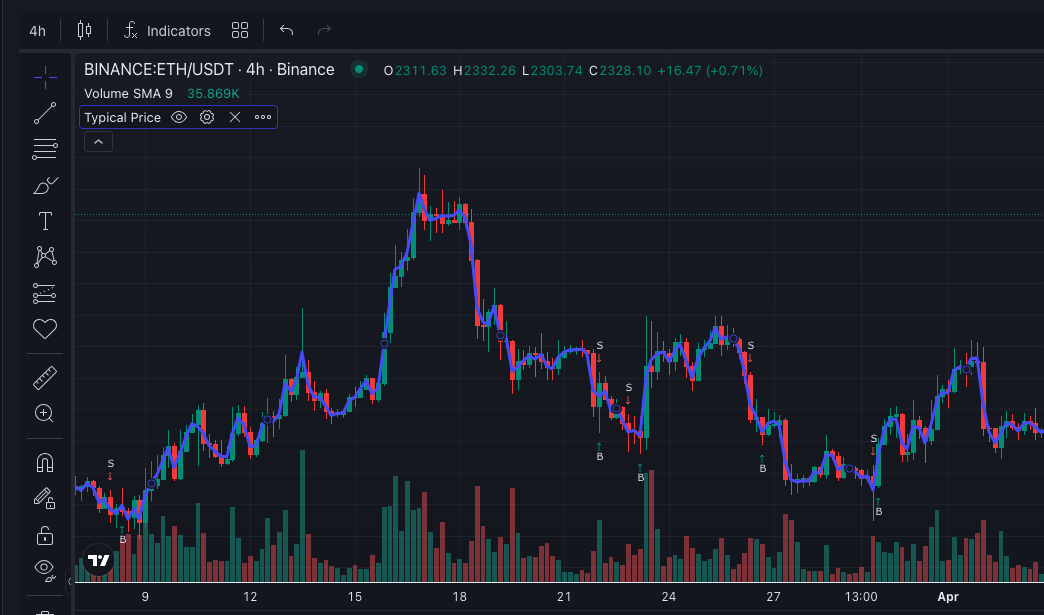
The Typical Price indicator is a foundational price calculation that averages the high, low, and close of each bar into a single value. It is one of the most widely used price inputs in technical analysis — underpinning indicators like VWAP, Money Flow Index, and many others. Understanding how the Typical Price indicator works helps systematic traders build more accurate signals from volume-weighted and price-based tools.
What Is the Typical Price Indicator?
Typical Price is a composite price measure. Rather than using only the closing price to represent a bar, it accounts for the full range of trading activity by incorporating the high, the low, and the close.
The result is a single number that sits closer to the midpoint of the bar’s price action. This makes it a more balanced representation of where the market traded during that period.
Typical Price is rarely plotted on its own as a primary signal. Its main role is as a building block — a cleaner price input for more complex indicators. It is closely related to the VWAP indicator, which uses Typical Price as its core price input. You can also explore the concept in detail at Investopedia’s guide to Typical Price.
How Is It Calculated?
The formula is straightforward. For each bar, Typical Price is calculated as:
(High + Low + Close) ÷ 3
That is all there is to it. No look-back period, no smoothing, no complex parameters. Each bar produces one Typical Price value based solely on that bar’s high, low, and close.
For example: if Bitcoin has a high of $82,000, a low of $79,500, and a close of $81,000, the Typical Price for that bar is ($82,000 + $79,500 + $81,000) ÷ 3 = $80,833.
This differs from the closing price ($81,000) by giving equal weight to the extreme levels reached during the session — not just where price settled at the end.
How to Read Typical Price Signals?
Because Typical Price is a price derivation rather than an oscillator, it does not produce overbought/oversold readings or crossover signals on its own. You interpret it in the context of the indicators it feeds into.
However, when plotted directly, Typical Price can be used in a few ways:
As a smoothed price line: Typical Price plots slightly differently from the close line. It responds to intrabar extremes. This can expose price levels that the close alone would hide.
As a trend baseline: Apply a moving average to the Typical Price series instead of the closing price series. The result is a trend line that responds to the full range of price activity, not just where price closed.
As a reference level: Compare current price to a moving average of Typical Price. If close is above the Typical Price MA, the current close is above the average midpoint of recent bars — a mild bullish signal.
Which Strategies Use It Most Effectively?
1. Typical Price Moving Average Crossover
Apply two moving averages to the Typical Price series — a fast one (e.g. 10 bars) and a slow one (e.g. 30 bars). When the fast MA crosses above the slow MA, it signals bullish momentum based on the full price range, not just closing prices. This approach is subtly more robust than close-based crossovers in volatile markets where close prices cluster at session extremes.
2. VWAP Foundation Strategy
The Volume-Weighted Average Price is calculated by multiplying Typical Price by volume at each interval. Understanding the Typical Price component helps you interpret VWAP deviations more accurately. When price is above VWAP, the closing price is above the volume-weighted Typical Price average — a confluence signal for long bias.
3. Typical Price as a Filter
Use Typical Price to filter trade entries. Only take long entries when the close is above a moving average of Typical Price. This ensures the current close is stronger than the average midpoint of recent bars — adding a confirming condition that the close alone does not capture.
Common Mistakes to Avoid
Treating it as a standalone oscillator. Typical Price has no fixed range and generates no threshold-based signals. It works best as an input or component of a broader strategy, not as a primary signal generator.
Overlooking its role in other indicators. Many traders use MFI or VWAP without realising those indicators are built on Typical Price. Understanding this connection helps you interpret their signals more accurately and troubleshoot unexpected behaviour.
Confusing it with Median Price or Weighted Close. These are related but different calculations. Median Price uses (High + Low) ÷ 2. Weighted Close uses (High + Low + Close × 2) ÷ 4 — giving the close double weight. Each produces a slightly different value and has different applications.
Using it without a look-back context. A single Typical Price value tells you very little on its own. Apply a moving average or compare it to a baseline to extract actionable information from the series.
How to Build Typical Price Strategies in Arrow Algo?
Arrow Algo includes the Typical Price indicator as a native block. You can add it to any strategy in the drag-and-drop visual builder — no coding required.
Here is how to build a Typical Price moving average crossover in the visual builder:
- Add a Typical Price block. This outputs the (High + Low + Close) ÷ 3 value for each bar automatically.
- Feed the Typical Price output into two EMA (or SMA) blocks — set one to a short period (e.g. 10) and one to a longer period (e.g. 30).
- Add a Crossover condition block: trigger a long entry when the fast EMA crosses above the slow EMA.
- Add an exit condition: trigger a close when the fast EMA crosses back below the slow EMA.
- Backtest against real exchange data on Binance or Coinbase to validate the logic across different market conditions.
You can also use the Typical Price block as a price source input for the MFI or VWAP blocks already in Arrow Algo — giving you full visibility into how these indicators are constructed.
What Are the Key Takeaways?
- The Typical Price indicator is calculated as (High + Low + Close) ÷ 3, giving a balanced view of each bar’s price activity.
- It is a building block for other indicators — most notably VWAP and Money Flow Index.
- On its own, it can serve as a smoother price input for moving averages and crossover strategies.
- It differs from Median Price (no close) and Weighted Close (double-weighted close).
- In Arrow Algo, add the Typical Price block to any strategy using the no-code visual builder and connect it to downstream indicator blocks.
Disclaimer: This content is for educational purposes only and does not constitute financial advice. Trading involves significant risk and you should only trade with capital you can afford to lose. Past performance is not indicative of future results. Always conduct your own research before making any trading decisions.
Ready to build your own automated trading strategies without writing a single line of code? Start for free at Arrow Algo and join thousands of traders who’ve made the switch to systematic trading.