
Ultimate Oscillator (UO): Complete Guide for Algorithmic Trading
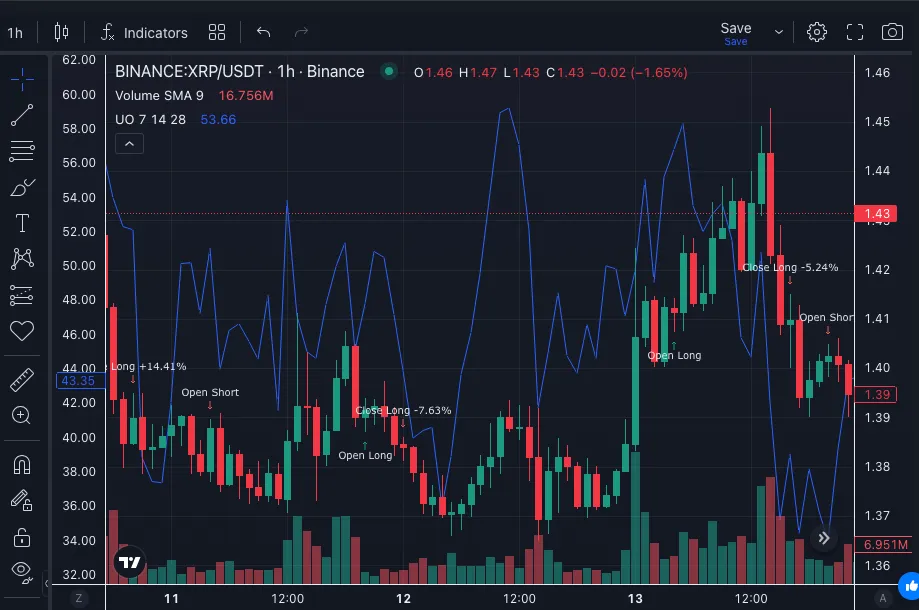
The Ultimate Oscillator is a momentum indicator that combines three different timeframes into a single reading, giving traders a more balanced view of buying and selling pressure. Developed by Larry Williams in 1976 and published in Stocks & Commodities Magazine in 1985, the Ultimate Oscillator was designed to reduce the false signals that plague single-timeframe momentum tools. If you have ever been whipsawed by an RSI or Stochastic signal that reversed immediately, the Ultimate Oscillator addresses that exact problem.
What Is the Ultimate Oscillator?
The Ultimate Oscillator is a bounded momentum indicator that oscillates between 0 and 100, combining short-term, intermediate-term, and long-term price action into one value. Unlike indicators that rely on a single lookback period, the Ultimate Oscillator blends three timeframes — typically 7, 14, and 28 periods — to capture momentum at different speeds simultaneously.
By weighting all three timeframes, the Ultimate Oscillator smooths out the noise that often triggers premature entries on shorter-period oscillators. The result is a more reliable signal that confirms genuine shifts in buying pressure rather than reacting to every minor price fluctuation.
How Is the Ultimate Oscillator Calculated?
The Ultimate Oscillator calculation involves three main steps, all done automatically when you use the indicator block in a visual strategy builder:
- Calculate Buying Pressure (BP): This is the current close minus the lower of the current low or the previous close. It measures how much of the current bar’s range represents buying activity.
- Calculate True Range (TR): The greater of the current high minus current low, the current high minus previous close, or the previous close minus the current low. This establishes the full range of price movement.
- Build three averages: Sum the buying pressure over 7, 14, and 28 periods respectively, then divide each by the corresponding True Range sum. These give you short, medium, and long-term buying pressure ratios.
- Combine with weights: The short-term average gets a weight of 4, the medium-term gets 2, and the long-term gets 1. Add them together, divide by 7 (the sum of the weights), then multiply by 100.
The heavier weighting on the short-term component makes the Ultimate Oscillator responsive to recent price action while the longer components prevent overreaction. According to Investopedia, this multi-timeframe approach is what separates the Ultimate Oscillator from simpler momentum tools.
How to Read Ultimate Oscillator Signals?
The Ultimate Oscillator generates signals primarily through divergence and threshold levels:
Overbought and oversold zones: Readings above 70 indicate overbought conditions, while readings below 30 suggest oversold territory. However, Larry Williams himself cautioned against trading these levels alone — the real power of the Ultimate Oscillator comes from combining them with divergence.
Bullish divergence (buy signal): When price makes a lower low but the Ultimate Oscillator makes a higher low, and the oscillator’s second low is below 30. This suggests that selling pressure is weakening even though price continues to fall.
Bearish divergence (sell signal): When price makes a higher high but the Ultimate Oscillator makes a lower high, and the oscillator’s second high is above 70. This signals that buying pressure is fading despite rising prices.
The three-step confirmation that Williams recommended involves: identifying the divergence, confirming the threshold level is crossed, and then waiting for the oscillator to break its most recent extreme. This disciplined approach filters out many false signals.
What Are the Best Ultimate Oscillator Trading Strategies?
1. Divergence-based reversal strategy: Watch for bullish divergence with the Ultimate Oscillator below 30 to enter long positions, or bearish divergence with the oscillator above 70 to enter short or exit longs. This is the classic Williams approach and works best in ranging or mildly trending markets.
2. Multi-indicator confirmation: Pair the Ultimate Oscillator with a trend-following tool like the MACD or a Bollinger Bands squeeze. When the MACD signals a trend direction and the Ultimate Oscillator confirms with a divergence or threshold cross, the probability of a successful trade increases significantly.
3. Mean reversion with thresholds: In sideways markets, buy when the Ultimate Oscillator drops below 30 and starts rising, then sell when it climbs above 70 and begins falling. Adding a ATR-based stop loss helps manage risk on these trades.
What Are Common Ultimate Oscillator Mistakes to Avoid?
- Trading thresholds without divergence: Simply buying at 30 or selling at 70 produces too many false signals. The indicator was designed to be used with divergence confirmation.
- Using it in strong trends: Like most oscillators, the Ultimate Oscillator can remain overbought or oversold for extended periods during powerful trends. Always check the broader trend context before fading an extreme reading.
- Ignoring the timeframe weighting: The default 7/14/28 periods with 4/2/1 weights were chosen deliberately by Williams. Changing these without backtesting can degrade signal quality.
- Skipping backtesting: Every market behaves differently. What works on Bitcoin 4-hour charts may not work on Ethereum daily charts. Always validate your Ultimate Oscillator settings against historical data before risking real capital.
How to Build Ultimate Oscillator Strategies in Arrow Algo?
Arrow Algo makes it straightforward to add the Ultimate Oscillator to any strategy. In the visual block builder, drag the Ultimate Oscillator indicator block onto your canvas and connect it to your preferred data source — whether that is BTC, ETH, SOL, or any other supported pair. The block automatically calculates the multi-timeframe output and passes it to your condition blocks.
You can set up divergence detection by combining the Ultimate Oscillator output with condition blocks that compare current and previous readings. For a simple threshold strategy, connect the oscillator output to a condition block checking if the value crosses above 30 (buy) or below 70 (sell). Arrow Algo’s AI-assisted builder can also help you configure the parameters and connect blocks if you prefer a guided approach.
Once your strategy is built, backtest it directly against live exchange data from Binance, Coinbase, or HyperLiquid to see exactly how your Ultimate Oscillator rules would have performed historically.
What Are the Key Takeaways?
- The Ultimate Oscillator combines 7, 14, and 28-period momentum into a single 0–100 reading
- It was specifically designed to reduce false signals from single-timeframe oscillators
- The best signals come from divergence combined with overbought (above 70) or oversold (below 30) readings
- Pair it with trend-following indicators like MACD or Bollinger Bands for higher-probability setups
- Always backtest your specific Ultimate Oscillator settings before trading live
- Arrow Algo’s visual builder and AI assistant let you build and test UO strategies without writing any code
Educational disclaimer: This content is for educational purposes only and does not constitute financial advice. Trading involves significant risk and you should only trade with capital you can afford to lose. Past performance is not indicative of future results.
Disclaimer: The information provided in this article is for educational purposes only and does not constitute financial advice. Trading involves significant risk and you should only trade with capital you can afford to lose. Past performance is not indicative of future results. Always conduct your own research before making any trading decisions.
Ready to build your own automated trading strategies without writing a single line of code? Start for free at Arrow Algo and join thousands of traders who’ve made the switch to systematic trading.