
Variable Index Dynamic Average (VIDYA): Complete Guide for Algorithmic Trading
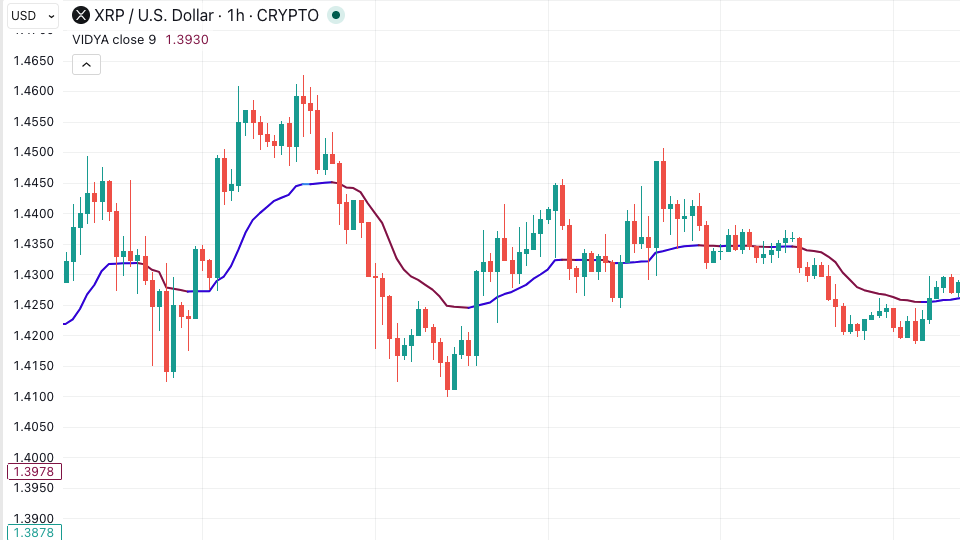
The Variable Index Dynamic Average (VIDYA) is an adaptive moving average that automatically adjusts its speed based on how strongly the market is trending. Developed by Tushar Chande and introduced in Technical Analysis of Stocks and Commodities magazine in 1992, VIDYA uses the Chande Momentum Oscillator as its volatility index. When momentum is strong and directional, VIDYA moves quickly — tracking price closely like a short-period moving average. When momentum is weak and the market is ranging, VIDYA slows almost to a standstill. This self-adjusting behaviour makes the Variable Index Dynamic Average one of the most responsive adaptive indicators available for algorithmic trading.
What Is the Variable Index Dynamic Average?
The Variable Index Dynamic Average is a type of exponential moving average where the smoothing constant changes with each bar rather than staying fixed. A standard EMA applies the same weight to recent prices regardless of whether the market is trending or choppy. VIDYA measures current momentum and uses that reading to decide how much weight to give the latest price. Strong momentum — a high absolute CMO reading — means VIDYA reacts like a fast moving average. Weak momentum — a low absolute CMO reading — means VIDYA barely moves and filters out noise. The result is a moving average that is never too slow in a trend and never too noisy in a range. For a comparison with another adaptive moving average, see our guide on the Kaufman Adaptive Moving Average (KAMA), which achieves a similar goal using the Efficiency Ratio rather than CMO.
How Is the Variable Index Dynamic Average Calculated?
VIDYA builds on two components: the Chande Momentum Oscillator (CMO) and an exponential smoothing formula.
The CMO measures momentum by comparing the sum of upward price changes to the sum of all price changes over a lookback period — typically 9 bars. A high absolute CMO value means price has been moving consistently in one direction. A low absolute CMO value means price has been moving erratically back and forth. VIDYA takes the absolute value of the CMO and divides it by 100 to produce a scaling factor between 0 and 1. When that factor is close to 1, VIDYA moves fast. When it is close to 0, VIDYA moves slow. That scaling factor then feeds into a standard exponential smoothing calculation, blending the current close with the previous VIDYA value. The higher the scaling factor, the more weight goes to today’s close. Investopedia covers the Chande Momentum Oscillator formula in full for those who want to explore the underlying momentum calculation.
How to Read Variable Index Dynamic Average Signals?
VIDYA generates signals through its slope and its relationship to price, not through fixed thresholds.
- Price above a rising VIDYA: The market is in an uptrend with momentum behind it. VIDYA is moving fast because CMO is high. Trend-following long entries align with this setup.
- Price below a falling VIDYA: The market is in a downtrend. Trend-following short entries align with this setup.
- VIDYA flat or barely moving: CMO is low and the market is ranging. VIDYA is applying minimal smoothing and staying almost stationary. This is a signal to avoid trend-following entries and wait for momentum to return.
- Price crossing VIDYA: When price crosses from below to above a rising VIDYA, it signals a bullish momentum entry. When price crosses from above to below a falling VIDYA, it signals a bearish entry. These crossovers carry more weight than EMA crossovers because VIDYA’s speed confirms that momentum is already present.
What Are the Best Variable Index Dynamic Average Trading Strategies?
VIDYA crossover entries: Buy when price crosses above VIDYA while VIDYA is rising. Sell or exit when price crosses below VIDYA while VIDYA is falling. The adaptive nature of VIDYA means this crossover already implies a momentum environment — reducing the false signal rate compared with a standard EMA crossover in choppy conditions.
VIDYA slope filter: Use the direction and steepness of the VIDYA line as a trend filter before any other entry condition. Only take long entries when VIDYA slopes upward. Only take short entries when VIDYA slopes downward. This gates your directional trades inside confirmed trend conditions.
Dynamic support and resistance: In trending markets, VIDYA often acts as a dynamic support level during pullbacks. When price pulls back toward a rising VIDYA and holds, that bounce becomes a trend continuation entry. Use a separate oscillator to time the pullback low within the bounce zone.
VIDYA and RSI combination: VIDYA provides trend direction while RSI provides entry timing on pullbacks. When VIDYA slopes upward, take long entries only when RSI dips to an oversold reading and recovers. This combination avoids chasing extended moves and improves entry quality in trending environments.
What Are Common Variable Index Dynamic Average Mistakes to Avoid?
Expecting consistent lag behaviour: Unlike an EMA which always has the same lag relative to price, VIDYA’s lag changes constantly. In a strong trend it can track very close to price. In a range it can sit far behind. Treat VIDYA as a dynamic tool rather than a fixed reference line.
Taking crossover signals in low-momentum conditions: When the CMO is near zero, VIDYA barely moves. A price crossover of a nearly flat VIDYA carries no directional information. Always check whether VIDYA is actively sloping before acting on a crossover signal.
Using VIDYA alone without a momentum confirmation: VIDYA adapts to momentum but does not independently confirm the strength of a move. Pair it with a volume indicator or a secondary momentum oscillator for higher-confidence signals.
Applying the same lookback period across all timeframes: The CMO lookback drives VIDYA’s sensitivity. A 9-period CMO on a 1-minute chart produces very different results than on a daily chart. Test and calibrate the lookback for the specific asset and timeframe you trade.
How to Build Variable Index Dynamic Average Strategies in Arrow Algo?
Arrow Algo includes the Variable Index Dynamic Average block in its visual indicator library. Drop it onto your strategy canvas and set the CMO lookback period in the block settings. The default of 9 periods is a practical starting point for most crypto pairs on a 4-hour or daily timeframe.
To build a crossover strategy, add a crossover block that compares the close price against the VIDYA output. Set the long entry to trigger when price crosses above VIDYA and the short entry to trigger when price crosses below. Add a slope condition block to filter out crossovers that occur while VIDYA is flat — this removes false signals in ranging conditions. Connect the slope condition to the entry block as a gate: the crossover only triggers a trade when the slope condition confirms directional movement.
To build the VIDYA and RSI pullback strategy, add both a VIDYA block and an RSI block to your canvas. Create a condition that checks: is VIDYA sloping upward? Is RSI below 40 and recovering? When both conditions are true at the same time, trigger a long entry. Arrow Algo’s visual builder connects all of these logic blocks with simple links — no formulas, no programming at any stage.
What Are the Key Takeaways?
- The Variable Index Dynamic Average is an adaptive moving average that speeds up in trending markets and slows in ranging ones
- It uses the absolute value of the Chande Momentum Oscillator to scale its smoothing factor dynamically
- VIDYA crossovers carry more weight than EMA crossovers because momentum is already confirmed when the signal fires
- A flat or barely-moving VIDYA signals a low-momentum, ranging market — avoid trend entries in this condition
- Pair VIDYA with RSI for pullback entries or with volume for breakout confirmation
- Test the CMO lookback period for your specific asset and timeframe before going live
- Arrow Algo’s visual builder lets you build full VIDYA strategies without writing any code
Educational disclaimer: This content is for educational purposes only and does not constitute financial advice. Trading involves significant risk and you should only trade with capital you can afford to lose. Past performance is not indicative of future results.
Disclaimer: The information provided in this article is for educational purposes only and does not constitute financial advice. Trading involves significant risk and you should only trade with capital you can afford to lose. Past performance is not indicative of future results. Always conduct your own research before making any trading decisions.
Ready to build your own automated trading strategies without writing a single line of code? Start for free at Arrow Algo and join thousands of traders who’ve made the switch to systematic trading.