
Variance Over Period (Var): Complete Guide for Algorithmic Trading
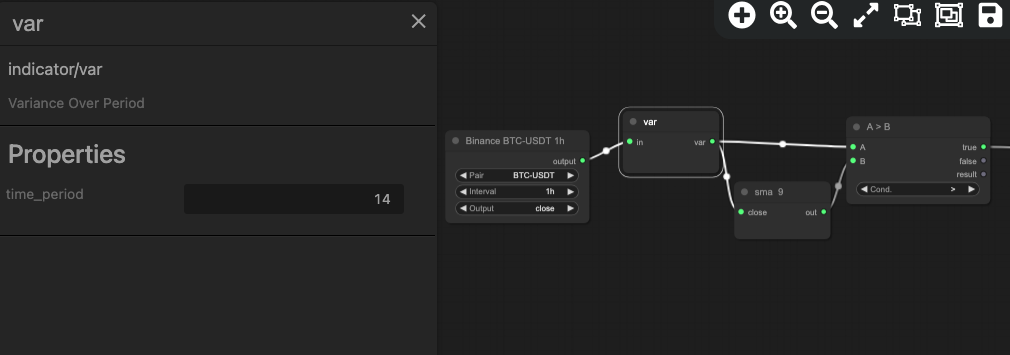
The Variance Over Period, known in Arrow Algo as Var, is a statistical indicator that quantifies how spread out price values are across a defined lookback window. As the mathematical foundation of standard deviation, variance gives algorithmic traders a direct measure of price dispersion — opening the door to volatility-aware strategy design without any coding required.
What Is the Variance Over Period?
Variance Over Period is a statistical measure that calculates how far individual price values deviate from their mean over a set number of candles. A high variance reading means prices have been widely scattered around the average. A low reading means prices have clustered tightly around it.
Variance is the foundation of standard deviation. Standard deviation is simply the square root of variance. While standard deviation is more commonly displayed on charts, working with variance directly gives you the raw dispersion data before the square root transformation — which matters when combining it with other mathematical blocks in a strategy.
In Arrow Algo, the Var block accepts a price series input (typically close) and a period length, then outputs a single numeric value representing the statistical variance of that series over the chosen window.
How Is Variance Over Period Calculated?
The calculation follows four steps, all of which happen automatically inside Arrow Algo’s Var block:
- Calculate the mean (average) price over the period.
- For each price in the window, subtract the mean to find the deviation.
- Square each deviation. This removes negative values so that deviations above and below the mean both contribute positively.
- Average the squared deviations to produce the variance value.
A longer period produces a smoother, slower-moving reading that reflects broader market conditions. A shorter period reacts quickly to recent price activity. Most traders use periods between 10 and 30 for short-to-medium-term analysis. Refer to Investopedia’s variance overview for a deeper look at the underlying mathematics.
How to Read Variance Signals?
Variance does not produce directional buy or sell signals. It tells you about the state of the market — how much volatility is present — rather than which way price will move next.
- Rising variance: Prices are moving further from their average. Volatility is expanding. Momentum and breakout strategies are better suited to this environment.
- Falling variance: Prices are contracting toward the mean. Volatility is compressing. Mean reversion strategies tend to perform better in low-variance conditions.
- Variance spike: A sharp jump often coincides with a major price move or news event. It frequently signals the end of a consolidation phase.
- Sustained low variance: Extended compression often precedes explosive directional moves — a market coiling before it releases energy.
Thresholds are not fixed. A variance level that qualifies as “high” during a calm period may be unremarkable during a volatile one. The most reliable approach is to compare the current reading to its own recent historical range rather than applying an absolute number.
What Are the Best Variance-Based Trading Strategies?
Volatility Regime Filter
Use variance to classify the market as high-volatility or low-volatility, then apply different logic for each regime. When variance is above a moving average of its own value, activate a trend-following approach. When variance drops below that moving average, switch to a mean reversion strategy. This prevents using the wrong strategy type for current conditions — one of the most common causes of drawdown in algorithmic trading.
Variance Breakout Detection
Monitor variance for periods of sustained compression. When it spikes sharply after a prolonged low reading, a directional move is beginning. Combine the variance spike with a price confirmation — such as a close above a recent swing high — to trigger an entry. The spike acts as your early warning that volatility is returning before a conventional breakout signal would fire.
Dynamic Position Sizing
Variance gives you a real-time measure of market dispersion. Use it as an input to your position sizing logic: reduce trade size when variance is elevated and increase it when variance is compressed. This means you take proportionally larger positions when conditions are calmer and smaller ones when the market is behaving erratically.
What Are Common Variance Mistakes to Avoid?
- Treating variance as a direction signal: A rising variance reading is not a buy or sell signal. It tells you the environment is becoming more volatile, nothing more.
- Using fixed thresholds: Hard-coded levels are brittle. What counts as high variance in a calm period may be low in a volatile one. Use relative comparisons — variance versus its own moving average, for example.
- Choosing too short a period: Very short periods (3–5 candles) produce extremely noisy readings and frequent false signals. A minimum of 10–14 periods gives more stable output.
- Ignoring timeframe context: A variance reading that looks elevated on a 5-minute chart may be entirely unremarkable on a daily chart. Always evaluate it within the context of your trading timeframe.
- Stacking multiple variance settings: Running several Var blocks with different periods on the same chart rarely adds value and increases overfitting risk.
How to Build Variance Strategies in Arrow Algo
Arrow Algo’s visual block builder lets you add the Var indicator to any strategy without writing a single line of code. Drag the Var block onto your canvas, connect a price input (close is standard), and set the period using a number block. The output — a single variance value per candle — connects directly to any downstream logic.
Common configurations include:
- Connecting the Var output to a moving average block, then using a comparison block to detect when current variance is above or below its own average — your regime filter is built.
- Feeding variance values into a condition block to toggle between two different entry strategies depending on market state.
- Using variance as a divisor in a position sizing formula — larger variance produces a smaller position, smaller variance allows a larger one.
Once the strategy is built, backtest it across multiple assets and timeframes in Arrow Algo to validate how variance-based signals hold up in different market environments. The closely related Standard Deviation (StdDev) guide is a natural companion to this post. Start building for free at Arrow Algo.
What Are the Key Takeaways?
- Variance Over Period measures how dispersed prices are from their mean over a defined window.
- High variance means volatility is expanding; low variance signals compression.
- It is a state indicator, not a direction indicator — combine it with a signal to generate entries.
- Most effective as a regime filter, breakout confirmation tool, or dynamic position sizing input.
- Use relative comparisons rather than fixed thresholds.
- In Arrow Algo, the Var block connects to any strategy logic through drag-and-drop visual blocks.
Disclaimer: This content is for educational purposes only and does not constitute financial advice. Trading involves significant risk and you should only trade with capital you can afford to lose. Past performance is not indicative of future results. Always conduct your own research before making any trading decisions.
Ready to build your own automated trading strategies without writing a single line of code? Start for free at Arrow Algo and join thousands of traders who’ve made the switch to systematic trading.