
Volume Price Trend (VPT): Complete Guide for Algorithmic Trading
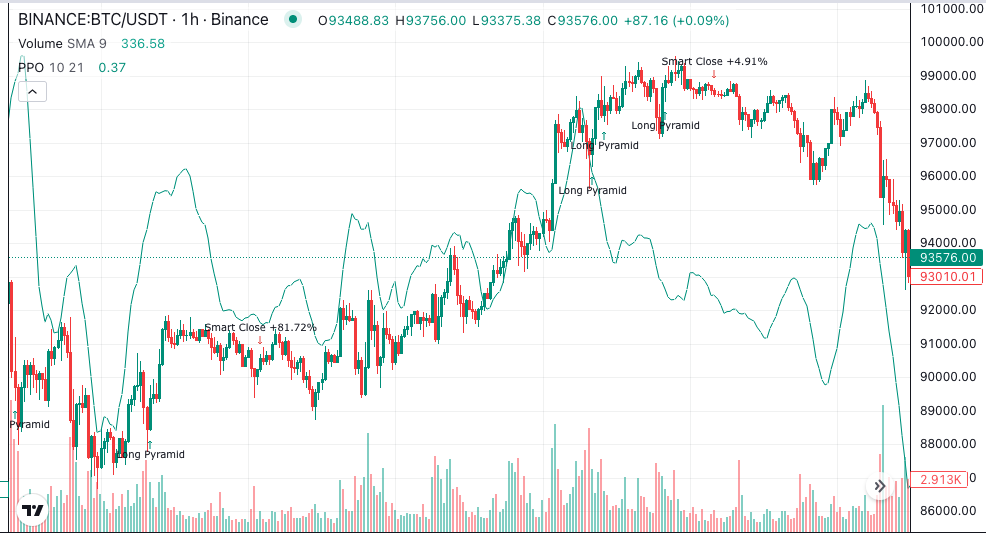
Volume Price Trend (VPT) is a cumulative volume indicator that improves on basic volume analysis by weighting each bar’s volume contribution by the size of the price move behind it. Rather than simply adding or subtracting a fixed volume figure, VPT scales the contribution by the percentage change in price — so a 3% move on high volume has far more impact on the indicator than a 0.1% move on the same volume. The result is a running total that tracks the real balance of buying and selling pressure over time.
What Is the Volume Price Trend Indicator?
Volume Price Trend is a momentum-volume indicator that accumulates over time as new bars are added. Each bar contributes a value equal to the bar’s volume multiplied by the percentage change in closing price from the previous bar. The running total of these contributions forms the VPT line.
VPT shares the same core idea as On-Balance Volume (OBV): accumulate volume in the direction of price movement to reveal underlying buying and selling pressure. The key difference is in precision. OBV treats any up-close bar the same regardless of whether price moved 0.01% or 5% — it adds the full volume either way. VPT scales the contribution by the actual percentage change. A strong move on high volume pushes VPT much further than a weak move on the same volume. This makes VPT more sensitive to the magnitude of price moves, not just their direction.
How Does VPT Track Buying and Selling Pressure?
Each bar’s VPT contribution follows a simple principle: strong up-closes on heavy volume add significantly to the cumulative total. Strong down-closes on heavy volume subtract significantly. Weak moves in either direction — regardless of volume — contribute very little.
The cumulative line rises during periods of genuine accumulation: sustained up-moves on increasing volume where buyers are paying up to acquire the asset. It falls during distribution: sustained down-moves on volume where sellers are accepting lower prices to exit. Flat periods — where volume is high but price is going nowhere — contribute near zero, correctly reflecting that no directional pressure is dominating.
What Do VPT Signals Tell You?
VPT has no fixed upper or lower boundary. Its absolute value carries no intrinsic meaning — the direction and slope of the line are what matter.
- Rising VPT: buying pressure is building. Volume is flowing into the asset in the direction of upward price moves.
- Falling VPT: selling pressure is building. Volume is flowing out of the asset in the direction of downward price moves.
- VPT flat while price rises: the price move lacks volume backing — a potential warning of a weak or unsustainable rally.
- VPT rising while price falls: bullish divergence. Sellers are controlling price but volume is actually supporting buyers underneath — a potential reversal signal.
- VPT falling while price rises: bearish divergence. Price is advancing but the volume flow does not support the move — watch for a reversal or stall.
What Are the Best VPT Strategy Applications?
Trend confirmation: use VPT as a directional filter alongside price-based entry signals. Require VPT to be trending in the same direction as the trade before entry fires. Connect VPT to a moving average or a slope check in Arrow Algo’s condition blocks. Only take long entries when VPT is above its own short-term average — confirming that volume is supporting the upward move.
Divergence-based exits: monitor VPT for divergence from price during open positions. A long position showing price at new highs but VPT making a lower high is a high-conviction warning. Tighten the stop-loss or reduce size before the reversal completes. For a broader view of how volume indicators connect to directional bias, the order flow trading guide covers the underlying framework.
Breakout confirmation: price breakouts on low VPT are more likely to fail than breakouts accompanied by a simultaneous VPT surge. Use VPT confirmation as a secondary condition on breakout strategies to reduce false entries — particularly useful in volatile, thin-volume conditions like holiday trading sessions.
What Mistakes Should You Avoid With VPT?
Treating the absolute value as meaningful: VPT is a cumulative line that starts from an arbitrary zero point. The number itself means nothing across different assets, timeframes, or start dates. Always read VPT in terms of direction and slope relative to recent history — never as a fixed threshold.
Confusing VPT with OBV: both are cumulative volume indicators and often move in similar directions. VPT is more granular because it weights by percentage price change. On strongly trending days they will behave similarly. During choppy markets with large intraday swings, their readings can diverge meaningfully. Use the one that fits your strategy’s sensitivity requirements.
Applying VPT to low-liquidity pairs: on illiquid assets, a single large trade can distort VPT sharply. The indicator works best on liquid pairs with consistent volume participation — major crypto pairs on established exchanges. Always verify that the trading pair you are using has reliable, consistent volume data.
How to Build VPT Strategies in Arrow Algo
In Arrow Algo’s visual block builder, the VPT block takes two inputs: close and volume. Both connect directly from your data watcher block. VPT produces a single cumulative output with no properties to set — the calculation runs automatically from the first available bar.
- Drag the VPT block onto your canvas and connect close and volume from your data watcher
- Add an EMA block connected to the VPT output to create a smoothed reference line
- Add a condition block to check whether VPT is above its EMA — confirming upward momentum in volume flow
- Connect that condition to an AND gate alongside your directional entry signal
- Backtest and compare results with and without the VPT filter to measure its impact on signal quality
Pairing VPT with Chaikin Money Flow provides two complementary views of volume pressure — CMF measures the normalised period reading while VPT reveals the cumulative directional trend. Together they give a richer picture of whether price moves have genuine volume backing.
Key Takeaways
- Volume Price Trend (VPT) is a cumulative indicator that weights each bar’s volume by the percentage price change — not just the direction
- Rising VPT signals accumulation; falling VPT signals distribution; flat VPT on a rising price warns of a weak move
- Divergence between VPT and price is one of the indicator’s most reliable signals — use it for exits and risk reduction
- VPT is more sensitive to the magnitude of price moves than OBV, making it better suited to strategies where move size matters
- The absolute VPT value is meaningless — read direction and slope relative to recent history only
- Use VPT as a confirmation layer on top of a directional signal, not as a standalone trigger
Disclaimer: This content is for educational purposes only and does not constitute financial advice. Trading involves significant risk and you should only trade with capital you can afford to lose. Past performance is not indicative of future results. Always conduct your own research before making any trading decisions.
Ready to build your own automated trading strategies without writing a single line of code? Start for free at Arrow Algo and join thousands of traders who’ve made the switch to systematic trading.