
Weighted Close Price: Complete Guide for Algorithmic Trading
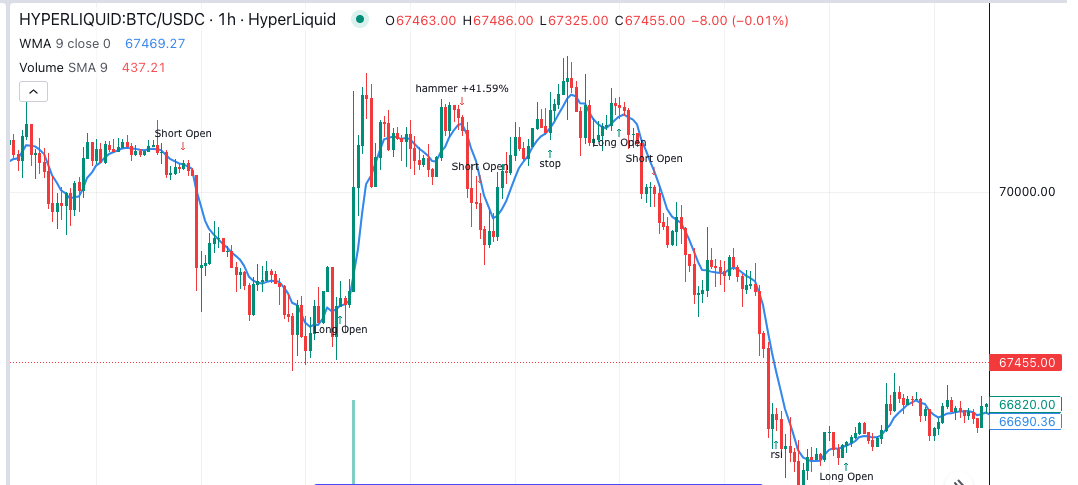
The Weighted Close Price is a price calculation that averages the high, low, and close of each bar — giving the close twice the weight of the other two values. The result is a single number that leans more heavily toward where price settled than where it traveled. This makes the Weighted Close Price indicator a useful tool for systematic traders who want a price input that rewards strong closes and reflects the market’s conviction at the end of each bar.
What Is the Weighted Close Price Indicator?
Weighted Close Price is a composite price measure. It takes the high, the low, and the close — but instead of treating all three equally, it counts the close twice. This gives the final price a stronger directional lean than the Typical Price indicator, which weights all three values equally.
In practical terms: if a bar closes near its high, the Weighted Close will be pulled upward beyond what Typical Price would show. If a bar closes near its low — a sign of selling pressure — the Weighted Close will sit lower. It captures the market’s closing conviction more clearly than a simple average.
Like Typical Price, Weighted Close Price is most commonly used as an input to other indicators rather than as a standalone signal. You can read more about price derivation methods at Investopedia’s guide to Weighted Close.
How Is It Calculated?
The formula is straightforward:
(High + Low + (Close × 2)) ÷ 4
Each bar produces one value. No look-back period is required. The calculation is applied fresh on every candle.
For example: if Bitcoin has a high of $81,000, a low of $78,000, and a close of $80,000, the Weighted Close is ($81,000 + $78,000 + $160,000) ÷ 4 = $79,750.
Compare that to the Typical Price for the same bar: ($81,000 + $78,000 + $80,000) ÷ 3 = $79,667. The Weighted Close is slightly higher because the close of $80,000 is above the midpoint of the range. Had the bar closed at $78,500 — near the low — the Weighted Close would be pulled down, giving a clearer bearish signal.
How to Read Weighted Close Price Signals?
Weighted Close Price does not generate standalone buy or sell signals. It is an input — a smarter way to represent each bar’s price before feeding it into indicators or calculations.
Here is how to interpret it contextually:
Weighted Close near the high of the range: Price closed strongly. The indicator registers a relatively high value. Bullish conviction for that bar.
Weighted Close near the low of the range: Price gave back most of its gains and closed weak. Bearish conviction for that bar.
Weighted Close vs Typical Price: If Weighted Close is consistently above Typical Price, closes have been strong relative to the trading range — a bullish sign. If it is consistently below, closes have been weak — a bearish signal.
Moving average of Weighted Close: Apply a moving average to the Weighted Close series to create a trend line that responds to closing conviction, not just midpoints.
Which Strategies Use It Most Effectively?
1. Weighted Close Moving Average Crossover
Apply a fast and slow moving average to the Weighted Close series — for example, 10-period and 30-period EMAs. Because the close is double-weighted, the resulting crossover is more sensitive to the direction of bar closes than a standard close-based crossover. This can reduce false signals in choppy markets where price traverses a wide range but repeatedly closes near neutral.
2. Weighted Close as a Directional Filter
Use the Weighted Close to confirm entry direction. Before entering a long trade, check that the current Weighted Close is above a moving average of previous Weighted Close values. This ensures you are entering when bars are closing with bullish conviction — not just when price has temporarily spiked above a level.
3. Weighted Close vs Typical Price Divergence
Compare the Weighted Close series directly against the Typical Price series. When Weighted Close consistently exceeds Typical Price, the market is closing in the upper part of its daily range — a sign of sustained buying pressure. When it falls below Typical Price, closes are weak relative to the full range. This divergence can act as a regime indicator for trend strength.
Common Mistakes to Avoid
Treating it as a momentum oscillator. Weighted Close Price has no upper or lower bound. It does not produce overbought or oversold signals. Use it as a price series input, not as a signal oscillator.
Confusing it with Typical Price. The two are related but distinct. Typical Price weights high, low, and close equally. Weighted Close gives the close double weight. The difference is subtle but meaningful — especially in trending markets where close strength is a useful signal.
Applying it without context. A single Weighted Close value tells you nothing useful. Apply a moving average, compare it to a baseline, or use it as an input to another indicator to extract actionable information from the series.
Ignoring candle range. The Weighted Close formula is sensitive to range size. A bar with a very tight range will produce a Weighted Close very close to the actual close. A bar with a wide range will show more differentiation. This is by design — but be aware that range expansion affects the indicator’s behaviour.
How to Build Weighted Close Price Strategies in Arrow Algo?
Arrow Algo includes Weighted Close Price as a native indicator block. You can add it to any strategy in the drag-and-drop visual builder — no coding required.
Here is how to build a directional filter strategy using Weighted Close Price:
- Add a Weighted Close Price block. It automatically outputs the (High + Low + Close × 2) ÷ 4 value for every bar.
- Feed the Weighted Close output into an EMA block (e.g. 20-period) to create a trend baseline.
- Add a condition block: Weighted Close must be above its EMA before any long entry activates. This ensures the market is closing with bullish conviction.
- Connect your main entry signal — for example, an RSI oversold condition — to an AND gate alongside the Weighted Close filter.
- Backtest the combined strategy against real historical data from Binance or Coinbase to measure how much the Weighted Close filter improves signal quality.
You can also compare the Weighted Close block output directly against the Typical Price block output as a regime signal — a useful addition to any strategy that trades based on closing strength.
What Are the Key Takeaways?
- Weighted Close Price is calculated as (High + Low + Close × 2) ÷ 4, giving the close twice the weight.
- It sits between the Typical Price and the plain close — more directional than Typical Price, less extreme than close alone.
- Strong closes push it higher; weak closes pull it lower — making it a useful proxy for bar-level conviction.
- It works best as an input to moving averages, filters, and trend indicators rather than as a standalone signal.
- In Arrow Algo, add the Weighted Close Price block to any strategy using the no-code visual builder.
Disclaimer: This content is for educational purposes only and does not constitute financial advice. Trading involves significant risk and you should only trade with capital you can afford to lose. Past performance is not indicative of future results. Always conduct your own research before making any trading decisions.
Ready to build your own automated trading strategies without writing a single line of code? Start for free at Arrow Algo and join thousands of traders who’ve made the switch to systematic trading.