
Weighted Moving Average (WMA): Complete Guide for Algorithmic Trading
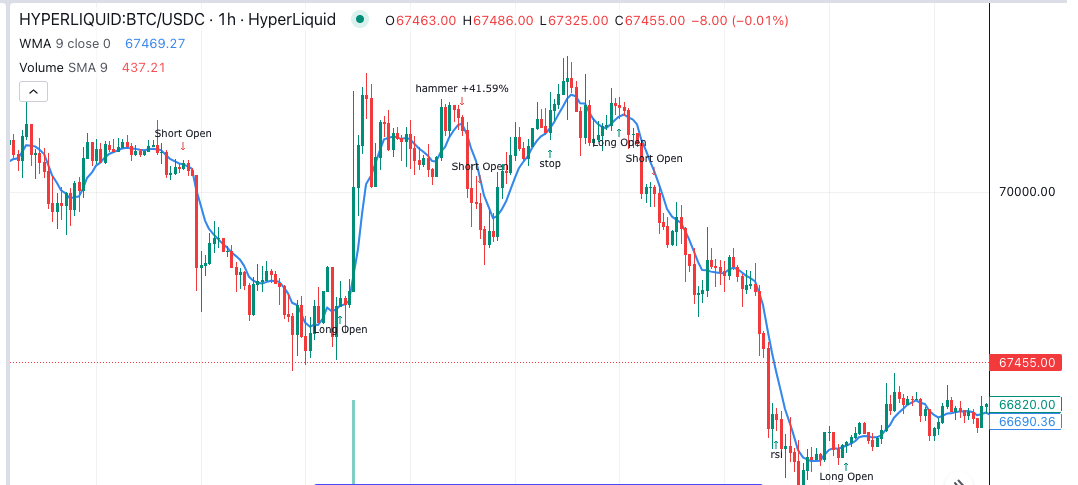
The Weighted Moving Average (WMA) is a trend-following indicator that solves one of the most common criticisms of the Simple Moving Average: treating last month’s price data the same as today’s. The Weighted Moving Average fixes this by giving progressively more importance to recent price bars — making it more responsive to current market conditions without sacrificing the smoothing that makes moving averages useful in the first place.
What Is the Weighted Moving Average?
The Weighted Moving Average is a technical indicator that assigns a higher multiplier to more recent price data and a lower multiplier to older price data within the same lookback period. Unlike the Simple Moving Average (SMA), which weights every candle equally, the Weighted Moving Average treats the most recent price as the most relevant.
In practical terms, this makes the WMA faster to respond to new price movements than the SMA, but smoother than raw price action. That balance — responsiveness without excessive noise — is what makes the Weighted Moving Average a popular choice in systematic trading strategies. It sits between the SMA (slow) and the Exponential Moving Average (EMA), which also weights recent data but uses a different decay formula.
How Is the Weighted Moving Average Calculated?
The Weighted Moving Average is calculated by assigning a numerical weight to each price bar in the lookback period. The most recent bar receives the highest weight, and each preceding bar receives a weight one unit lower.
For a 5-period Weighted Moving Average, the weighting works as follows: the most recent close is multiplied by 5, the one before it by 4, then 3, 2, and 1 for the oldest bar. These weighted values are summed and then divided by the total of all weights — in this case, 5+4+3+2+1 = 15.
The result is a single value that reflects a weighted average of recent prices, with current price carrying the most influence. A longer WMA period (such as 50) produces a smoother, slower line. A shorter period (such as 10) reacts faster but produces more signals — including false ones. Choosing the right period depends on your trading timeframe and strategy type.
How to Read Weighted Moving Average Signals?
Reading a Weighted Moving Average follows the same core logic as any moving average. When price trades above the WMA, the trend is considered upward. When price falls below, the trend is downward. The gap between price and the Weighted Moving Average can indicate how extended or compressed a move is relative to recent history.
Crossover signals are the most widely used application of the Weighted Moving Average. When a short-period WMA crosses above a longer-period WMA, it signals potential upward momentum. When the short-period WMA crosses below, it signals potential downward pressure. Commonly used pairings are 10 and 30 periods or 20 and 50 periods, depending on the timeframe being traded.
Because the Weighted Moving Average reacts faster than the SMA, it tends to generate earlier entry signals — but also more false positives in sideways or choppy conditions. A volume filter is a useful addition to reduce noise.
What Are the Best Weighted Moving Average Trading Strategies?
WMA Crossover Strategy
A short-period Weighted Moving Average crossing above a longer-period WMA signals a potential long entry. A cross below signals a potential short entry or exit. This is one of the simplest Weighted Moving Average strategies and works best in trending markets. The key risk is whipsawing in flat conditions — which is why most traders add a trend filter such as the ADX to confirm the trend is strong enough before acting on a crossover.
WMA and RSI Combination
Combining the Weighted Moving Average with the Relative Strength Index (RSI) adds a momentum confirmation layer. A WMA bullish crossover accompanied by RSI below 70 (not yet overbought) tends to produce higher-quality entries than a crossover where RSI is already extended. The RSI filters out signals where the move has likely exhausted itself.
WMA as Dynamic Support and Resistance
In strongly trending markets, price repeatedly pulls back to the Weighted Moving Average line and bounces. Traders use this as a dynamic support level in uptrends and a dynamic resistance level in downtrends. The WMA acts as a flexible guideline that adapts to recent price behaviour — more useful than a fixed horizontal level during a fast-moving trend.
What Are Common Weighted Moving Average Mistakes to Avoid?
The most costly mistake is applying the Weighted Moving Average in a sideways or ranging market. When there is no trend, WMA crossovers occur frequently and cancel each other out, producing a series of small losses. Always assess whether the market is trending before deploying a moving average strategy.
Using a period that is too short generates excessive noise. A 3-period or 5-period WMA will whipsaw constantly on most timeframes. For most systematic strategies, starting at 10 periods or higher provides a more useful signal-to-noise ratio. From there, backtesting helps identify the optimal period for your specific market and timeframe.
A third common error is ignoring volume. A Weighted Moving Average crossover on low volume is far less reliable than one accompanied by expanding volume. Volume confirms that real buying or selling pressure is behind the move — not just a temporary imbalance.
How to Build Weighted Moving Average Strategies in Arrow Algo?
Arrow Algo includes a dedicated WMA block in its visual strategy builder. Drag the Weighted Moving Average block onto the canvas, set the time period you want, and connect it to a close price output from any Data Watcher block. No code is required at any step.
To build a WMA crossover strategy, use two Weighted Moving Average blocks with different periods, feed both from the same close price source, and connect their outputs to a Crossover block. When the short WMA crosses the long WMA, the Crossover block fires — feed that signal into a Buy or Sell action block and your strategy is complete.
You can layer in additional filters using Arrow Algo’s other indicator blocks. Adding an RSI block for momentum confirmation or an ATR block to set dynamic stop distances takes minutes using the drag-and-drop interface. Once built, run a backtest directly on the platform to see how the strategy performs across historical data before going live.
What Are the Key Takeaways?
- The Weighted Moving Average prioritises recent price data by assigning higher weights to more recent bars — making it more responsive than the Simple Moving Average.
- WMA crossovers and dynamic support/resistance are its two core applications in systematic trading.
- The Weighted Moving Average performs best in trending markets. In sideways conditions it generates noise, so a trend filter is recommended.
- Combining the WMA with volume and momentum indicators improves signal quality and reduces false positives.
- Arrow Algo’s visual builder includes a WMA block — build and backtest Weighted Moving Average strategies without writing any code.
For more on moving averages, see our guides on the Simple Moving Average and the Exponential Moving Average. For a deeper look at how weighted averaging fits into the wider family of technical indicators, Investopedia’s moving averages guide provides useful context. The mathematical foundations of price weighting are also covered in Investopedia’s weighted average explainer.
Educational disclaimer: This content is for educational purposes only and does not constitute financial advice. Trading involves significant risk and you should only trade with capital you can afford to lose. Past performance is not indicative of future results.
Disclaimer: The information provided in this article is for educational purposes only and does not constitute financial advice. Trading involves significant risk and you should only trade with capital you can afford to lose. Past performance is not indicative of future results. Always conduct your own research before making any trading decisions.
Ready to build your own automated trading strategies without writing a single line of code? Start for free at Arrow Algo and join thousands of traders who’ve made the switch to systematic trading.