
Wilder's Smoothing (Wilders): Complete Guide for Algorithmic Trading
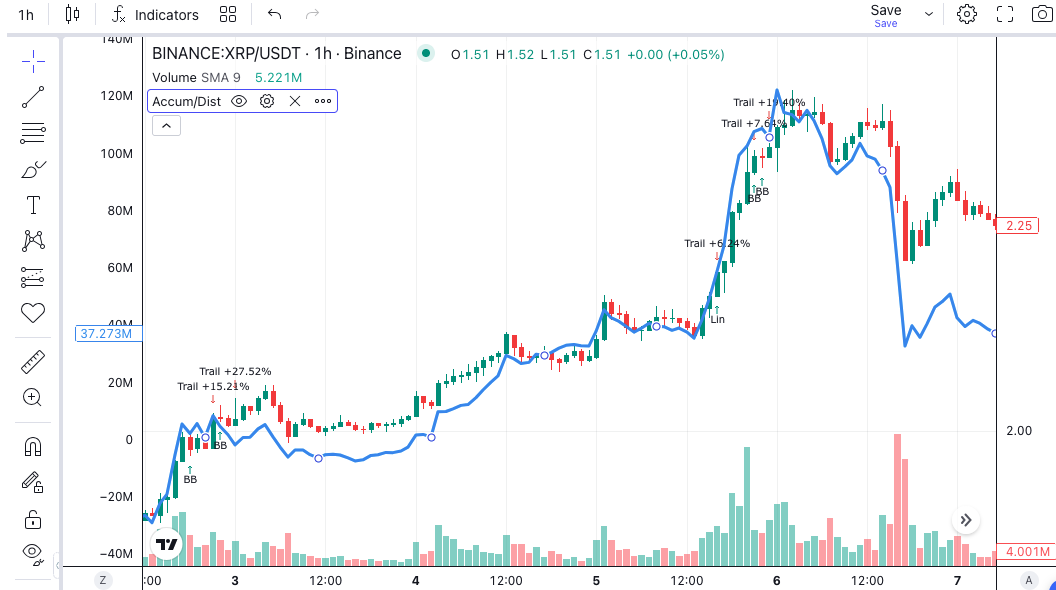
Wilder’s Smoothing is a type of exponential moving average developed by J. Welles Wilder Jr. and introduced in his landmark 1978 book New Concepts in Technical Trading Systems. It is not a standalone chart overlay in the traditional sense — it is the calculation engine running silently inside some of the most widely used indicators in technical analysis, including the RSI, ATR, and ADX. Understanding Wilder’s Smoothing means understanding why those indicators behave the way they do.
What Is Wilder’s Smoothing?
Wilder’s Smoothing — sometimes called the Wilder’s Moving Average or Smoothed Moving Average (SMMA) — applies a specific smoothing factor that makes it react more slowly to recent price changes than a standard exponential moving average of the same period.
The practical result is a cleaner, more stable output line. It filters out short-term noise more aggressively than the EMA. This makes it well suited to two things: trend identification on its own, and as a reliable baseline calculation inside more complex indicators.
Arrow Algo supports Wilder’s Smoothing directly as the wilders block in the visual builder, giving you access to this calculation as a standalone component you can attach to any data stream.
How Is Wilder’s Smoothing Calculated?
The key difference between Wilder’s Smoothing and a standard EMA comes down to the smoothing factor. EMA uses a factor of 2 ÷ (N + 1), where N is your period. Wilder’s uses 1 ÷ N. That single change makes Wilder’s noticeably more sluggish to new information for the same period setting.
Here is how the values build, in plain English:
- Take the simple average of the first N price bars — this becomes the first output value.
- For each subsequent bar, multiply the previous Wilder’s value by (N − 1), add the current bar’s value, then divide the total by N.
A 14-period Wilder’s Smoothing is roughly equivalent in lag to a 27-period EMA. This was a deliberate design choice by Wilder. He wanted a smoother baseline for his indicators — particularly for calculating average gains and losses inside the RSI. The slower response reduces false signals triggered by short-lived price spikes. You can read more about how moving average types compare on Investopedia for additional context on the underlying mathematics.
How to Read Wilder’s Smoothing Signals
On a chart, the Wilder’s line behaves like a slow, steady moving average. There are three main ways to interpret it:
- Direction: A rising line indicates an uptrend. A falling line indicates a downtrend. The slope gives you a cleaner trend read than raw price.
- Price relationship: Price trading above the Wilder’s line is broadly bullish. Price trading below it is broadly bearish. Crossovers in either direction signal a potential trend change.
- Rate of change: A Wilder’s line that starts flattening after a sustained uptrend suggests momentum is fading. A steepening line indicates acceleration.
Because the line is slower than most moving averages, these signals are lower frequency. You will get fewer crossovers than with an EMA — but the ones that do occur tend to carry more weight.
What Are the Best Wilder’s Smoothing Trading Strategies?
Wilder’s Smoothing works best as a component within a broader strategy rather than as a standalone signal generator. Three effective approaches:
Trend Filter
Apply Wilder’s Smoothing on a higher timeframe — daily or 4-hour. Only allow long trades when price is above the Wilder’s line. Only allow short trades when price is below it. This filter removes countertrend entries and keeps your strategy aligned with the dominant direction without adding complexity to your signal logic.
Dual Period Crossover
Use two Wilder’s lines — a shorter period (e.g. 10) and a longer period (e.g. 30). When the short-period line crosses above the long-period line, that is a long signal. When it crosses below, that is a short or exit signal. The slow nature of Wilder’s means crossovers in this setup tend to reflect genuine trend shifts rather than noise — producing fewer but higher-quality signals.
Custom Smoothing for Other Inputs
The wilders block in Arrow Algo is not limited to price. Connect it to volume, the output of another indicator, or a ratio you have calculated. This lets you build a customised smoothed oscillator base — applying Wilder’s known smoothing properties to any data stream your strategy needs.
Common Wilder’s Smoothing Mistakes to Avoid
- Treating it like an EMA: Wilder’s reacts much more slowly. Expecting EMA-speed responses from a 14-period Wilder’s will consistently give you late entries and exits. Either widen your period expectations or switch to EMA where speed matters more than smoothness.
- Applying it to fast timeframes: On 1-minute or 5-minute charts, the additional lag of Wilder’s Smoothing means signals can arrive well after the move has passed. It performs better on hourly or daily charts.
- Using it as the only signal: Like any moving average, Wilder’s generates false signals in choppy, rangebound conditions. Always combine it with a second confirmation — a momentum indicator, a volume filter, or a volatility threshold.
- Double-counting smoothing: Applying Wilder’s Smoothing to an RSI output (which already uses Wilder’s internally) creates a doubly-smoothed value with severe lag. This is rarely useful and easy to do accidentally.
How to Build Wilder’s Smoothing Strategies in Arrow Algo
Arrow Algo’s wilders block applies Wilder’s Smoothing to any connected input with no code required. Here is how to build a basic trend-following strategy using visual blocks:
- Drag the wilders block onto your canvas and connect it to your close price input. Set your period — 14 is Wilder’s own default for most applications, but 10 and 20 both work well depending on timeframe.
- Add a crossover block. Connect price to one input and the Wilder’s output to the other. The crossover block fires when price crosses the Wilder’s line in either direction.
- Route the crossover output into your entry logic. A price crossover above the Wilder’s line triggers a long. A crossover below triggers a short or exit.
- Optionally add a second wilders block with a longer period as a trend filter. Only allow entries in the direction of the longer Wilder’s slope.
- Connect your risk management blocks — stop-loss, take-profit, and position size — to complete the strategy.
Once built, run a backtest in Arrow Algo using live exchange data from Binance, Coinbase, or HyperLiquid. Adjust periods and test across multiple timeframes to find the settings that fit your chosen market. It is also worth exploring how RSI uses Wilder’s Smoothing internally to see exactly how this calculation underpins one of trading’s most popular indicators.
Key Takeaways
- Wilder’s Smoothing uses a 1/N factor — slower than a standard EMA of the same period
- It is the internal smoothing mechanism inside RSI, ATR, and ADX
- A 14-period Wilder’s is equivalent in lag to roughly a 27-period EMA
- Best used as a trend filter or within multi-indicator setups — not as a sole entry signal
- The slower response reduces noise and false signals but increases lag — balance these based on your timeframe
- Arrow Algo’s wilders block lets you apply Wilder’s Smoothing to any input stream with drag-and-drop blocks
Disclaimer: This content is for educational purposes only and does not constitute financial advice. Trading involves significant risk and you should only trade with capital you can afford to lose. Past performance is not indicative of future results. Always conduct your own research before making any trading decisions.
Ready to build your own automated trading strategies without writing a single line of code? Start for free at Arrow Algo and join thousands of traders who’ve made the switch to systematic trading.