
Acceleration Bands Breakout Strategy: How to Build It in Arrow Algo
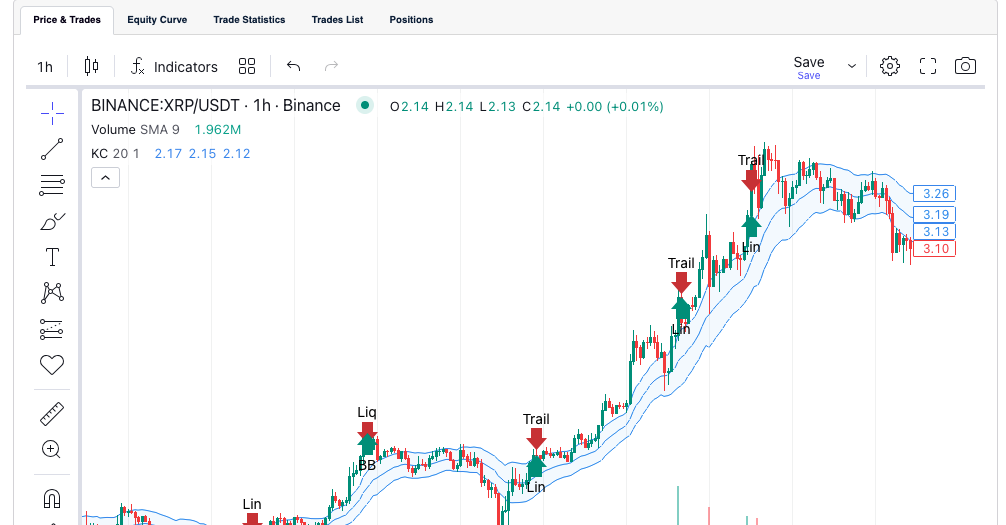
An Acceleration Bands breakout strategy buys the moment a market starts moving faster than its own recent range. That is the whole idea. Most channel indicators ask whether price is stretched. Acceleration Bands ask whether the move is accelerating. Price Headley built them for exactly one purpose: catching the start of a sharp move and staying in it until the pace slows. Our Acceleration Bands guide explained how the bands are drawn. This post turns them into a breakout rule set you can backtest on live exchange data without writing code.
Why Do Acceleration Bands Suit Breakouts?
The bands are built from the high-low range of each candle, scaled by that candle’s price. A wide-range candle pushes its band further out. A narrow one pulls it in. The result is a channel that tracks how much price is travelling, not how far it has drifted from a mean.
That changes what a touch means. When price closes outside a Bollinger Band, the usual reading is “too far, expect a snap back”. When price closes outside an Acceleration Band, the reading is “moving faster than the last 20 candles could contain”. One is a mean-reversion cue. The other is a momentum cue.
Headley’s original rule leans into that. Buy after two consecutive closes above the upper band. Sell after two consecutive closes below the lower band. Exit when price closes back inside the channel. There is no target. The trade ends when the acceleration does. The general logic of breakout trading is the same. The band just supplies the trigger.
How Should the Entry Be Defined?
A breakout rule lives or dies on its definition of “outside”. Three choices matter.
Close or wick. Headley uses closes. A wick above the band is noise. A close above it is commitment. Using closes means the signal arrives one candle later. It also removes most of the false triggers. Every backtest we have seen on crypto pairs favours the close.
One candle or two. The classic rule wants two consecutive closes outside. That halves the number of signals and cuts whipsaws hard. On a 4-hour chart it costs you four to eight hours of entry. On a daily chart it costs a day. The trade-off is worth testing both ways on your pair and timeframe.
Which band. Longs trigger on the upper band. Shorts trigger on the lower band. A long-only version is simpler and suits spot accounts. The short side works on perpetual contracts, where funding costs need including in the backtest.
Write the entry down as a sentence before building anything. “Buy when the close is above the upper Acceleration Band for two candles in a row.” If you cannot state it that plainly, the blocks will not be able to either.
Three Acceleration Bands Breakout Strategies to Test
The pure Headley rule
Entry: two consecutive closes above the 20-period upper band. Exit: first close back below the upper band. Nothing else. This is the baseline. Run it first so every filter you add later has something to beat. Expect a low win rate, around 35 to 45 percent, with a handful of large winners carrying the result. That shape is normal for a momentum system.
Headley with a trend filter
Add a 100-period EMA. Only take longs when the close is above it. Only take shorts when the close is below it. This removes counter-trend breakouts, which are the ones most likely to fail. It will also skip the first leg of a new trend, because the EMA has not turned yet. In most backtests the filter trades fewer times and keeps more of what it makes.
Breakout with an ATR exit
Keep the Headley entry. Replace the “close back inside the band” exit with an ATR trailing stop set at 3 times the 14-period ATR. The band exit is quick and gives back little. The ATR stop is slower and rides longer trends. Which is better depends on the pair. Fast, choppy pairs favour the band exit. Pairs that trend for weeks favour the ATR stop. Backtest both and compare the average winner, not just the total return.
What Settings Should You Start With?
The band period defaults to 20. Shorter periods produce tighter bands and more signals. Longer periods produce fewer signals of higher quality. On crypto, 20 on the 4-hour and daily charts is a sensible start. Avoid going below 10. At that point the bands react to single candles and the breakout becomes a coin flip.
The band multiplier in Headley’s formula is fixed at 4. Some platforms expose it. If yours does, resist tuning it. Every extra parameter is another chance to overfit. The confirmation count, one close or two, is a far more useful knob.
Timeframe is the biggest lever. On a 15-minute chart the bands breathe constantly and the two-close rule still produces several signals a day. On the daily chart a signal might arrive twice a month. Match the timeframe to how often you want to trade, then test the settings on that timeframe only.
Where Does an Acceleration Bands Breakout Strategy Fail?
Ranging markets. This is the big one. In a sideways market, price closes above the band, closes back inside, and the strategy loses a small amount each time. Twenty of those add up. A trend filter or an ADX threshold above 20 keeps the strategy out of the chop.
Gaps and news candles. A single enormous candle pushes its own band out so far that the next candle closes back inside. The two-close rule never completes. The strategy misses the move entirely. There is no fix for this. Accept it as the cost of the confirmation rule.
Late exits on reversals. The band exit waits for a close back inside the channel. On a sharp reversal that can be well below the entry. Pairing the band exit with a fixed stop at 2 ATR below entry caps the damage on the trades that reverse immediately.
Overfitting the period. Scanning periods from 5 to 50 and picking the best is the fastest way to a backtest that fails live. Pick 20, test it on five pairs, and only change it if all five agree.
How to Build an Acceleration Bands Breakout Strategy in Arrow Algo
Arrow Algo’s visual builder has an Acceleration Bands block with upper, middle and lower outputs. The pure Headley rule needs five blocks.
- Add the Acceleration Bands block and set the period to 20.
- Add a Lag block on the close and on the upper band, each lagged by one candle. This gives you the previous candle’s values.
- Add two condition blocks. One checks that the current close is above the current upper band. The other checks that the lagged close is above the lagged upper band.
- Connect both conditions to a condition block set to AND. That is your two-consecutive-closes entry.
- Add a third condition block that checks the close is below the upper band. Connect it to your exit order block.
For the trend-filter version, add an EMA block set to 100 and a condition that the close is above it. Feed that into the AND alongside the two breakout conditions. For the ATR exit, swap the exit condition for the TrailingStop block with an ATR input, as described in our ATR trailing stop strategy post.
Backtest on at least two years of data and more than one pair. Check the number of trades. A breakout system with 30 trades in two years has not been tested yet.
Points to Take Into the Backtest
- Acceleration Bands measure the pace of a move, not its distance from a mean. A close outside the band is a momentum signal.
- The classic rule needs two consecutive closes outside the band to enter and one close back inside to exit.
- Use closes, not wicks. The lag is worth the reduction in false triggers.
- Run the bare rule first. Then add a trend filter and compare.
- Ranging markets are the enemy. An EMA or ADX filter keeps the strategy on the sidelines when there is no trend to catch.
- Build it in Arrow Algo with the Acceleration Bands, Lag and condition blocks, then test on several pairs before trusting any single result.
Disclaimer: This content is for educational purposes only and does not constitute financial advice. Trading involves significant risk and you should only trade with capital you can afford to lose. Past performance is not indicative of future results. Always conduct your own research before making any trading decisions.
Ready to build your own automated trading strategies without writing a single line of code? Start for free at Arrow Algo and join thousands of traders who've made the switch to systematic trading.