
Accumulation Distribution Line (A/D): Complete Guide for Algorithmic Trading
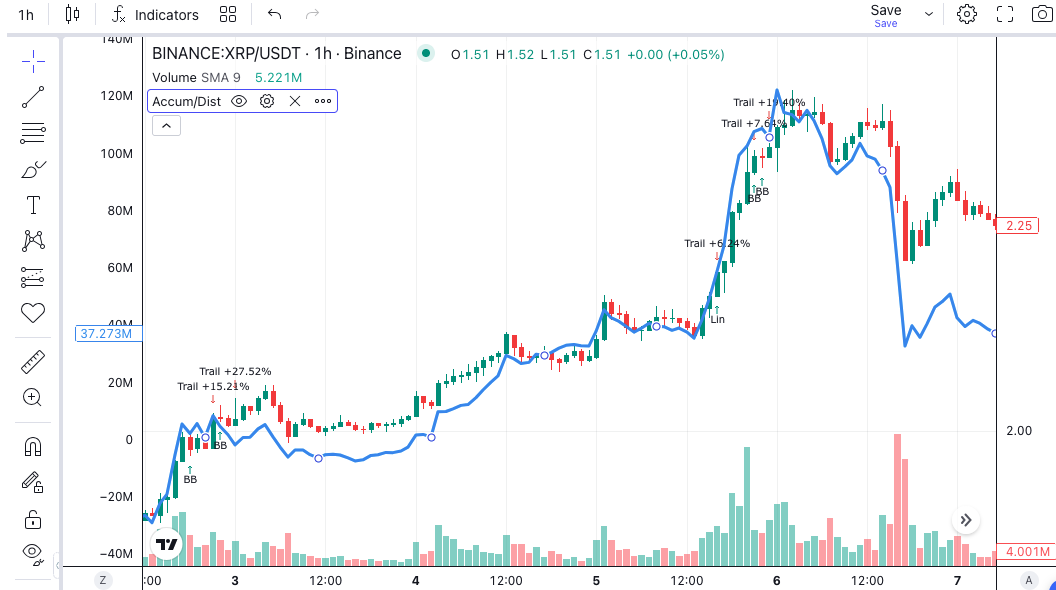
The Accumulation Distribution Line is one of the most powerful volume-based indicators available to algorithmic traders, yet it remains underused compared to more popular tools like RSI or MACD. Developed by Marc Chaikin in the 1980s, this indicator reveals whether a market is being accumulated (bought) or distributed (sold) by analysing the relationship between price and volume. For systematic traders looking to confirm trends and spot reversals before they happen, the A/D Line deserves a permanent place in your trading toolkit.
What Is the Accumulation Distribution Line?
The Accumulation Distribution Line is a cumulative volume-based indicator that measures the flow of money into and out of an asset by combining price action and trading volume. Unlike indicators that rely solely on closing prices, the A/D Line examines where the close falls within the high-low range of each period, then weights that position by volume. The core idea is straightforward: if an asset closes near its high on strong volume, money is flowing in — that is accumulation. If it closes near its low on heavy volume, money is flowing out — that is distribution.
The result is a running total that rises when buying pressure dominates and falls when selling pressure takes over. Because it is cumulative, the Accumulation Distribution Line creates a flowing line on your chart that you can compare directly against price action to spot confirmations and divergences. This makes it particularly useful for traders who want to understand the conviction behind a price move rather than just the move itself.
How Is the Accumulation Distribution Line Calculated?
The calculation behind the Accumulation Distribution Line involves two key components: the Money Flow Multiplier and the Money Flow Volume. Understanding these steps in plain terms helps you interpret what the indicator is actually telling you.
Step 1: The Money Flow Multiplier. This value measures where the closing price sits relative to the high-low range of the period. If the close equals the high, the multiplier is +1. If the close equals the low, the multiplier is -1. A close right in the middle produces a multiplier of zero. In simple terms, the closer the price finishes to the top of its range, the more bullish the reading.
Step 2: Money Flow Volume. The Money Flow Multiplier is then multiplied by the period’s total volume. This gives each candle a volume value that is either positive (accumulation) or negative (distribution), weighted by how strongly the close favoured buyers or sellers.
Step 3: The Cumulative Line. Each period’s Money Flow Volume is added to a running total. That running total is the Accumulation Distribution Line itself. Because it is cumulative, the absolute value matters less than the direction and shape of the line over time.
You never need to perform these calculations manually. The important takeaway is that the A/D Line gives more weight to candles where price closes near its high or low on strong volume, and less weight to candles with indecisive closes or thin volume.
How to Read Accumulation Distribution Line Signals?
Reading the Accumulation Distribution Line effectively comes down to three core techniques: divergence analysis, trend confirmation, and volume conviction assessment.
Bullish divergence occurs when price makes a lower low but the A/D Line makes a higher low. This suggests that despite falling prices, buying pressure is quietly increasing — a potential reversal signal. Bearish divergence is the opposite: price reaches a higher high while the A/D Line prints a lower high, indicating distribution is happening beneath the surface of an uptrend.
For trend confirmation, you want the Accumulation Distribution Line moving in the same direction as price. A rising price accompanied by a rising A/D Line confirms that volume supports the uptrend. A falling price with a falling A/D Line confirms genuine selling pressure. When both align, the trend is more likely to continue.
Volume conviction is where the A/D Line adds nuance that raw volume bars cannot. A sharp rise in the indicator tells you that closes are consistently landing near period highs on strong volume. A flat A/D Line during a price rally warns you that volume is not confirming the move — a red flag for sustainability.
What Are the Best Accumulation Distribution Line Trading Strategies?
Here are three practical strategies that algorithmic traders can build around the A/D Line.
1. Divergence Trading. Monitor for bullish or bearish divergences between the Accumulation Distribution Line and price. When a bullish divergence forms after a sustained downtrend, it can signal an entry opportunity. Pair this with a support level or a secondary indicator like RSI dropping below 30 to filter for higher-probability setups. For bearish divergences, look for resistance zones where distribution is increasing despite rising prices.
2. Trend Confirmation with Moving Averages. Combine the A/D Line with a simple moving average crossover strategy. Only take long signals from your moving average crossover when the Accumulation Distribution Line is rising, confirming that volume supports the bullish move. Only take short signals when the A/D Line is falling. This filter eliminates many false crossover signals that occur during low-conviction moves. According to Investopedia, combining the A/D Line with trend-following tools significantly improves signal reliability.
3. A/D Line and OBV Confirmation. The On Balance Volume (OBV) indicator is a close cousin of the A/D Line, but it uses a simpler calculation that only considers whether the close was up or down. When both the A/D Line and OBV agree on direction, the volume signal is especially strong. If the A/D Line is rising but OBV is flat, the mixed reading suggests caution. Using both together as a volume confirmation filter adds a layer of robustness to any strategy.
What Are Common Accumulation Distribution Line Mistakes to Avoid?
Ignoring the broader trend. The A/D Line works best as a confirmation or divergence tool within context. Using it in isolation without considering the overall market trend leads to premature entries and false signals.
Over-relying on small divergences. Not every minor divergence leads to a reversal. Small, short-lived disagreements between price and the Accumulation Distribution Line are common and often meaningless. Focus on divergences that develop over multiple candles and across significant price swings.
Confusing the absolute level with direction. Because the A/D Line is cumulative, its absolute value carries no inherent meaning. What matters is whether it is rising, falling, or diverging from price. A high A/D Line value does not mean an asset is overbought.
Using it on low-volume assets. The indicator depends entirely on volume data. On thinly traded assets, the A/D Line can produce erratic and unreliable readings. Stick to liquid markets where volume data is meaningful.
Neglecting gaps. The A/D Line does not account for gaps between periods. In markets that gap frequently, the indicator can misrepresent actual buying or selling pressure during the gap itself.
How to Build Accumulation Distribution Line Strategies in Arrow Algo?
Arrow Algo makes it simple to build strategies using the Accumulation Distribution Line without writing a single line of code. In the visual block builder, you can drag and drop the “ad” indicator block directly onto your strategy canvas. This block automatically calculates the A/D Line from your chosen asset’s price and volume data.
To create a divergence strategy, connect the ad block’s output to condition blocks that compare the A/D Line’s direction against price direction. For trend confirmation, wire the ad block alongside a moving average block and use logic blocks to ensure both agree before triggering a trade. You can combine the ad block with the OBV block to build the dual-volume-confirmation strategy described above — all through drag-and-drop, no programming required.
Once your strategy is built visually, you can backtest it directly on live historical exchange data from Binance, Coinbase, HyperLiquid, and other supported exchanges. Arrow Algo pulls data directly from the exchange, so you are always testing against real market conditions. Refine your block parameters, adjust your conditions, and iterate until your backtest results meet your standards — then deploy your strategy to run automatically, 24/7.
What Are the Key Takeaways?
- The Accumulation Distribution Line is a cumulative, volume-weighted indicator that tracks money flow by analysing where price closes within its high-low range.
- Bullish and bearish divergences between the A/D Line and price are among its most valuable signals for spotting potential reversals.
- The indicator is most effective when used for trend confirmation alongside tools like moving averages, OBV, or RSI.
- Focus on the direction of the A/D Line, not its absolute value — rising means accumulation, falling means distribution.
- Avoid using the Accumulation Distribution Line on low-volume assets where the data is unreliable.
- In Arrow Algo, the “ad” indicator block lets you build and backtest A/D Line strategies visually with no coding required.
- Always backtest thoroughly on real historical data before deploying any strategy to live markets.
Educational disclaimer: This content is for educational purposes only and does not constitute financial advice. Trading involves significant risk and you should only trade with capital you can afford to lose. Past performance is not indicative of future results.
Disclaimer: The information provided in this article is for educational purposes only and does not constitute financial advice. Trading involves significant risk and you should only trade with capital you can afford to lose. Past performance is not indicative of future results. Always conduct your own research before making any trading decisions.
Ready to build your own automated trading strategies without writing a single line of code? Start for free at Arrow Algo and join thousands of traders who’ve made the switch to systematic trading.