
Multi-Timeframe Analysis: Trade with Full Context
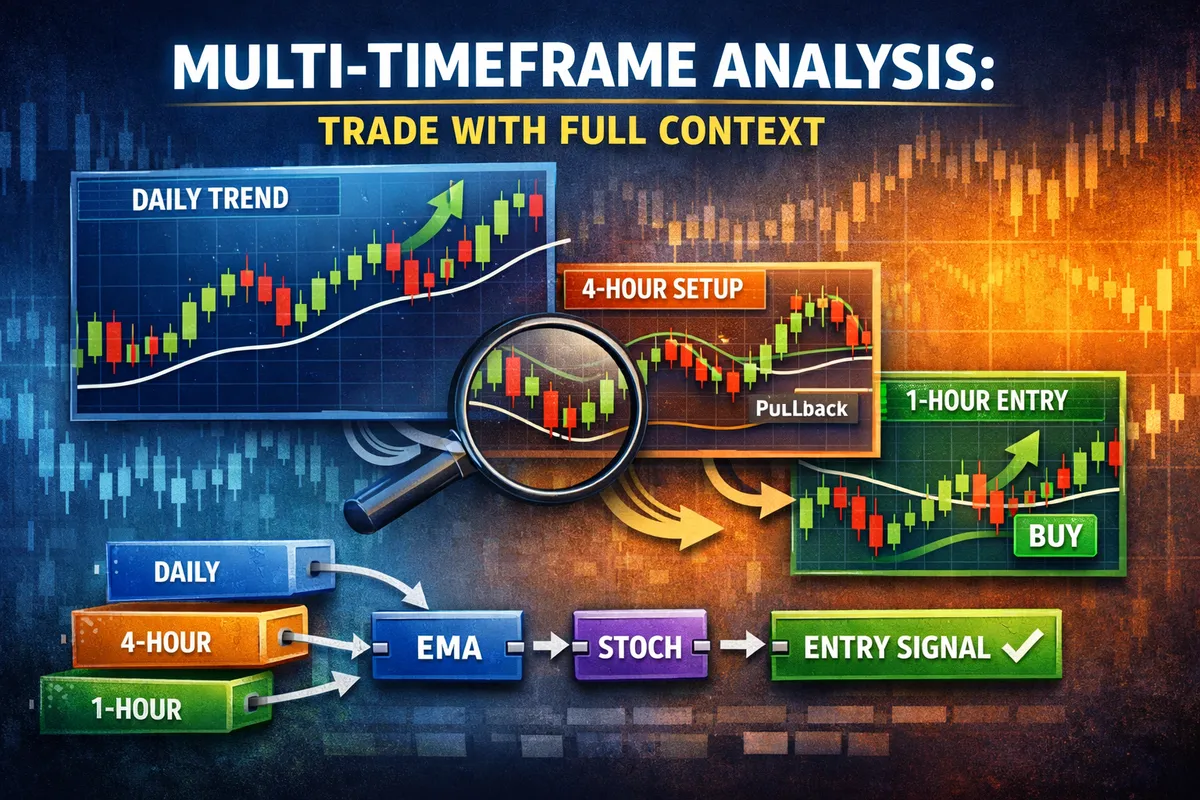
Multi-timeframe analysis is one of the most powerful techniques available to systematic traders who want to see the full picture before placing a trade. Rather than relying on a single chart interval, this approach layers multiple timeframes together to confirm trends, filter noise, and time entries with precision. In this guide, we break down exactly how it works and how you can build multi-timeframe strategies using visual blocks in Arrow Algo.
What Is Multi-Timeframe Analysis?
Multi-timeframe analysis is a trading technique where you examine the same asset across two or more chart intervals to build a more complete view of price action. For example, you might check the daily chart to identify the dominant trend, then switch to the 4-hour chart to find a pullback, and finally use the 1-hour chart to pinpoint your entry. Each timeframe reveals different information. Higher timeframes show the big-picture direction, while lower timeframes expose short-term momentum and precise turning points. By combining these layers, you make decisions based on context rather than a single snapshot.
Why Does Multi-Timeframe Analysis Matter?
Trading on a single timeframe is like reading one chapter of a book and guessing the plot. Here is why adding more timeframes transforms your results:
- Reduces false signals. A buy signal on the 15-minute chart means very little if the daily trend is pointing firmly downward. Checking the higher timeframe first filters out trades that fight the dominant direction.
- Aligns entries with the bigger trend. Trend following strategies become far more effective when you confirm the trend on a higher interval before entering on a lower one.
- Improves entry timing. Once the higher timeframe confirms direction, the lower timeframe lets you wait for a pullback or momentum shift, giving you a tighter stop-loss and better risk-reward.
- Builds confidence. When two or three timeframes agree, you have convergence. Convergence reduces second-guessing and keeps your trading systematic.
How to Choose Your Timeframes
The most common mistake is picking timeframes that are too close together, like the 5-minute and 10-minute charts. When intervals overlap too much, they show almost identical information and add no real value. A widely used guideline is the rule of 4-6x. Each timeframe should be roughly four to six times larger than the next one down. This creates enough separation to reveal genuinely different market structure. Here are popular combinations for different trading styles:
- Scalping: 1-hour trend, 15-minute setup, 1/5-minute entry
- Day trading: 4-hour trend, 1-hour setup, 5/15-minute entry
- Swing trading: Weekly trend, daily setup, 1/4-hour entry
- Position trading: Monthly trend, weekly setup, daily entry
Stick to two or three timeframes. More than that leads to conflicting signals and hesitation. According to Investopedia’s guide on trading timeframes, three is the sweet spot for most traders.
What Are Common Multi-Timeframe Trading Strategies?
Top-Down Analysis
Top-down analysis starts with the highest timeframe and works downward. You identify the trend on the weekly or daily chart first. Then you look for setups on the intermediate timeframe. Finally, you fine-tune entries on the lowest timeframe. This approach ensures every trade flows in the direction of the dominant trend.
The Triple Screen Method
Developed by Dr. Alexander Elder, the triple screen method uses three timeframes as filters. The first screen identifies the long-term trend using a trend-following indicator like MACD or an EMA crossover. The second screen spots corrections against that trend using an oscillator like RSI or Stochastic. The third screen is for timing the entry, often with a trailing stop or breakout trigger. Each screen acts as a gate. A trade must pass all three before execution.
Higher-Timeframe Filter
This is the simplest approach. You add a single condition from a higher timeframe to your existing strategy. For example, if your strategy generates buy signals on the 1-hour chart, you add a filter that only allows those signals when the EMA on the 4-hour chart is sloping upward. That one extra layer can dramatically reduce losing trades by keeping you on the right side of the bigger trend.
What Are Common Mistakes with Multi-Timeframe Analysis?
- Analysis paralysis. Watching five or six timeframes at once creates confusion. Each chart tells a slightly different story, and you end up frozen. Keep it to three timeframes maximum.
- Conflicting signals across timeframes. Sometimes the daily chart says buy while the 4-hour chart says sell. The solution is hierarchy. Always give priority to the higher timeframe. If there is genuine conflict, the disciplined move is to stay flat and wait for alignment.
- Overcomplicating the setup. Stacking five indicators on each of three timeframes gives you fifteen signals to interpret. Simplicity wins. Use one indicator per timeframe or one indicator across all three.
- Ignoring the entry timeframe. Some traders confirm the trend on the higher timeframe but then enter recklessly on the lower one. The lower timeframe still needs a defined trigger, whether that is a support bounce, a candle pattern, or an RSI reversal from oversold.
How to Build Multi-Timeframe Strategies in Arrow Algo
Arrow Algo makes multi-timeframe analysis straightforward because the visual block builder supports multiple data intervals in a single strategy. Here is how it works:
- Add multiple Data Watcher blocks. Drag a Data Watcher block onto the canvas for each timeframe you need. Set one to the daily interval, another to 4-hour, and a third to 1-hour. Each block pulls live candle data from the exchange at its own interval.
- Attach indicator blocks to each timeframe. Connect an EMA block to your daily Data Watcher and a Stochastic block to your 1-hour Data Watcher. Each indicator calculates on its own timeframe automatically.
- Use Condition blocks to compare across timeframes. Build a condition that checks whether the daily EMA is rising AND the 1-hour Stochastic is oversold. Both conditions must be true before the strategy triggers a buy signal.
- Set your execution blocks. Once the multi-timeframe conditions align, the signal flows into your order block. No code, no scripting. Just visual connections between blocks.
Because everything is drag-and-drop, you can experiment rapidly. Swap the 4-hour timeframe for a 2-hour. Replace RSI with ADX. Backtest each variation against real exchange data to see which combination of timeframes and indicators performs best for your chosen asset.
What Are the Key Takeaways?
- Multi-timeframe analysis means examining the same asset on two or three chart intervals to get a complete view of trend, setup, and entry.
- Use the rule of 4-6x to space your timeframes far enough apart that each one adds unique information.
- Always give the higher timeframe priority. It sets the direction; lower timeframes handle timing.
- Stick to three timeframes maximum to avoid analysis paralysis and conflicting signals.
- The triple screen method and higher-timeframe filters are proven strategies you can implement today.
- Arrow Algo’s no-code visual builder lets you combine multiple Data Watcher blocks, indicator blocks, and condition blocks across different intervals, all without writing a single line of code.
Educational disclaimer: This content is for educational purposes only and does not constitute financial advice. Trading involves significant risk and you should only trade with capital you can afford to lose. Past performance is not indicative of future results.
Disclaimer: The information provided in this article is for educational purposes only and does not constitute financial advice. Trading involves significant risk and you should only trade with capital you can afford to lose. Past performance is not indicative of future results. Always conduct your own research before making any trading decisions. Ready to build your own automated trading strategies without writing a single line of code? Start for free at Arrow Algo and join thousands of traders who’ve made the switch to systematic trading.