
AI Backtesting: Test a Strategy From a Chat Prompt
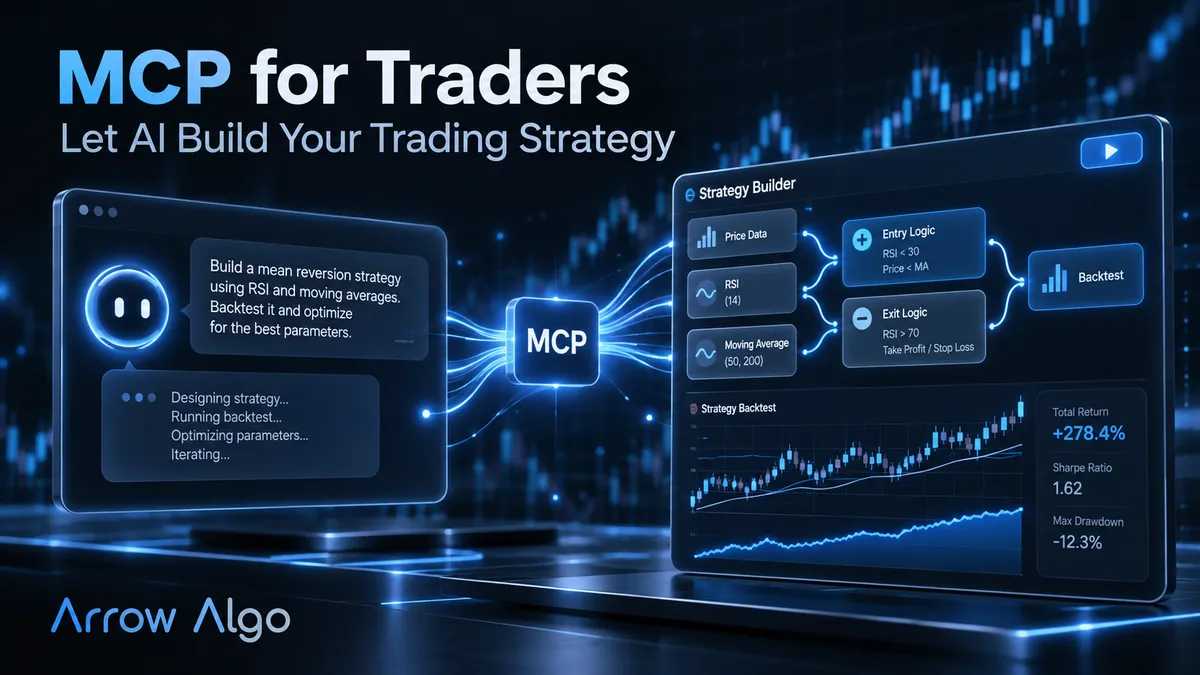
AI backtesting means asking an assistant to run the test and read the report back to you. You type the request in a chat window. The assistant runs the backtest on real exchange data, waits for the result, and tells you what it found. The useful part is not the running. It is the reading, because the assistant can flag weaknesses you would skim past.
This post covers how to phrase the request, what a good reading looks like, and where an AI summary can mislead you.
What Is AI Backtesting?
AI backtesting is the use of an AI assistant to launch a backtest, retrieve the results, and interpret them in plain language. The strategy itself is still a set of rules on a visual canvas. The historical data is still the exchange’s own record. The AI sits between you and those two things as an operator and an analyst.
In Arrow Algo this works through a connector built on the Model Context Protocol. That open standard lets assistants such as Claude, ChatGPT and Grok use outside tools. The connector exposes a small set of actions. One starts a backtest on a named strategy and date range. Another fetches the finished report. The assistant chains them for you.
Nothing about this changes what a backtest is. Investopedia’s definition still applies. The AI just removes the clicking and adds a second pair of eyes.
Why Does AI Backtesting Matter for Retail Traders?
Most traders run a backtest, look at the total return, and stop. The report has twenty other numbers. Few of them get read.
An assistant reads all of them in the same two seconds. It can notice that the Sharpe ratio is fine but the trade count is eleven. It can notice that most of the profit came from one month. It can notice that the maximum drawdown lasted 140 days, which is longer than most people would tolerate.
None of that requires intelligence beyond pattern matching. It requires attention, and attention is what tired traders run out of. The second benefit is speed of iteration. Changing a parameter and re-running by hand takes a few minutes. Asking for it takes one sentence. Our guide on how to build a trading strategy with AI covers the building half of that loop. This post covers the testing half.
Which Words Belong in the Backtest Prompt?
A vague prompt gets a vague test. Four details make the request complete.
- Which strategy. Name it as it appears in your account. If you have three versions, say which one.
- The date range. “January 2024 to June 2026” is clear. “The last couple of years” invites the assistant to pick for you.
- Costs. State the fee and slippage assumptions. If you leave them out, the test may run at zero cost and flatter the result.
- What you want back. “Summarise the headline metrics and tell me the three biggest weaknesses” produces a different answer from “did it make money?”
A prompt that works: “Run the ETH mean-reversion scenario from 1 January 2024 to 30 June 2026 with 0.1% fees and 0.05% slippage. Then give me the key metrics and the three things you would worry about most.”
That is one paragraph. It replaces a dozen clicks and a spreadsheet.
Reading the Report Back: What Should the AI Flag?
Ask the assistant to check the report against a short list. These are the items that most often separate a real edge from a lucky curve.
Trade count. Fewer than thirty trades is a thin sample. Fewer than a hundred leaves wide uncertainty around every metric. Our post on backtest sample size explains why.
Profit concentration. If the top three trades account for most of the return, remove them mentally and look again. A strategy that depends on three events is a strategy that depends on luck.
Drawdown shape. Depth is one number. Duration is another. A 20% drawdown that recovers in three weeks is a different experience from a 20% drawdown that lasts five months.
Win rate against average win and loss. A 35% win rate is fine if winners are three times the size of losers. A 70% win rate is a trap if one loss wipes out six wins.
Stability across periods. Ask for performance by quarter or by year. A strategy that made all its money in one regime has not been tested in the others.
A good reading names the specific problem and the specific number. “Trade count is 23, which is too few to trust the Sharpe of 1.8” is useful. “Looks solid overall” is not.
Where Can an AI Reading Mislead You?
The assistant is confident whether or not it is right. Three failure modes deserve a rule each.
It summarises what is there, not what is missing. If the report has no slippage applied, the AI will happily summarise the inflated result. Always ask it to confirm the cost settings before anything else.
It can agree with you. Ask “is this strategy good?” and the answer tends toward yes. Ask “what would make this strategy fail?” and the answer gets sharper. Phrase the request to invite criticism.
It cannot see the chart. A human eye catches a strategy that only trades on Mondays, or that stopped trading entirely in 2025. Ask for the trade list, not just the metrics, and scan the dates yourself.
The fix for all three is the same. Treat the AI reading as a first draft of your own analysis, never as a verdict.
From One Backtest to a Fair Comparison
The real power shows up on the second test. Once the first run is read, ask for a change and a re-run. One change at a time.
“Same test, but with the RSI threshold at 25 instead of 30.” “Same test, but only trade between 08:00 and 20:00 UTC.” “Same test, on BTC instead of ETH.”
After each run, ask the assistant to compare the new report with the previous one and say what moved. Did the trade count fall? Did the drawdown shorten? Did the improvement come from fewer losers or bigger winners?
Five single-change runs, each compared with the last, teach more than one run with five changes. The assistant keeps the bookkeeping. You keep the judgement.
How to Apply AI Backtesting in Arrow Algo
Connect your preferred assistant through the Arrow Algo connector, or use Artemis inside the platform. Then:
- Build or open a strategy on the visual canvas. The blocks are the rules. Confirm they match what you intend.
- Write the backtest prompt with the strategy name, date range, costs and the reading you want.
- Let the assistant run it. It starts the backtest on exchange data and fetches the report when finished.
- Read the flags. Check trade count, profit concentration, drawdown duration and period stability.
- Ask for the trade list and scan it yourself for gaps and clusters.
- Change one thing, re-run, compare. Repeat until the weaknesses are understood, not just hidden.
No code is written. The strategy stays visible as blocks throughout. If a version earns a live run, the user decides whether to deploy it. The rules then send signals to the user’s own exchange account, and the exchange decides whether to execute.
What Are the Key Takeaways?
- AI backtesting lets you launch a test and get the report read back from a single chat prompt.
- Put the strategy name, date range, costs and the reading you want in the prompt.
- Ask the assistant to flag trade count, profit concentration, drawdown duration and stability by period.
- Phrase requests to invite criticism, confirm cost settings, and scan the trade list yourself.
- Iterate one change per run and ask for a comparison each time.
- In Arrow Algo the AI operates the test. The visual blocks remain the strategy, and you remain the judge.
Disclaimer: This content is for educational purposes only and does not constitute financial advice. Trading involves significant risk and you should only trade with capital you can afford to lose. Past performance is not indicative of future results. Always conduct your own research before making any trading decisions.
Ready to build your own automated trading strategies without writing a single line of code? Start for free at Arrow Algo and join thousands of traders who've made the switch to systematic trading.