
Ranging Markets: Algo Strategies That Work
A ranging market strategy requires a fundamentally different approach from trend-following systems. Most traders build their first algorithms around trends. But markets spend significantly more time consolidating than they do trending. Developing a dedicated ranging market strategy can convert a consistent source of losses into a repeatable, systematic edge.
What Is a Ranging Market?
A ranging market — sometimes called a sideways market or a consolidating market — is one where price moves back and forth between a defined upper boundary (resistance) and a lower boundary (support). Price oscillates within a zone without establishing a clear directional trend. It tests the top of the range, gets rejected, falls toward the bottom, bounces, and repeats.
Ranging markets appear across all timeframes and all asset classes, including crypto markets. They are not a sign that something is wrong with the market. They represent normal price consolidation between larger directional moves.
Why a Ranging Market Strategy Matters for Algorithmic Traders
Research across crypto and equity markets consistently shows that prices are in a trending phase only 20–30% of the time. That means markets are ranging or consolidating for the remaining 70–80% of candles. If your algorithmic strategy is built purely for trending conditions, it is statistically likely to lose money most of the time.
Trend-following strategies — moving average crossovers, momentum systems, breakout entries — generate their best returns when price is directional. In a ranging market, those same strategies produce repeated false breakouts. They buy at resistance and sell at support, taking small losses over and over until a trend eventually forms.
A dedicated ranging market strategy — or a regime filter that detects when you are in a range and pauses trend-following logic — can dramatically improve overall system performance.
What Is the Best Ranging Market Strategy?
Mean Reversion
Mean reversion is the foundation of most ranging market strategies. In a ranging market, price tends to return to its average after moving too far in either direction. A mean reversion strategy buys when price drops toward the lower boundary of the range and sells when it approaches the upper boundary. The take-profit is set near the opposite edge of the range, and a stop-loss sits just outside to protect against breakouts.
Oscillator-Based Entry Signals
Oscillators excel in ranging markets because they identify overbought and oversold conditions within a bounded price zone. RSI, Stochastic, and CCI are particularly effective here. A typical setup enters long when RSI drops below 30 (oversold at the lower boundary) and exits when it rises above 70 (overbought near the upper boundary). The same logic applies in reverse for short entries.
Bollinger Band Range Strategies
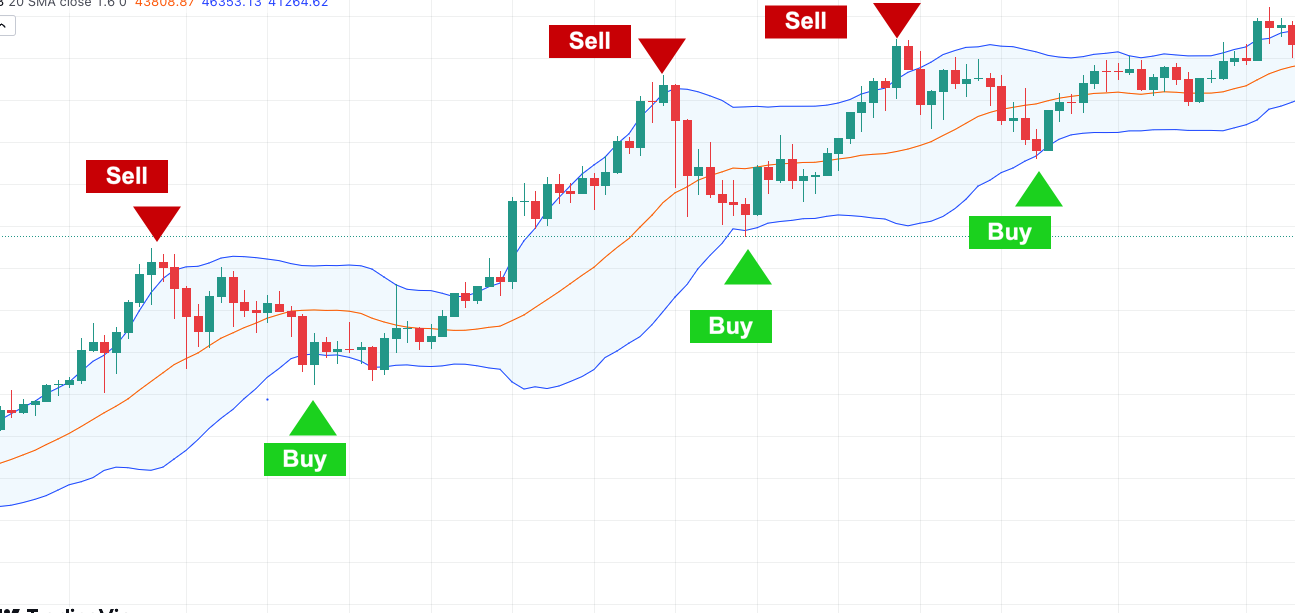
Bollinger Bands define a dynamic price channel based on standard deviation. In a ranging market, price tends to bounce off the upper and lower bands rather than break through them. A range strategy can enter long at the lower band and target the upper band. A stop-loss just outside the channel protects against a genuine breakout scenario.
How Do You Know You Are in a Ranging Market?
The key to a profitable ranging market strategy is detecting the range before applying range-specific logic. Running a mean reversion system during a strong trend is just as damaging as running a trend-following system during a range.
Two indicators work well for identifying ranging conditions:
- ADX (Average Directional Index): ADX measures trend strength. A reading below 25 typically indicates a ranging or trendless market. A reading above 25 signals a trending market. Use ADX as a regime gate: apply range strategies when ADX is below 25, and trend strategies when it rises above.
- Aroon Indicator: Aroon measures how recently price made a new high or low. When Aroon Up and Aroon Down are both low and close together, the market is likely ranging. When one clearly dominates the other, a trend is forming.
Adding a regime detection block to your strategy is one of the highest-value improvements you can make. It prevents your system from applying the wrong logic at the wrong time. For more on how ADX quantifies trend strength, Investopedia’s ADX guide covers the mechanics in depth.
What Mistakes Do Algorithmic Traders Make with a Ranging Market Strategy?
- Running trend systems without a regime filter: This is the most common and most costly mistake. Trend-following strategies generate consistent small losses during ranges. A regime filter prevents this entirely.
- Setting take-profit targets too wide: In a ranging market, price rarely travels far before reversing. Wide targets are rarely hit. Tighter targets near the range boundaries are more realistic and more frequently achieved.
- Ignoring breakout risk: Every range eventually ends in a breakout. A ranging market strategy without a stop-loss just outside the boundaries can take a large loss when that breakout occurs. Always account for the regime change.
- Over-trading the noise: Price oscillates within the range, but not every movement is a tradable signal. Adding a smoothing filter or a minimum distance requirement to your oscillator can reduce low-quality entries significantly.
How to Build a Ranging Market Strategy in Arrow Algo
Arrow Algo’s visual builder makes it straightforward to build a ranging market strategy using drag-and-drop blocks — no coding required. Here is a basic setup:
- Add an ADX block and set it to period 14. This detects whether the market is currently ranging or trending.
- Add a condition block: only allow entry signals when ADX is below 25.
- Add an RSI block (or Stochastic) as your entry signal generator. Set entry long when RSI drops below 30. Set entry short when RSI rises above 70.
- Set a take-profit near the range boundary. Set a stop-loss just outside it to handle breakouts.
- Backtest on live exchange data from Binance, Coinbase, or HyperLiquid to validate across different market periods.
You can also build a strategy that switches automatically between a trend mode and a range mode. When ADX rises above 25, the system activates trend-following logic. When ADX falls below 25, it switches to the ranging market strategy. This type of adaptive, regime-aware system is among the most sophisticated approaches available — and Arrow Algo’s visual builder makes it buildable without writing a single line of code.
What Are the Key Takeaways?
- Markets spend 70–80% of the time in ranging or consolidating conditions — not in trends.
- Trend-following strategies generate repeated small losses during ranges. A dedicated ranging market strategy prevents this.
- Mean reversion, oscillator-based entries (RSI, Stochastic, CCI), and Bollinger Band approaches are the most effective ranging market strategy types.
- ADX (below 25) and the Aroon Indicator are the most reliable tools for detecting when you are in a range.
- Always include a stop-loss just outside the range boundaries to protect against breakout events.
- Arrow Algo’s visual builder lets you build regime-aware strategies that switch automatically between trend and range modes — no coding required.
Educational disclaimer: This content is for educational purposes only and does not constitute financial advice. Trading involves significant risk and you should only trade with capital you can afford to lose. Past performance is not indicative of future results.
Disclaimer: The information provided in this article is for educational purposes only and does not constitute financial advice. Trading involves significant risk and you should only trade with capital you can afford to lose. Past performance is not indicative of future results. Always conduct your own research before making any trading decisions.
Ready to build your own automated trading strategies without writing a single line of code? Start for free at Arrow Algo and join thousands of traders who’ve made the switch to systematic trading.