
Positive Volume Index (PVI): Complete Guide for Algorithmic Trading
The Positive Volume Index (PVI) is a cumulative momentum indicator that tracks price performance exclusively on days when trading volume is higher than the previous session. It separates crowd-driven price activity from the quieter moves that occur on low-volume days. For algorithmic traders, PVI offers a reliable tool for detecting whether the crowd is pushing prices higher — or dragging them down — on the days when market participation peaks.
What Is the Positive Volume Index?
The Positive Volume Index is a running cumulative indicator. It only updates its value on days when today’s volume exceeds yesterday’s volume. The logic behind this comes from a specific market hypothesis: uninformed participants — retail traders, momentum chasers, and reactive buyers — tend to concentrate their activity on high-volume days. By tracking what price does specifically on those days, PVI isolates the behaviour of the crowd during periods of peak activity.
PVI was first developed by Paul Dysart in the 1930s. It was later refined and popularised by analyst Norman Fosback, who applied it to long-term bull and bear market analysis. His research found that when PVI was above its one-year moving average, the market was in a bullish phase approximately 79% of the time. That research has since been applied across equity and crypto markets.
PVI works as a complementary pair with the Negative Volume Index (NVI), which tracks price changes on low-volume days. Used together, they give a fuller picture of whether both crowd activity and smart-money behaviour are aligned.
How Is the Positive Volume Index Calculated?
PVI starts at a base value — typically 1,000. From there, it updates once per bar based on two simple conditions:
- If today’s volume is higher than yesterday’s volume: PVI adjusts to reflect today’s percentage price change.
- If today’s volume is lower or equal to yesterday’s volume: PVI stays exactly the same.
In plain terms: on a high-volume day, PVI rises if price rises and falls if price falls. On a low-volume day, PVI does not move. This makes PVI a slow-building, cumulative measure of crowd behaviour on active trading days. It does not react to individual candles in isolation. It accumulates gradually over time, which makes it more useful as a long-term trend filter than as a short-term entry signal.
How to Read Positive Volume Index Signals?
PVI is most useful when compared against a long-term moving average — typically a 255-day exponential moving average (EMA), which approximates one trading year. The raw PVI value alone has little meaning. The relationship between PVI and its moving average is what creates tradable signals.
- PVI above its 255-day EMA: The crowd is actively participating in price increases on high-volume days. This is historically a bullish signal. Fosback’s research placed this condition at roughly 79% accuracy for bull market identification.
- PVI below its 255-day EMA: The crowd is selling or staying passive on high-volume days. This is a cautionary signal. The market may still rise, but crowd participation on active days is working against price.
- PVI trending upward: Even without a crossover, a steadily rising PVI confirms that high-volume days are generally positive for price. This supports a bullish bias in trend-following systems.
- PVI divergence with price: If price makes a new high but PVI does not follow, crowd participation on high-volume days may be weakening. This can be an early warning of a fading rally before it reverses.
Unlike oscillators such as RSI or Stochastic, PVI does not have fixed overbought or oversold levels. Its value is only meaningful relative to its own history and its moving average.
What Are the Best Positive Volume Index Trading Strategies?
PVI works best as a trend filter or regime confirmation tool. It is not designed for short-term signal generation. Here are three effective approaches for systematic traders:
1. PVI and Moving Average Crossover
The most direct approach is to use the crossover of PVI above or below its 255-day EMA as a regime signal. When PVI crosses above the EMA, the system enters a bullish mode. When it crosses below, the system enters a cautious or neutral mode. This works well as a long-term filter on daily or weekly charts. It is slow to trigger — but slow means fewer false signals in this context.
2. PVI and NVI Dual Confirmation
Combining PVI with NVI creates a powerful dual-confirmation framework. When both PVI and NVI are above their long-term moving averages, crowd activity and smart-money behaviour are both bullish. Fosback identified this dual condition as one of the strongest long-term bull market signals available. When one diverges from the other, it signals a more uncertain environment where caution is warranted.
3. PVI as a Trend Entry Filter
Rather than triggering trades directly, PVI can act as a gate. Take long signals from your primary strategy — such as RSI, MACD, or a moving average crossover — only when PVI is above its 255-day EMA. This removes a meaningful portion of false signals generated during bear market rallies. It is one of the simplest improvements you can make to an existing strategy without changing its core logic.
What Are Common Positive Volume Index Mistakes to Avoid?
- Using PVI without a moving average: Raw PVI values are not actionable on their own. The relationship between PVI and its moving average is what creates a signal. Trading PVI alone introduces too much noise.
- Using a short-period EMA: PVI is a slow indicator by design. Short-period EMAs (10, 20, or 50 days) introduce too many false crossovers. Stick to 255 days or longer for reliable, low-noise signals.
- Expecting fast reactions: PVI builds cumulatively over weeks and months. It is not suited for intraday or swing trading as a primary signal. Its strength lies in identifying longer-term regime conditions, not short-term momentum.
- Treating PVI in isolation: PVI tells you what the crowd is doing on high-volume days. It does not tell you the complete story on its own. Combine it with NVI and a price trend indicator for proper context.
- Confusing PVI with NVI: Both indicators track cumulative price change based on volume conditions — but they measure opposite situations. PVI activates on high-volume days. NVI activates on low-volume days. Mixing them up leads to misreading market dynamics entirely.
How to Build Positive Volume Index Strategies in Arrow Algo?
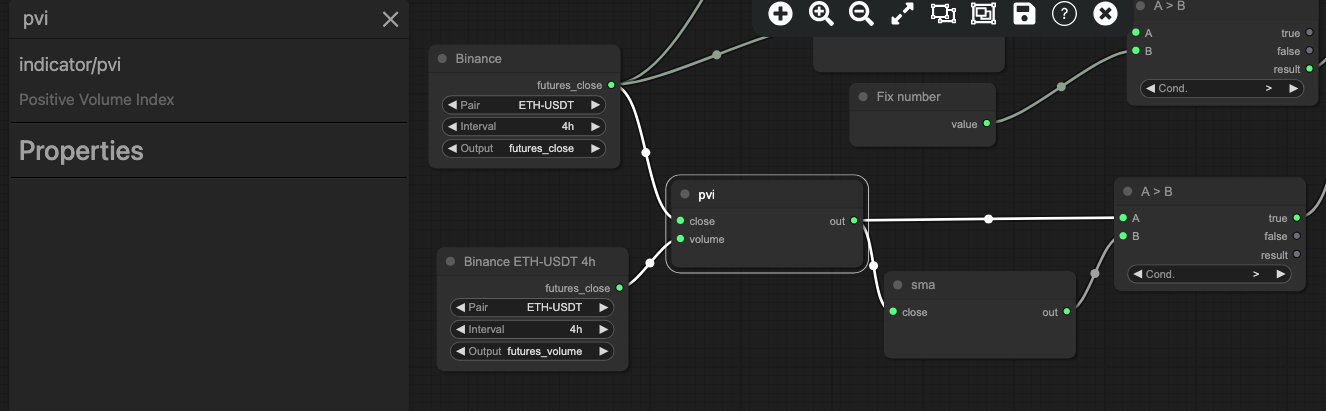
Arrow Algo includes a PVI block in its indicator library. You can build PVI-based strategies using drag-and-drop visual blocks — no coding required. Here is how to set up the core approach:
- Open the visual builder and add the PVI block from the indicator library.
- Add an EMA block and set the period to 255. Connect it to the PVI output to create a moving average of PVI.
- Add a crossover detection block. Set it to trigger when PVI crosses above or below the EMA.
- Set your entry rule: enter long when PVI crosses above its 255-day EMA. Exit or go neutral when it crosses below.
- Optionally, add an NVI block with its own 255-day EMA. Use a logical AND block to require both PVI and NVI to be above their moving averages before allowing an entry.
You can also use PVI as a filter within a larger strategy. Connect it to any existing entry signal and add a condition: only allow that entry if PVI is currently above its 255-day EMA. This improves signal quality without changing your core strategy logic. Backtest your PVI setup on live exchange data from Binance, Coinbase, or HyperLiquid directly within Arrow Algo to validate performance before going live.
What Are the Key Takeaways?
- The Positive Volume Index tracks cumulative price change on days when volume is higher than the previous day.
- Developed by Paul Dysart and popularised by Norman Fosback, it is historically one of the most reliable long-term trend identification tools available.
- Compare PVI to its 255-day EMA: above the EMA is bullish, below the EMA signals caution.
- When combined with the Negative Volume Index, it creates a dual-confirmation framework that captures both crowd and smart-money behaviour.
- PVI works best as a regime filter or trend gate — not as a standalone short-term signal generator.
- Arrow Algo’s visual builder lets you build and backtest PVI strategies using drag-and-drop blocks on real exchange data.
Educational disclaimer: This content is for educational purposes only and does not constitute financial advice. Trading involves significant risk and you should only trade with capital you can afford to lose. Past performance is not indicative of future results.
Disclaimer: The information provided in this article is for educational purposes only and does not constitute financial advice. Trading involves significant risk and you should only trade with capital you can afford to lose. Past performance is not indicative of future results. Always conduct your own research before making any trading decisions.
Ready to build your own automated trading strategies without writing a single line of code? Start for free at Arrow Algo and join thousands of traders who’ve made the switch to systematic trading.