
Balance of Power (BOP): Complete Guide for Algorithmic Trading
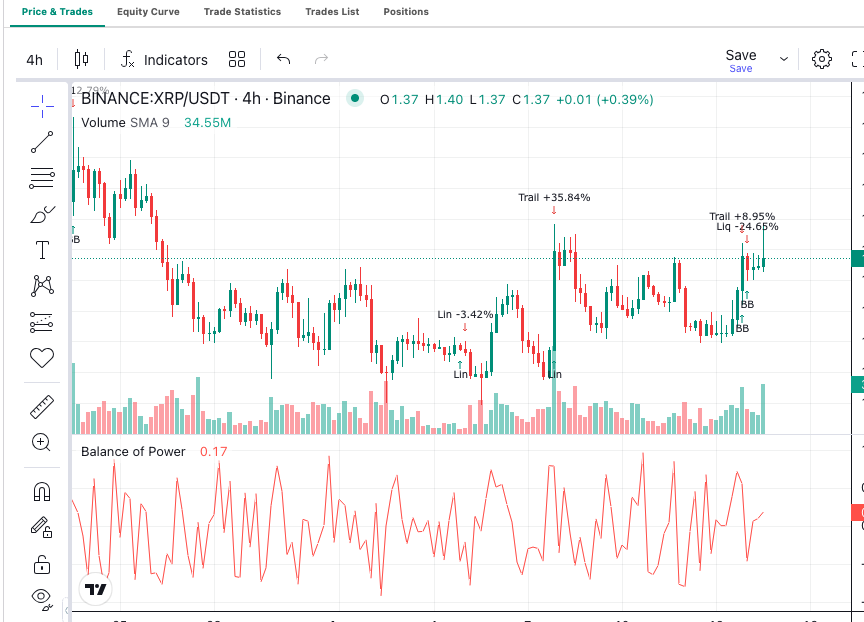
The Balance of Power (BOP) is a momentum indicator that measures the strength of buyers and sellers by comparing where price closes within each session’s range. Algorithmic traders use Balance of Power to detect shifts in control before price confirms the move — making it a valuable early-warning tool in any systematic strategy.
What Is the Balance of Power?
Balance of Power is a momentum indicator that calculates which side controls price action during each trading session — buyers or sellers. It looks at where price closed relative to where it opened, then weighs that against how wide the session’s full range was.
A positive BOP value means buyers dominated the session. A negative value means sellers were in control. The closer the reading sits to +1 or -1, the more one side dominated.
Developed by Igor Levshin and introduced to wider audiences by Donald Dorsey, BOP works across all timeframes and asset classes. Crypto traders find it particularly useful because digital asset markets trade 24/7, making open-to-close dynamics a consistent and reliable signal source. For a broader look at momentum measurement in algo strategies, see Arrow Algo’s Trading Indicators library.
How Is the Balance of Power Calculated?
The calculation takes the difference between a candle’s closing and opening price, then divides by the difference between the session’s high and low.
In plain terms: if price opened at the bottom of its range and closed at the top, BOP reads close to +1. If it opened at the top and closed near the bottom, BOP reads close to -1. Mid-range closes produce readings near zero.
Most implementations apply a smoothing period — typically 14 periods — to reduce bar-to-bar noise. The raw single-bar reading can be erratic. The smoothed version reveals sustained shifts in buying or selling pressure far more clearly.
How to Read Balance of Power Signals?
BOP oscillates around zero. The key reference points are:
- Above zero: Buyers control the session. Sustained positive readings confirm bullish momentum.
- Below zero: Sellers dominate. Sustained negative readings confirm bearish pressure.
- Crossing zero: A shift in control. Price often follows the crossover direction within a few bars. This is the most traded BOP signal.
- Divergence: When BOP makes higher lows but price makes lower lows (or vice versa), the divergence frequently signals an upcoming reversal — often before price confirms it.
A smoothed BOP above zero for several consecutive bars while price trends upward confirms trend strength. A BOP that flips negative while price is still rising warns that buyers are losing conviction before any price weakness appears.
What Are the Best Balance of Power Trading Strategies?
Zero-Line Crossover Strategy
The simplest BOP approach. Enter long when BOP crosses above zero. Exit when it crosses back below. Add a trend filter — such as a 50-period moving average — to avoid trading crossovers against the prevailing trend. This reduces false signals in choppy markets significantly.
BOP Divergence Strategy
Watch for divergence between BOP and price. If price reaches a new high but BOP fails to follow, selling pressure is growing beneath the surface. That divergence warns of a potential reversal. Enter short when price confirms with a bearish candle after the divergence forms. The same logic applies in reverse for bullish divergences at lows.
BOP and Volume Confirmation Strategy
Combine BOP with volume. A BOP zero-line cross supported by above-average volume carries far more weight than one on thin volume. Use a volume moving average (typically 20 periods) as your filter. Only take BOP signals where volume exceeds that average. Investopedia’s BOP overview covers the foundational formula in detail for further reading.
What Are Common Balance of Power Mistakes to Avoid?
Trading raw, unsmoothed BOP. The single-bar reading is too noisy to trade directly. Always apply a smoothing period. Most traders use 14 periods. Some prefer 21 for calmer signals on shorter timeframes.
Ignoring trend context. BOP crossovers work best with the prevailing trend. Trading every zero-line cross in a ranging market generates excessive false signals. Apply a trend filter before acting on BOP entries.
Missing divergences. BOP’s real edge is in divergence signals. Traders who only watch the zero line miss the indicator’s most reliable warning system. Always compare BOP peaks and troughs against price peaks and troughs on the same chart.
Over-relying on BOP alone. Like all momentum oscillators, BOP works best as part of a multi-signal system. Combine it with a trend indicator and volume confirmation for the highest-probability setups.
How to Build Balance of Power Strategies in Arrow Algo?
Arrow Algo includes Balance of Power as a ready-to-use indicator block. Add it to your strategy canvas, set the smoothing period, and connect its output to condition blocks — all by dragging and dropping, with no programming required.
To build a zero-line crossover strategy, place a BOP block on the canvas and set the period to 14. Add a Condition block that checks whether BOP crossed above zero. Connect that to a Buy signal block. Mirror the logic for short entries when BOP crosses below zero. The full signal flow is visible on the canvas at every step.
For divergence detection, add a Comparison block that evaluates whether BOP direction conflicts with recent price direction. When the two diverge, your strategy can reduce position size or flag a potential reversal — before price shows it in the chart.
Run a backtest directly in Arrow Algo to measure how BOP performs on your chosen asset and timeframe, then iterate with different smoothing periods or additional filters until the strategy meets your criteria.
What Are the Key Takeaways?
- Balance of Power measures buyer vs seller dominance using each candle’s open-to-close movement relative to its full range.
- Smoothed BOP (14 periods) removes noise. Always apply smoothing before using BOP in a live strategy.
- The zero-line crossover is the primary entry signal. A trend filter improves accuracy in trending markets.
- BOP divergence is the indicator’s strongest signal — it frequently leads price reversals by several bars.
- Combine BOP with volume confirmation for the highest-confidence entries.
- Arrow Algo includes BOP as a native block. Build, test, and refine BOP strategies visually without writing a line of code.
Educational disclaimer: This content is for educational purposes only and does not constitute financial advice. Trading involves significant risk and you should only trade with capital you can afford to lose. Past performance is not indicative of future results.
Disclaimer: The information provided in this article is for educational purposes only and does not constitute financial advice. Trading involves significant risk and you should only trade with capital you can afford to lose. Past performance is not indicative of future results. Always conduct your own research before making any trading decisions.
Ready to build your own automated trading strategies without writing a single line of code? Start for free at Arrow Algo and join thousands of traders who’ve made the switch to systematic trading.