
Chaikin Money Flow (CMF): Complete Guide for Algorithmic Trading
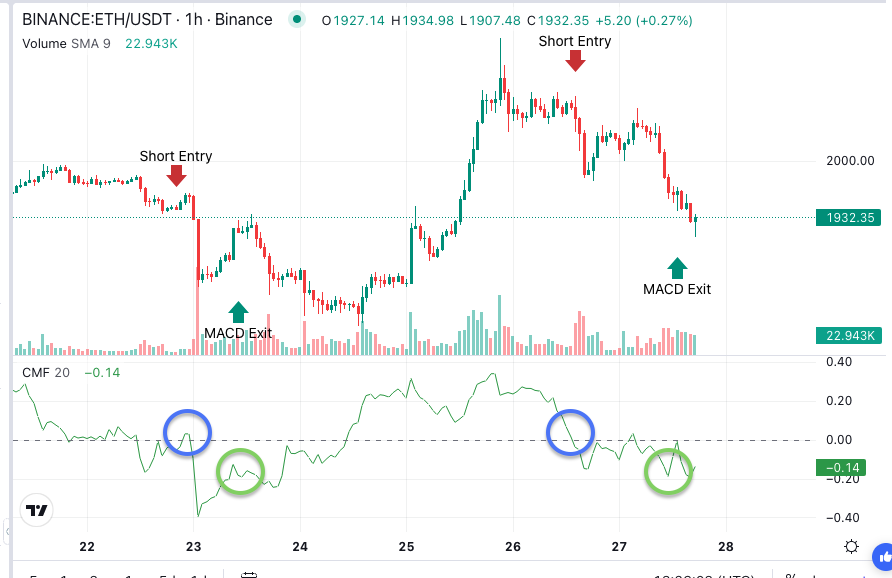
The Chaikin Money Flow indicator is one of the most widely used volume-based tools in systematic trading, offering a direct measure of whether an asset is under accumulation or distribution over any given period. Unlike price-only indicators, Chaikin Money Flow weighs every candle’s movement against its volume — making it sensitive to institutional activity that pure price analysis would miss.
What Is the Chaikin Money Flow Indicator?
Chaikin Money Flow (CMF) is a volume-weighted accumulation and distribution oscillator that measures the flow of money into and out of an asset over a defined look-back period, typically 20 or 21 candles. Developed by Marc Chaikin in the 1980s, it builds on the Accumulation/Distribution Line concept by normalising the result into a bounded oscillator between -1 and +1. A positive CMF reading indicates net accumulation — more money flowing in than out. A negative reading indicates net distribution — more money leaving than entering.
The key distinction between Chaikin Money Flow and similar indicators like the Money Flow Index (MFI) is how it handles the relationship between the closing price and the trading range. CMF rewards candles where price closes near the high — treating this as buying pressure — and penalises candles where price closes near the low, treating this as selling pressure.
How Is the Chaikin Money Flow Calculated?
The Chaikin Money Flow calculation proceeds in three steps, all handled automatically by Arrow Algo’s indicator block.
First, a Money Flow Multiplier is calculated for each candle. This compares the closing price to the candle’s high-low range: the closer the close is to the high, the more positive the multiplier (approaching +1). The closer the close is to the low, the more negative (approaching -1). A close at the exact midpoint produces zero.
Second, the Money Flow Volume multiplies the Money Flow Multiplier by that candle’s volume. This weights the directional signal by activity — a strong close near the high on heavy volume contributes far more than the same close on thin volume.
Third, CMF totals the Money Flow Volume over the look-back period and divides it by total volume over the same period. The result: a number between -1 and +1 reflecting the net direction of volume-weighted money flow.
How to Read Chaikin Money Flow Signals?
The CMF oscillates around the zero line — the most important reference point:
- Above zero: Net accumulation — buyers are in control. The higher above zero, the stronger the signal.
- Below zero: Net distribution — sellers dominate. The further below zero, the stronger the selling pressure.
- +0.25 or above: Strong accumulation — often seen at the start of new uptrends or healthy pullback continuations.
- -0.25 or below: Strong distribution — a warning sign for long positions, often preceding further downside.
Divergences are CMF’s most powerful signal. A bullish divergence — price at a lower low while CMF makes a higher low — suggests selling pressure is weakening even as price tests new lows. A bearish divergence — price at new highs while CMF trends lower — warns the rally lacks genuine accumulation backing.
What Are the Best Chaikin Money Flow Trading Strategies?
Zero Line Crossover Strategy
The simplest approach enters long when CMF crosses above zero from below — signalling net money flow has turned positive. Combine with ADX above 25 to confirm the crossover is occurring in a trending market. Exit when CMF crosses back below zero or a trailing stop triggers. This works well on daily and 4H timeframes where volume data is most meaningful.
Trend Confirmation Filter
Many systematic traders use Chaikin Money Flow not as a primary signal but as a confirmation layer. Before any entry fires, they require CMF to be above zero — confirming money is flowing in, not out. This eliminates a significant proportion of false breakouts where price moves higher but volume analysis reveals the move lacks genuine accumulation. Pair with the EMA for trend direction and CMF for volume health.
Divergence Strategy
CMF divergences work particularly well at established support levels. When price retests a major support zone and CMF makes a higher low compared to the previous test, it confirms less selling volume is hitting the market — buyers are absorbing supply. Arrow Algo’s visual block builder lets you combine the Chaikin Money Flow block with price level conditions to automate this logic without any programming.
What Are Common Chaikin Money Flow Mistakes to Avoid?
- Trading every zero line crossover in isolation: CMF crosses zero frequently in choppy markets. Without a trend filter this generates many false signals. Always combine it with a directional indicator.
- Ignoring the look-back period: The default 20-period setting is well-tested, but short timeframes amplify individual volume spikes. Test any adjustment on historical data before going live.
- Using it on assets with unreliable volume data: Like all volume indicators, CMF depends on accurate volume reporting. Verify data quality before building volume-based strategies on any pair.
- Confusing CMF with the Accumulation/Distribution Line: The A/D Line is cumulative with no boundary — hard to compare across time. CMF normalises the result into a bounded oscillator, more practical for strategy conditions.
How to Build Chaikin Money Flow Strategies in Arrow Algo?
Arrow Algo’s no-code visual block builder includes Chaikin Money Flow as a ready-to-use indicator block. Drag it onto your strategy canvas, set the look-back period (20 is the standard starting point), and connect it to condition blocks defining your entry logic.
For a trend confirmation setup, add a condition requiring CMF to be above zero before any entry fires. Layer in the EMA50 directional filter and ADX trend strength condition for a complete three-part confirmation system. Run the strategy through Arrow Algo’s backtesting engine on live historical exchange data and compare results with and without the Chaikin Money Flow filter to quantify its exact impact before committing capital.
What Are the Key Takeaways?
- Chaikin Money Flow is a volume-weighted oscillator bounded between -1 and +1 measuring accumulation and distribution
- Values above zero indicate net accumulation; below zero indicate net distribution
- Readings above +0.25 signal strong accumulation; below -0.25 signal strong distribution
- Divergences between price and CMF are the indicator’s most powerful signal
- It works best as a trend confirmation filter, not a standalone entry trigger
- In Arrow Algo, build and backtest Chaikin Money Flow strategies visually without writing any code
For further reading, see Investopedia’s guide to Chaikin indicators and the StockCharts technical reference for Chaikin Money Flow.
Educational disclaimer: This content is for educational purposes only and does not constitute financial advice. Trading involves significant risk and you should only trade with capital you can afford to lose. Past performance is not indicative of future results.
Disclaimer: The information provided in this article is for educational purposes only and does not constitute financial advice. Trading involves significant risk and you should only trade with capital you can afford to lose. Past performance is not indicative of future results. Always conduct your own research before making any trading decisions.
Ready to build your own automated trading strategies without writing a single line of code? Start for free at Arrow Algo and join thousands of traders who’ve made the switch to systematic trading.