
Money Flow Index (MFI): Complete Guide for Algorithmic Trading
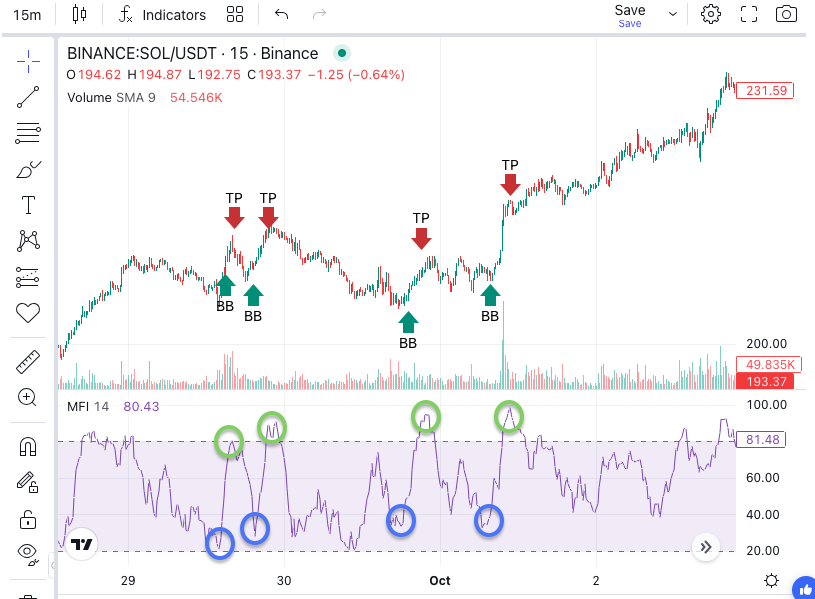
The Money Flow Index is one of the most powerful volume-based indicators available to systematic traders, offering a perspective on momentum that pure price indicators cannot provide. By combining price movement with trading volume, the Money Flow Index reveals whether the money behind a move is genuine or thin — a critical distinction when building automated trading strategies.
What Is the Money Flow Index?
The Money Flow Index (MFI) is a volume-weighted momentum oscillator that measures the strength of money flowing into and out of an asset over a defined period. Developed by Gene Quong and Avrum Soudack, it is often described as a volume-weighted version of the Relative Strength Index (RSI). Like RSI, the Money Flow Index oscillates between 0 and 100 and uses overbought and oversold thresholds to generate signals — but unlike RSI, every calculation incorporates volume, making it sensitive to institutional buying and selling pressure rather than price alone.
This volume sensitivity is what sets the indicator apart. A price rally on low volume looks very different to the Money Flow Index than a rally on high volume — and that distinction can be the difference between a reliable breakout signal and a false one.
How Is the Money Flow Index Calculated?
The Money Flow Index builds in four steps. Arrow Algo’s indicator block handles all of this automatically — no programming required.
First, the Typical Price is calculated: high plus low plus close, divided by three. Second, Raw Money Flow multiplies the Typical Price by the candle’s volume — a measure of capital moving through the market that period. Third, each candle’s flow is classified as Positive (Typical Price above the previous candle’s) or Negative (below). Over 14 periods, positive and negative flows are summed separately. Fourth, the Money Flow Ratio divides total positive flow by total negative flow. The final formula mirrors RSI: 100 minus 100 divided by (1 plus the ratio), producing a smooth 0–100 oscillator.
How to Read Money Flow Index Signals?
Three zones matter when reading the Money Flow Index:
- Above 80 (Overbought): Over 80% of recent flow has been positive — the asset may be overextended. Some traders use 90 as the extreme threshold.
- Below 20 (Oversold): Over 80% of recent flow has been negative — selling pressure may be exhausting. Some traders use 10 as the extreme threshold.
- 50 midline: A cross above 50 signals positive money flow starting to dominate. A cross below 50 signals the reverse.
Divergences are the most powerful Money Flow Index signal. A bullish divergence occurs when price makes a new low but the indicator makes a higher low — selling volume is decreasing even as price falls, suggesting the downtrend is losing conviction. A bearish divergence — price making a higher high while MFI makes a lower high — signals that the rally lacks volume support and may be near exhaustion.
What Are the Best Money Flow Index Trading Strategies?
Overbought and Oversold Reversals
The most straightforward approach enters long when the Money Flow Index crosses back above 20 from below — signalling selling pressure has peaked. A stop-loss sits below the recent swing low with a 1:2 risk-reward target. The reverse applies for short entries from overbought territory above 80. Pair this with a flat 50-period EMA as a trend filter to avoid fighting strong directional moves.
Divergence Strategy
Divergence entries work particularly well at major support and resistance levels. When price retests key support and the Money Flow Index makes a higher low than the previous test, it confirms that less selling volume is hitting the market — buyers are absorbing supply. Arrow Algo’s visual block builder lets you combine the Money Flow Index block with price level conditions to automate this without any code.
Trend Confirmation Filter
Many systematic traders use the Money Flow Index not as a primary signal but as a filter. Before any momentum entry fires, they require the indicator to sit above 50 — confirming positive money flow dominates. This removes a significant number of false breakouts where price moves higher but volume does not support it. Combining this with the Average Directional Index (ADX) creates a complete trend-and-volume confirmation system.
What Are Common Money Flow Index Mistakes to Avoid?
- Ignoring the trend: The indicator produces frequent overbought readings in strong uptrends. Shorting every reading above 80 in a bull market produces consistent losses. Confirm trend direction first.
- Using it on low-volume assets: The Money Flow Index depends entirely on reliable volume data. On thinly traded pairs or during low-liquidity hours, volume spikes create misleading readings.
- Treating every divergence as a guaranteed reversal: Divergences can persist for many candles before price confirms — or never confirms. Always wait for price to begin turning before entering.
- Over-optimising the look-back period: The default 14-period setting is well-tested across markets. Fitting the period too tightly to historical data produces strategies that fail in live conditions.
How to Build Money Flow Index Strategies in Arrow Algo?
Arrow Algo’s no-code visual block builder includes the Money Flow Index as a ready-to-use indicator block. Drag it onto your strategy canvas, set the look-back period, and connect it to condition blocks defining your entry and exit logic.
For a reversal setup, add a condition that triggers a long entry when the Money Flow Index crosses above 20 from below. Add a stop-loss block below the recent swing low and a take-profit at 1:2. For a trend-confirmation filter, add a second condition requiring the indicator to be above 50 before any momentum entry fires — cutting low-conviction breakouts automatically. Run the strategy through Arrow Algo’s backtesting engine on live historical exchange data to validate your thresholds before going live.
What Are the Key Takeaways?
- The Money Flow Index is a volume-weighted momentum oscillator combining price and volume into a 0–100 reading
- Readings above 80 signal overbought; below 20 signal oversold — always interpret relative to the broader trend
- Divergences between price and the indicator are the strongest signals it produces
- It works best on liquid assets — avoid thinly traded pairs where volume data is unreliable
- As a trend-confirmation filter, the Money Flow Index meaningfully improves breakout strategy accuracy
- In Arrow Algo, build and backtest Money Flow Index strategies visually without writing any code
For further reading, see Investopedia’s guide to the Money Flow Index and the original research by Quong and Soudack in Stocks & Commodities magazine.
Educational disclaimer: This content is for educational purposes only and does not constitute financial advice. Trading involves significant risk and you should only trade with capital you can afford to lose. Past performance is not indicative of future results.
Disclaimer: The information provided in this article is for educational purposes only and does not constitute financial advice. Trading involves significant risk and you should only trade with capital you can afford to lose. Past performance is not indicative of future results. Always conduct your own research before making any trading decisions.
Ready to build your own automated trading strategies without writing a single line of code? Start for free at Arrow Algo and join thousands of traders who’ve made the switch to systematic trading.