
Chandelier Exit Strategy: How to Build It in Arrow Algo
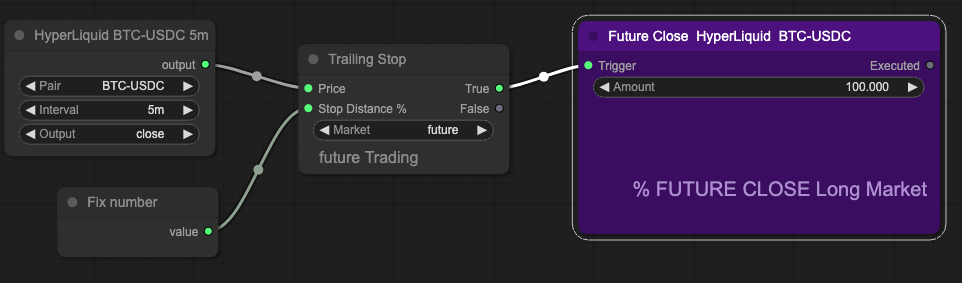
A Chandelier Exit strategy answers a question most trend traders never settle: where does the stop go once the trade is working? Fixed stops stay too close. Percentage trails ignore volatility. The Chandelier Exit hangs the stop a set number of average true ranges below the highest high since entry. It only moves up. When price falls through it, the trade is done. Our Chandelier Exit guide covered what the indicator is. This post is about turning it into a tested rule set.
What Makes the Chandelier Different From Other Trailing Stops?
Most trailing stops anchor to the close. The Chandelier anchors to the highest high of the lookback period. That one change matters. A close-anchored stop drifts down with each weak candle. A high-anchored stop stays put until price makes a new high. It never loosens.
The distance is set in ATR units. Chuck LeBeau, who developed the indicator, used three times the 22-period ATR as the default. StockCharts keeps that convention. Three ATRs is a wide stop. It is meant to survive normal pullbacks inside a trend and fire only when the trend breaks.
The result is a stop that tightens as volatility falls and widens as it rises. In a calm grind higher it sits close under price. In a volatile run it gives room. Compare that with a 5% trail, which is too tight on a volatile pair and too loose on a quiet one.
Why Use the Chandelier as the Whole Exit?
The Chandelier works best as the only exit, not as one of several. Add a take-profit and you cap the trades the Chandelier was built to ride. Add a time stop and you cut the long trends it exists to capture. The indicator’s edge is letting winners run until the trend itself ends. Every extra exit erodes that.
The cost is a lower win rate. A Chandelier exit gives back a chunk of open profit on every winning trade. The stop fires three ATRs below the high, so the final result is always below the peak. Traders who watch the equity curve candle by candle find this painful. The backtest usually shows it is worth it. A handful of large winners pay for the many small losses.
That trade-off is the whole decision. If your strategy depends on a high win rate for psychological or sizing reasons, the Chandelier is the wrong tool. If it depends on catching the occasional 30% move, it is one of the best.
Three Chandelier Exit Strategies to Backtest
Each combines a specific entry with the Chandelier as the sole exit. Test them one at a time.
Donchian breakout with a 3 ATR Chandelier
Enter long when price closes above the 20-period high. Exit when price closes below the Chandelier stop at 3 ATR. This is the closest thing to the classic trend-following template. It trades rarely, holds for weeks on daily candles, and depends entirely on a few big trends per year.
EMA cross with a tightened Chandelier
Enter long when a 20-period EMA crosses above a 50-period EMA. Exit at a 2 ATR Chandelier. The EMA cross fires later than a breakout, so the trade starts with less of the move left. A tighter multiplier compensates. Expect more trades, shorter holds and a slightly higher win rate than the breakout version.
Chandelier as a re-entry filter
Use any trend entry. After the Chandelier fires and closes the trade, do not re-enter until price closes back above the Chandelier level it fell through. This keeps the strategy out of the chop that follows a trend break. Many trend systems lose most of their money re-entering too early. The re-entry filter is often worth more than the original exit.
How Do You Choose the Multiplier and Period?
Two parameters control everything. The ATR period sets how quickly the stop responds to changing volatility. The multiplier sets how far below the high it sits.
Shorter ATR periods react faster. A 10-period ATR on 4-hour candles tightens within a day of volatility falling. A 22-period ATR takes most of a week. Faster is not better. A stop that tightens on one quiet day will be hit by the next normal candle.
The multiplier is the bigger lever. Investopedia notes that values between 2.5 and 4 are common. Below 2 the stop sits inside normal pullback range and fires constantly. Above 4 it gives back so much on each exit that the trades barely beat buy and hold.
Test the neighbourhood, not the point. If 2.5, 3 and 3.5 all produce a similar equity curve, the setting is robust. If only 3 works, the backtest found a coincidence.
Where a Chandelier Exit Strategy Goes Wrong
Running it on a ranging pair. The Chandelier assumes trends. In a range it enters on every false breakout and exits three ATRs later for a loss. A regime filter such as a long moving average or an ADX threshold belongs in front of the entry.
Anchoring to the close instead of the high. Some platforms default to the highest close. That is a different stop. It sits higher and fires more often. Check which one the block uses before trusting the backtest.
Resetting the lookback on each candle. The highest high should be measured since entry, or over a long fixed window. A short rolling window lets the stop fall when old highs drop out of the lookback. A Chandelier that can move down is not a Chandelier.
Mirroring the long rules for shorts. Crypto downtrends are faster and spikier than uptrends. A short-side Chandelier hangs above the lowest low and usually needs a larger multiplier. Test it separately.
How to Build a Chandelier Exit Strategy in Arrow Algo
Pick one exchange, one pair and one timeframe. Daily and 4-hour candles suit the indicator best.
For the Donchian breakout version:
- Find the breakout level. Add a Max block over 20 periods on the high.
- Catch the entry. Use a Crossover block to detect close crossing above that 20-period high. Combine it with a Position Status block so the strategy enters only when flat.
- Compute the stop. Add a Chandelier Exit block fed by high, low and close. Set the ATR period to 22 and the multiplier to 3.
- Wire the exit. A second Crossover block detects close crossing below the Chandelier output. Route it to the close order.
- Add a regime filter. A 200-period EMA block on the close. The entry condition requires close above it.
For the EMA cross version, replace steps 1 and 2 with two EMA blocks and a Crossover block between them. Drop the multiplier to 2.
For the re-entry filter, add a Latch block that is set when the exit fires. Clear it when close crosses back above the Chandelier output. The entry condition requires the latch to be clear.
Keep the Chandelier as the only exit in every version. Then backtest, run a walk-forward test, and compare the three on the same pair and period. If you want to see how the Chandelier compares with a close-anchored trail, our ATR trailing stop strategy guide builds that version.
Points to Carry Into Your Backtest
- The Chandelier hangs a stop a set number of ATRs below the highest high. It only moves up.
- It is built to be the sole exit. Extra take-profits and time stops erode its edge.
- Expect a lower win rate and a few large winners. The backtest, not the individual trade, is the judge.
- Three setups to test: Donchian breakout at 3 ATR, EMA cross at 2 ATR, and the Chandelier as a re-entry filter.
- Test the multiplier neighbourhood. Confirm the block anchors to the high, not the close.
- Put a regime filter in front of the entry. The Chandelier does not work in ranges.
Disclaimer: This content is for educational purposes only and does not constitute financial advice. Trading involves significant risk and you should only trade with capital you can afford to lose. Past performance is not indicative of future results. Always conduct your own research before making any trading decisions.
Ready to build your own automated trading strategies without writing a single line of code? Start for free at Arrow Algo and join thousands of traders who've made the switch to systematic trading.