
Claude vs ChatGPT vs Grok: Build Better Trading Rules
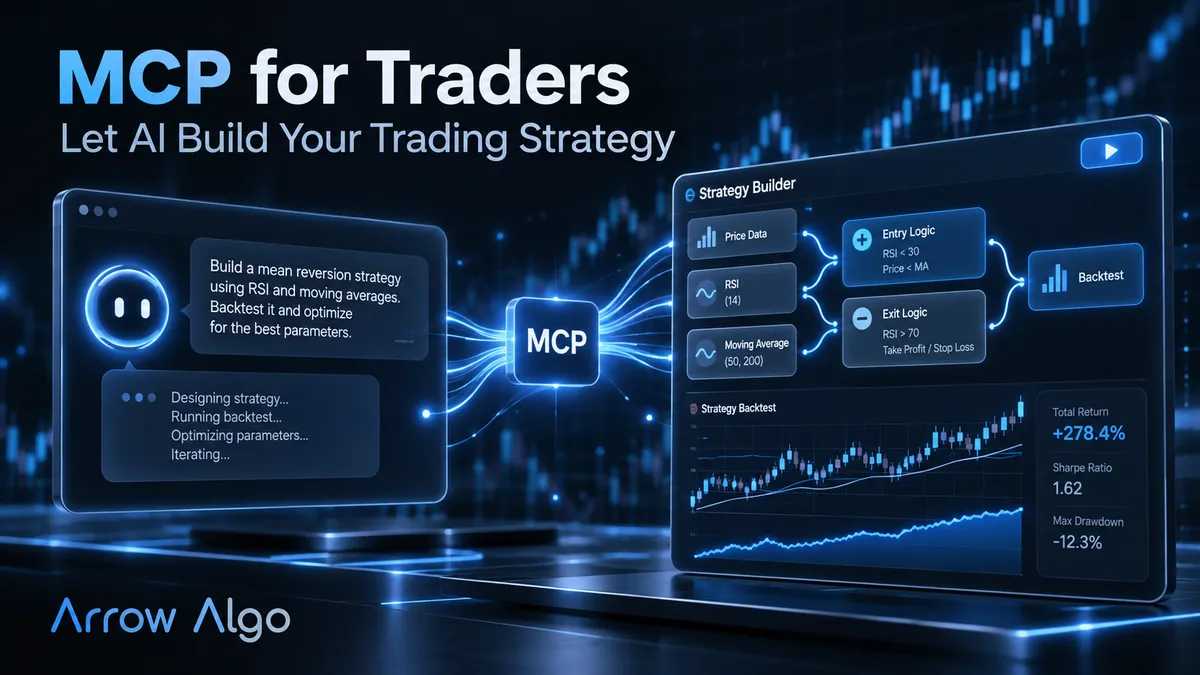
Claude vs ChatGPT vs Grok becomes a useful trading comparison when you give each assistant the same precise task. Can it build your rules, change them accurately and explain the actual backtest?
A confident answer tells you little about those abilities. A strategy you can inspect tells you much more.
This guide compares documented connection routes and gives you a repeatable assessment. It does not report a controlled benchmark or declare a performance winner. Capabilities and access reflect the documentation checked on 15 October 2026.
What Is an AI Trading Strategy Assistant?
An AI trading strategy assistant translates instructions into a proposed rule set. With an authorised tool connection, it can also operate a platform that builds and tests those rules.
Arrow Algo provides that connection through the Model Context Protocol, or MCP. The assistant can work with visual blocks and request backtests on exchange data.
The assistant, connection and trading engine perform different jobs. A good comparison checks all three. Our MCP for traders guide explains how they fit together.
Claude vs ChatGPT vs Grok: What Can You Connect?
All three have documented routes for external tools, but their setup paths differ.
| Assistant | Connection route | First thing to verify |
|---|---|---|
| Claude | Custom connectors for remote MCP servers | The Arrow Algo connector is authorised and enabled in the conversation |
| ChatGPT | Custom MCP servers through plugins | The plugin is connected and exposes the tools needed for your task |
| Grok | Arrow Algo’s Grok connector guide; remote MCP also has a documented API route | The selected Grok interface and account can access the required connector |
Anthropic documents custom connectors using remote MCP. OpenAI’s ChatGPT documentation describes custom MCP servers with read and write tools.
The xAI remote MCP documentation describes API support. API support alone does not establish which controls appear in every Grok chat account.
For Arrow Algo’s recorded setup walkthroughs, open the relevant assistant under Bring your own AI. Account access and workspace permissions can affect the options available.
Why Does Build Accuracy Matter More Than Writing Style?
Small translation errors can change a strategy completely.
“Buy when RSI crosses above 30” describes a transition. “Buy when RSI is above 30” describes a condition that can remain true for hours.
An assistant might explain both fluently. Only one matches the request.
Likewise, a two-percent stop from the entry price differs from a two-percent trailing stop. A 200-period moving average on hourly candles differs from one on daily candles.
Judge the saved strategy against the specification. Do not award accuracy points because the explanation sounds knowledgeable.
Give Each Assistant the Same Strategy Brief
Use a small educational example with enough detail to reveal mistakes:
Build a long-only Binance BTC/USDT strategy using one-hour candles. Use RSI with a 14-candle period. Buy after a completed candle crosses above RSI 30, provided its close exceeds the 200-period EMA. Allow one position at a time. Allocate 10% of starting capital to each trade. Exit at a fixed 2% stop or a fixed 4% profit target from the entry fill. Do not trail either level. Use $10,000 starting capital and no leverage. Backtest from 1 January through 30 September 2026. Show the fee, slippage and fill assumptions before running. Save the strategy without starting live trading.
These settings are illustrative. They are not a claim of profitability.
Start a fresh conversation for each assistant. Use identical account access, market data and test settings. Ask each to read the available block definitions before building.
Record the exact model, date and enabled tools. Product names alone are insufficient to reproduce a comparison.
Score the Build, the Edit and the Explanation
Use three practical checks rather than an overall impression.
Build Accuracy
Open each saved visual graph. Check the crossover direction, candle timing, trend filter, sizing and exits.
Record missing conditions and the number of corrections needed. A tool error that the assistant recognises differs from an unnoticed logic mistake.
Iteration Accuracy
Next, give each assistant the same change: “Change the profit target from 4% to 3%. Keep every other rule unchanged.”
Compare the revised graph with the original. Check that the stop, position sizing and entry conditions remain identical.
Measure the work required to obtain a correct revision. Total time includes your review and repairs, not just the assistant’s response time.
Explanation Quality
Request the net return, maximum drawdown, trade count and cost assumptions from the actual backtest report. Ask for one losing trade’s entry and exit explanation.
A strong answer connects statements to retrieved results. It distinguishes an observed loss from a hypothesis about its cause.
“This should work in trending markets” is a hypothesis. It is not evidence that this strategy passed the test.
How Should You Choose an Assistant for Arrow Algo?
Start with the assistant you already use, provided its Arrow Algo connection works. That reduces setup effort and makes the initial assessment easier.
Then compare the failure modes that matter to you. Perhaps one needs fewer corrections to the block graph. Another may explain trade records more clearly. Those are outcomes to measure, not permanent rankings to assume.
Keep the original strategy fixed during the comparison. If an assistant changes its rules, improved returns no longer measure build accuracy.
Use the same Arrow Algo backtest settings for every valid build. Matching rules and identical data should give matching results under the same engine assumptions. Investigate differences before crediting the assistant.
Finally, reserve a later period for validation. Do not repeatedly tune against the comparison window and call the best outcome reliable. Our backtest statistical significance guide explains why attractive results can still reflect luck.
Claude vs ChatGPT vs Grok: What Should Decide the Choice?
- A working connection comes first. Verify the actual tools available in your account.
- Compare saved visual rules against one shared specification.
- Measure corrections, edit accuracy and evidence in explanations.
- Keep market data, costs and execution assumptions consistent.
- Choose from observed results on your workflow, then review every strategy before deployment.
Disclaimer: This content is for educational purposes only and does not constitute financial advice. Trading involves significant risk and you should only trade with capital you can afford to lose. Past performance is not indicative of future results. Always conduct your own research before making any trading decisions.
Ready to build your own automated trading strategies without writing a single line of code? Start for free at Arrow Algo and join thousands of traders who've made the switch to systematic trading.