
Compounding Trading Strategy: Make Your Returns Work Harder
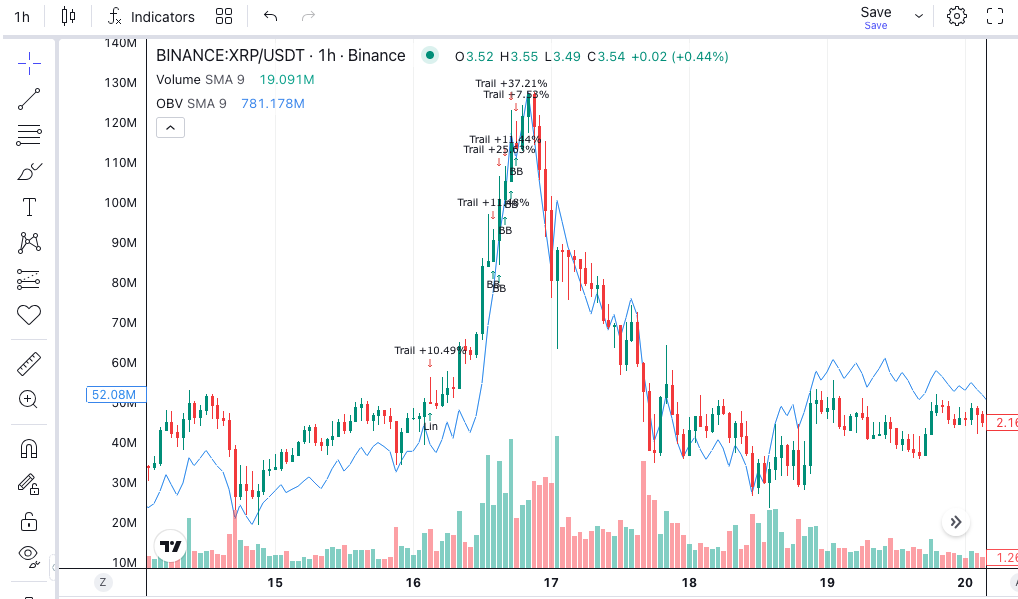
A compounding trading strategy turns each profit into the seed capital for the next trade — allowing returns to grow exponentially rather than linearly over time. It is one of the most powerful concepts in systematic trading, and one of the easiest to apply consistently when you use an automated strategy builder.
What Is a Compounding Trading Strategy?
Compounding is the process of reinvesting gains to increase position size over time. In a fixed-size approach, you trade the same amount on every trade regardless of previous results. In a compounding approach, position size scales with your account balance. Wins grow the base; losses reduce it.
Each profitable trade then generates slightly more than the last. Over dozens or hundreds of trades, that snowball effect produces returns a fixed-size approach cannot match. The same percentage edge, applied consistently, generates a larger absolute gain with every successive winner.
This is what separates compounding from simply trading bigger sizes by instinct. The reinvestment is automatic, every trade, without requiring a new decision each time.
Why Compounding Matters for Algorithmic Traders
Compounding is most powerful in consistent, systematic strategies. A human trader might instinctively revert to fixed sizes after a losing streak — breaking the mathematical consistency the approach depends on. An algorithm applies the same sizing rules every trade, without exception.
That consistency is the real edge. The strategy’s percentage win rate stays constant, but the absolute value of each gain grows as the account balance increases. Small, regular wins build a base that makes future wins larger — not because the strategy improved, but because the compounding is working.
For algorithmic traders specifically, automating the sizing calculation removes a decision that is prone to emotional interference. When position size follows a formula tied to account balance, the compounding happens whether the last trade won or lost.
How Does Position Sizing Control the Compounding Rate?
Compounding is driven entirely by position sizing logic. Instead of trading a fixed dollar amount, the strategy calculates trade size as a percentage of the current account balance before each new entry. That percentage — often called the risk fraction — directly controls how aggressively the account grows.
Conservative (1–2% per trade): Slow, steady growth. Drawdowns stay manageable. Best for live accounts where capital preservation is the priority.
Moderate (2–5% per trade): Meaningful acceleration in growth. Drawdowns become more noticeable after losing streaks. Suitable for accounts where higher variance is acceptable.
Aggressive (5%+ per trade): Rapid growth in winning runs, but losing streaks can significantly reduce the account. Only strategies with high win rates or very tight stops typically sustain this level.
The Kelly Criterion offers a mathematical framework for finding the theoretically optimal risk fraction for a given strategy. In practice, most systematic traders use half or quarter Kelly to reduce variance while retaining most of the compounding benefit. The Kelly Criterion guide on Arrow Algo covers the full approach, and Investopedia’s Kelly Criterion breakdown gives a useful background on the formula itself.
Does Compounding Amplify Losses Too?
Yes — and understanding this asymmetry is essential before deploying a compounding trading strategy live.
Compounding is symmetrical in percentage terms. A 20% gain followed by a 20% loss does not return you to breakeven. It leaves you 4% below your starting point. This is called variance drag — and it grows with the aggressiveness of the risk fraction.
In a sustained losing streak, a compounding system shrinks position sizes automatically as the balance falls. That is protective — it limits further damage. But the account can still reach a point where recovery requires an unusually strong winning run to get back to the prior high.
This is why compounding strategies benefit from thorough back-testing across multiple market regimes. A strategy that compounded well during a bull run may behave very differently in a ranging or bearish period. Walk-forward analysis — testing the strategy on data it was never optimised on — reveals how the compounding holds up out-of-sample. See the walk-forward analysis guide for more on this method.
How to Apply a Compounding Trading Strategy in Arrow Algo
Arrow Algo’s visual block builder lets you implement percentage-based position sizing without writing any code. Set your position size block to calculate trade size as a percentage of the available balance. Each time an entry signal fires, the block reads the current balance and sizes the trade accordingly. The compounding logic is automatic — no manual calculation needed between trades.
Adjust the percentage value in the block’s properties to change how aggressively the account compounds. Start conservative during back-testing and increase gradually as you understand the strategy’s drawdown profile across different market conditions.
You can also add a drawdown cap as a safety mechanism. Connect a condition block that checks whether the account has dropped below a set maximum drawdown threshold. If the threshold is hit, pause the strategy or reduce position sizing until the account recovers. This preserves the upside of compounding while limiting the damage from an extended losing run.
Back-test the compounding version against a fixed-size baseline. The difference in final equity will show whether the strategy’s edge is strong enough to sustain the compounding approach — or whether variance drag is consuming a significant portion of the gain.
Key Takeaways
- A compounding trading strategy reinvests profits to scale position size, producing exponential rather than linear returns over time
- Compounding works best in systematic strategies — an algorithm applies the sizing rules every trade where a human trader often does not
- The risk fraction (percentage of balance risked per trade) controls the compounding rate; start conservative and test across multiple market regimes
- Compounding amplifies losses as well as gains — always back-test in bear markets and ranging periods, not just bull runs
- Arrow Algo’s visual block builder lets you set percentage-based position sizing and add a drawdown cap without writing any code
Disclaimer: This content is for educational purposes only and does not constitute financial advice. Trading involves significant risk and you should only trade with capital you can afford to lose. Past performance is not indicative of future results. Always conduct your own research before making any trading decisions.
Ready to build your own automated trading strategies without writing a single line of code? Start for free at Arrow Algo and join thousands of traders who’ve made the switch to systematic trading.