
Directional Movement Index (DX): Complete Guide for Algorithmic Trading
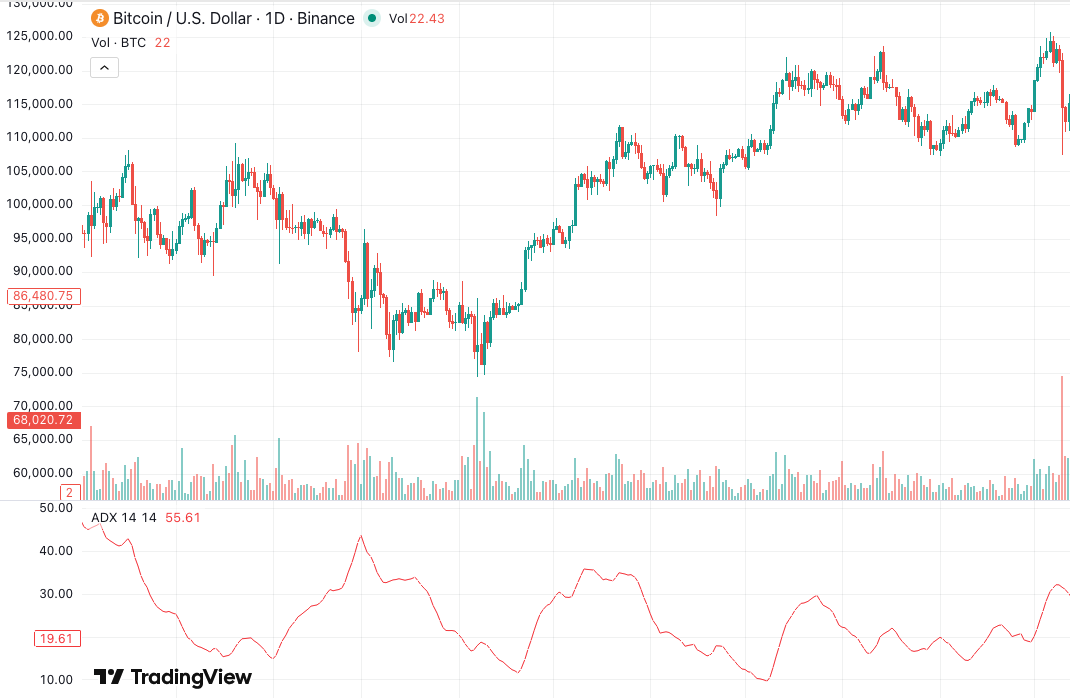
The Directional Movement Index is the raw, unsmoothed signal that drives one of the most widely used trend-strength frameworks in technical analysis — yet most traders only ever interact with its averaged form.
What Is the Directional Movement Index?
The Directional Movement Index (DX) is a technical indicator developed by J. Welles Wilder Jr. as part of his Directional Movement System, first published in 1978. It measures the degree of directional movement in price — specifically, how much more price is moving in one direction compared to the other. DX is the raw building block for the Average Directional Index (ADX). The ADX is a smoothed average of DX values taken over a rolling period. Understanding DX gives you a faster, more responsive read on trend strength before the smoothing takes effect. One critical point: DX measures the strength of a directional move, not the direction itself. A DX reading of 50 could represent a powerful uptrend or a powerful downtrend. Direction comes from two companion components — DI+ (Plus Directional Indicator) and DI- (Minus Directional Indicator).
What Does the DX Actually Measure?
DX captures the ratio of net directional movement to total directional movement. It is expressed as a value between 0 and 100. The calculation uses DI+ and DI-, which measure upward and downward price movement over a chosen period — typically 14 bars. From those two values, DX is determined by:
- Finding the absolute difference between DI+ and DI-.
- Dividing that by the sum of DI+ and DI-.
- Multiplying by 100.
A DX of 30 means 30% more price movement is happening in one direction than the other. Over 70 means the move is heavily one-directional. A DX near 0 means the two directional forces are roughly balanced — the market is ranging and directionless.
How Do You Interpret DX Readings?
Wilder’s original thresholds remain the most widely referenced:
- Below 20: Weak trend. The market is choppy or ranging. Trend-following strategies are likely to underperform here.
- 20–25: Borderline. A trend may be forming but is not confirmed. Proceed with caution.
- 25–50: Moderate trend. Directional strategies have a higher probability of working in this zone.
- Above 50: Strong trend. Price is making decisive, one-directional moves.
- Above 75: Very strong trend — uncommon, and often precedes a reversal or consolidation phase.
Because DX is unsmoothed, it reacts faster than ADX to changes in momentum. It spikes sharply on a strong candle and drops quickly when momentum fades. This makes it more sensitive but also noisier — useful for faster systems, but prone to false signals when used in isolation.
What Are the Best DX Trading Strategies?
Trend Strength Filter
The most common use of DX is as a filter gate. Only take entries from your primary strategy when DX is above 25 (or your chosen threshold). This removes trades taken in ranging markets where trend-following logic is statistically unprofitable. Pair with a DI+ vs DI- comparison to confirm direction before entry.
DX Threshold Breakout
When DX rises above a threshold after a prolonged period of low readings, it signals a potential trend initiation. Enter in the direction confirmed by DI+ vs DI-. Use a tighter stop than usual — false breakouts at the start of a move are common, and the DX spike needs to be sustained to confirm the trend is genuine.
DX Divergence with Price
If price makes a new high but DX is declining, the trend is losing directional conviction. This divergence often precedes a reversal or consolidation. Pair with a momentum oscillator like the Rate of Change Ratio (ROCR) for confirmation before exiting a position early.
What Are Common DX Mistakes to Avoid?
- Treating DX as directional: DX has no built-in notion of up or down. Always combine it with DI+ and DI- to determine whether the trend is bullish or bearish.
- Acting on single-bar spikes: A single volatile candle can push DX sharply above a threshold. Look for sustained readings rather than reacting to individual bars.
- Ignoring timeframe context: A 14-period DX on a 5-minute chart behaves very differently from a 14-period DX on a daily chart. Match the period and timeframe to your strategy’s holding time.
- Confusing DX with ADX: ADX is smoother and slower. If your strategy needs fast responsiveness to changes in trend strength, the raw DX is the better input. If you need confirmation with reduced noise, ADX is preferred.
How to Build DX Strategies in Arrow Algo
Arrow Algo includes the Directional Movement Index as a native indicator block in its no-code visual builder. Drag the DX block onto your canvas and wire it directly into your entry and exit logic — no formulas, no code. A typical trend-filter setup:
- Drag a DX block onto the canvas and set your period (14 is the default).
- Add a threshold comparison block. Connect the DX output and set the condition: DX > 25.
- Wire this condition as a gate on your entry signal. Trades only execute when the market is in a trending state.
- Add DI+ and DI- blocks and connect them to a comparison block to confirm direction. Use this to separate long and short entries.
Run a backtest directly in the platform against live exchange data from Binance, Coinbase, HyperLiquid, or any supported pair. Adjust the DX threshold and compare how different settings affect your results over the same period. For the full context on Wilder’s Directional Movement System, Investopedia’s DMI guide covers the complete framework including DI+, DI-, and their relationship to DX.
What Are the Key Takeaways?
- The Directional Movement Index measures trend strength on a scale of 0–100.
- DX is the raw, unsmoothed source of the ADX — it reacts faster but generates more noise.
- Readings above 25 indicate a trending market. Below 20 signals a range.
- DX does not indicate direction — always pair it with DI+ and DI- to determine which way the trend is running.
- Use DX as a filter gate to restrict trend-following entries to conditions where directional logic has a statistical edge.
- In Arrow Algo, drag the DX block onto your canvas, set a threshold, and wire it into your strategy without writing any code.
Disclaimer: This content is for educational purposes only and does not constitute financial advice. Trading involves significant risk and you should only trade with capital you can afford to lose. Past performance is not indicative of future results. Always conduct your own research before making any trading decisions. Ready to build your own automated trading strategies without writing a single line of code? Start for free at Arrow Algo and join thousands of traders who’ve made the switch to systematic trading.