
Sortino Ratio: Measure Risk the Smarter Way
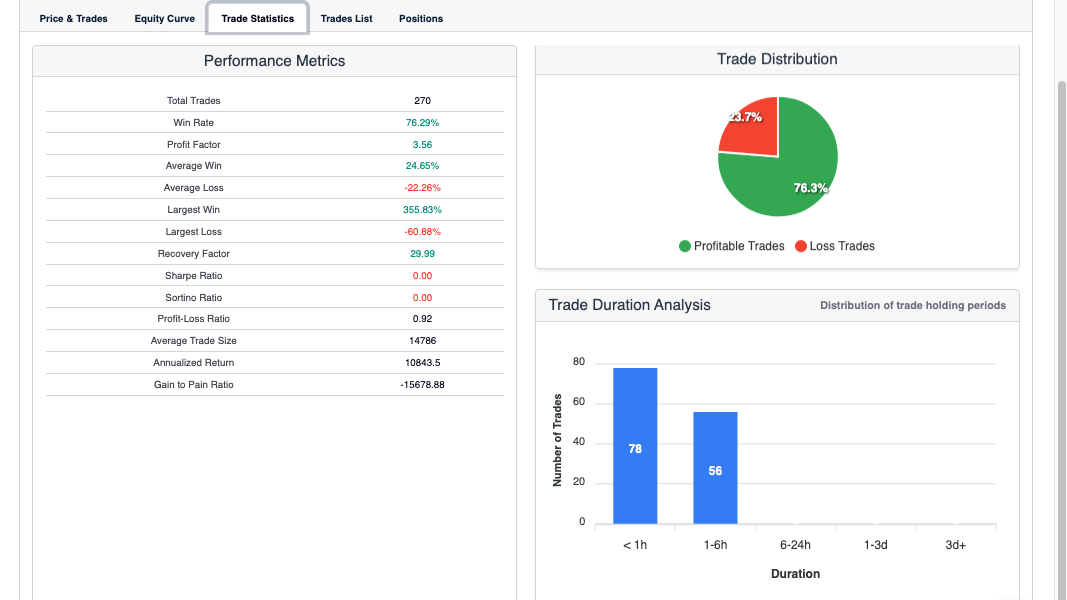
Most performance metrics penalise your strategy for being volatile — even when that volatility comes from your wins. The Sortino ratio draws a line between the kind of volatility you want and the kind you don’t.
What Is the Sortino Ratio?
The Sortino ratio is a risk-adjusted return metric that measures how much return a strategy generates per unit of downside risk. It was developed by Frank Sortino in the 1980s as a refinement of the Sharpe ratio for situations where upside volatility should not be treated as a liability.
The formula in plain English: take the strategy’s return above the minimum acceptable return (MAR, often set to 0%), and divide it by the downside deviation — the standard deviation of negative returns only. Positive swings in the equity curve play no role in the calculation.
A Sortino ratio above 1.0 is generally considered acceptable. Above 2.0 is strong. Above 3.0 is excellent. Like all single-number metrics, it is most useful in comparison — either against a benchmark or across multiple strategies you are evaluating.
Why the Sortino Ratio Matters for Systematic Traders
The Sharpe ratio divides excess return by total volatility — it treats upside swings and downside swings identically. A strategy that produces frequent large gains but occasional modest losses will be penalised by its high upside volatility, even though that volatility is the goal.
The Sortino ratio solves this by measuring the dispersion of negative returns only. Strategies with asymmetric return profiles — where wins are typically larger and more variable than losses — score far better on Sortino than on Sharpe. That asymmetry is exactly what a well-designed systematic strategy aims to produce.
For algorithmic traders building strategies with defined stop-losses and wider profit targets, the Sortino ratio is a more accurate measure of whether the strategy is doing its job. Investopedia’s Sortino ratio guide covers the mathematical derivation in full.
How Does the Sortino Ratio Compare to the Sharpe Ratio?
Both metrics divide return by a risk denominator. The difference is what counts as risk.
- Sharpe ratio: Divides excess return by total standard deviation — all volatility, up and down.
- Sortino ratio: Divides excess return by downside deviation — negative volatility only.
The relationship between the two ratios reveals how a strategy’s volatility is distributed:
- Sharpe > Sortino: Upside volatility dominates. Wins are larger and more variable than losses — the signature of an asymmetric strategy. A good sign.
- Sharpe approximately equals Sortino: Volatility is roughly symmetrical. Wins and losses are similar in scale.
- Sharpe < Sortino: Downside volatility dominates. Losses are larger and more erratic than gains. A warning sign that the strategy’s loss structure needs attention.
Use both metrics together. Sharpe gives you overall smoothness; Sortino tells you whether the roughness is coming from your wins or your losses.
What Counts as a Good Sortino Ratio?
There is no fixed universal benchmark — the right level depends on asset class, strategy type, and timeframe. Crypto strategies typically show wider variance in Sortino ratios than equity strategies, due to the higher underlying volatility of the asset class. As a general guide:
- Below 1.0: Weak. The strategy is not generating enough return to justify its downside risk.
- 1.0–2.0: Acceptable. Reasonable risk-adjusted performance for most strategy types.
- 2.0–3.0: Strong. The strategy delivers meaningful return relative to its downside exposure.
- Above 3.0: Excellent — but treat this with caution in backtests. Extremely high Sortino ratios can be a sign of overfitting. Always validate with walk-forward testing.
Compare your strategy’s Sortino ratio against others in the same asset class and timeframe. A Sortino of 2.5 on a 15-minute BTC strategy is a very different achievement than a Sortino of 2.5 on a daily equity strategy.
How to Apply the Sortino Ratio in Arrow Algo
Arrow Algo displays the Sortino ratio automatically in your backtest results alongside Sharpe ratio, maximum drawdown, win rate, and other key metrics. No manual calculation required — the platform handles it as part of every backtest run.
To improve your strategy’s Sortino ratio using Arrow Algo’s visual block builder:
- Add a stop-loss block: Capping the maximum loss per trade directly reduces downside deviation. Even a hard percentage stop below entry can meaningfully shift the Sortino ratio.
- Add a trend filter: Use a DX or ADX block to restrict entries to trending conditions. Trend filters remove random, unprofitable trades that contribute disproportionately to downside volatility.
- Set asymmetric profit targets: Use a 2:1 or 3:1 risk-reward ratio — take-profit target significantly wider than the stop-loss distance. This shapes the return distribution in favour of larger wins and smaller losses.
- Run walk-forward analysis: Use Arrow Algo’s walk-forward testing to confirm the Sortino ratio holds across unseen market periods. A high Sortino in a single backtest window alone is not enough.
For a broader picture of how the Sortino ratio fits alongside profit factor and other backtest metrics, see how profit factor rounds out your performance analysis. The Corporate Finance Institute’s Sortino ratio breakdown is a thorough reference for the underlying mathematics.
What Are the Key Takeaways?
- The Sortino ratio measures return per unit of downside risk — upside volatility does not count against the score.
- It is more honest than the Sharpe ratio for strategies designed to produce asymmetric returns (larger wins, smaller losses).
- A Sortino above 2.0 is strong; above 3.0 is excellent but requires walk-forward validation.
- Comparing Sortino and Sharpe together reveals whether a strategy’s volatility is coming from wins or losses.
- Arrow Algo shows the Sortino ratio automatically in every backtest report — no manual calculation needed.
- Improve it by tightening stop-losses, adding trend filters, and widening profit targets using the visual block builder.
Disclaimer: This content is for educational purposes only and does not constitute financial advice. Trading involves significant risk and you should only trade with capital you can afford to lose. Past performance is not indicative of future results. Always conduct your own research before making any trading decisions.
Ready to build your own automated trading strategies without writing a single line of code? Start for free at Arrow Algo and join thousands of traders who’ve made the switch to systematic trading.