
Golden Cross Death Cross Strategy: How to Build It in Arrow Algo
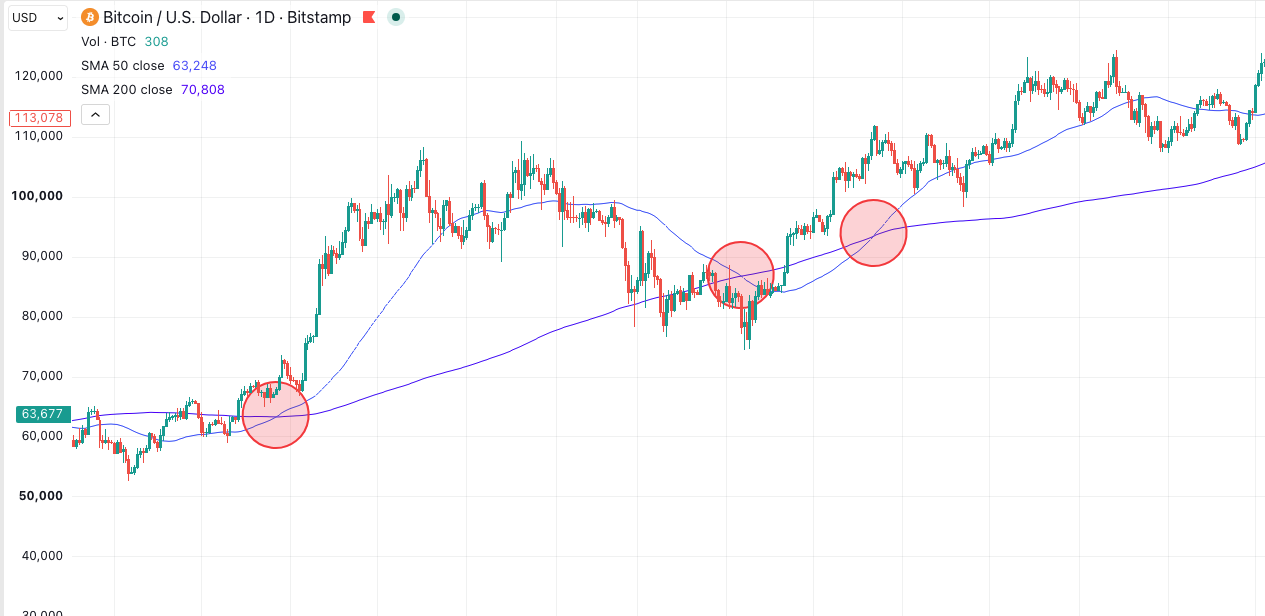
The Golden Cross and Death Cross strategy turns two Simple Moving Averages into one of the most widely-recognised signals in all of financial markets. Fund managers, institutional desks, and retail algorithmic traders all watch these crossovers — not because they are the most precise entry signals available, but because they reliably capture the beginning and end of major trends.
What Are the Golden Cross and Death Cross?
The Golden Cross occurs when the 50-period SMA crosses above the 200-period SMA. It signals that medium-term momentum has shifted above the long-term trend — a bullish regime change. The Death Cross is the reverse: the 50 SMA crosses below the 200 SMA, signalling a shift into a bearish regime.
These signals use Simple Moving Averages rather than Exponential ones. The SMA treats each historical price equally, making it slower and less reactive to short-term noise. That smoothing is precisely what makes the 50/200 crossover meaningful — it takes a sustained shift in price to move both averages enough to cross.
Why Do Institutional Traders Watch These Signals?
The Golden Cross and Death Cross carry weight partly because so many participants act on them. When a well-publicised signal is watched by enough market players — from retail traders to algorithmic funds — it can become self-reinforcing. Enough buyers entering on a Golden Cross confirmation can push price higher, validating the signal.
Beyond the reflexivity argument, the signals work because they genuinely capture regime transitions. A 50/200 crossover on the daily chart reflects months of sustained price behaviour. It does not fire on a single bad session or a short squeeze. The lag that critics point to is also its strength: it waits for confirmation before committing.
What Are the Biggest Limitations of This Approach?
Lag: Because both SMAs are slow, the crossover often fires well after the trend has started. In a fast-moving market, the entry price can be significantly removed from the actual turning point. Traders sometimes pair the signal with a shorter-term trigger — such as a pullback to the 50 SMA after the Golden Cross confirms — to improve entry timing.
Whipsaws in ranging markets: When price consolidates for an extended period, the 50 and 200 SMAs can converge and cross back and forth without any sustained trend developing. Each false signal incurs a small loss. Adding a trend-strength filter, such as requiring ADX above 25 at signal time, reduces these fakeouts significantly.
Single-timeframe risk: A Golden Cross on the daily chart does not mean every lower timeframe is aligned. In volatile conditions, shorter-term structure can be breaking down while the daily signal is still bullish. Multi-timeframe awareness prevents acting on daily signals into deteriorating lower-timeframe setups.
Three Ways to Trade the Golden Cross and Death Cross
Position entry on crossover confirmation: Enter long on the close of the bar that forms the Golden Cross. Exit on the Death Cross confirmation. Hold through the trend, using the 200 SMA as a dynamic support reference. This is the simplest implementation and works best on daily or weekly charts with trending instruments.
Pullback entry after crossover: Wait for the Golden Cross to confirm the bullish regime, then wait for price to retrace toward the 50 SMA. Enter on a bounce from 50 SMA support. This captures the same trend direction while entering at a better price with a tighter stop below the 50 SMA. The tradeoff is that some fast-moving trends never pull back and the entry is missed.
Regime filter for other strategies: Use the 50/200 crossover as a regime gate rather than a direct entry signal. Allow long-only signals from a separate indicator — such as RSI or MACD — only when the Golden Cross is active. Disable those signals when the Death Cross is in effect. This approach leverages the regime-reading strength of the 50/200 crossover without relying on its lagged timing for precise entries. See our related post on the EMA Crossover Strategy for how crossover-based logic applies at faster timescales.
How to Build a Golden Cross Strategy in Arrow Algo
Arrow Algo’s drag-and-drop builder makes it straightforward to implement this strategy without writing any code.
Add two SMA blocks to your canvas. Set one to period 50 and one to period 200, both using closing price as the input. Connect both outputs to a Cross Over block — when the 50 SMA output crosses above the 200 SMA output, that fires the Golden Cross buy signal. For the Death Cross sell signal, add a second Cross Over block with the inputs reversed.
To add an ADX regime filter, place an ADX block on the canvas and connect it to a condition block checking whether ADX is above 25. Wire the condition’s “true” output as a gate between your crossover signal and your entry block. Signals only pass through when trend strength is confirmed. This single addition substantially reduces false signals in ranging markets.
Run the full strategy through Arrow Algo’s backtester on the asset and timeframe you’re targeting. Compare the raw crossover results against the ADX-filtered version side by side — the filter’s impact on win rate and maximum drawdown is immediately visible without any manual calculation.
What Are the Key Takeaways?
- The Golden Cross fires when the 50 SMA crosses above the 200 SMA — a bullish regime signal; the Death Cross is the reverse
- These signals are widely watched, which gives them self-reinforcing properties beyond their technical merit
- Lag is the core weakness — entries are often late; a pullback-to-50-SMA entry helps improve timing
- Add an ADX filter (above 25) to reduce whipsaws in ranging conditions
- The 50/200 crossover works well as a regime gate for other indicators, not just as a standalone entry signal
- Arrow Algo’s no-code builder lets you set up, filter, and backtest a Golden Cross strategy visually in minutes
Disclaimer: This content is for educational purposes only and does not constitute financial advice. Trading involves significant risk and you should only trade with capital you can afford to lose. Past performance is not indicative of future results. Always conduct your own research before making any trading decisions.
Ready to build your own automated trading strategies without writing a single line of code? Start for free at Arrow Algo and join thousands of traders who’ve made the switch to systematic trading.