
Hull Moving Average Strategy: How to Build It in Arrow Algo
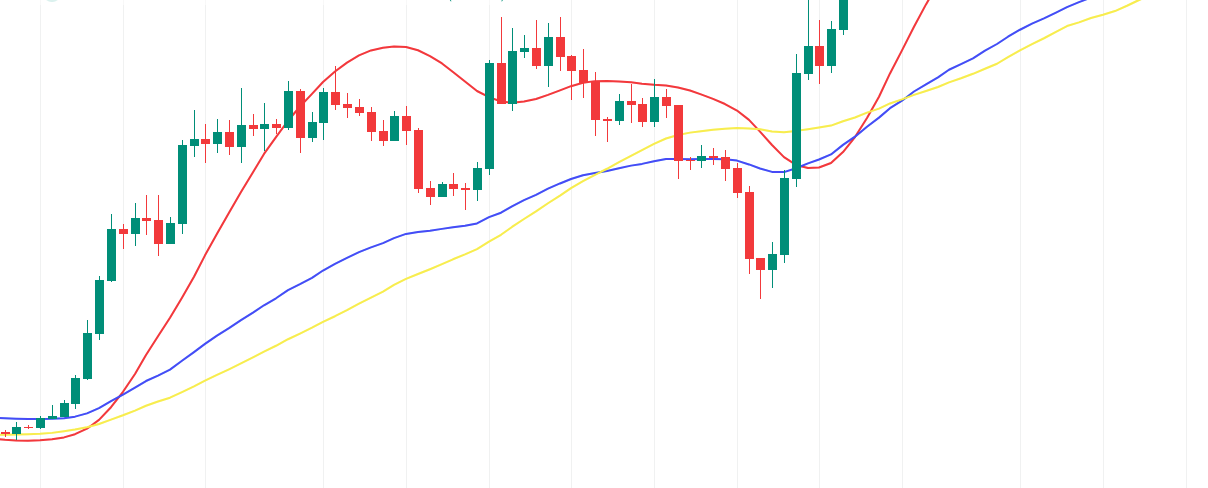
A hull moving average strategy attacks the trade-off that ruins most trend systems: smooth averages are slow, and fast averages are noisy. Alan Hull built his moving average in 2005 with one goal — cut the lag without letting the noise back in. The result hugs price so closely that many traders mistake it for a repainting indicator the first time they see it. It isn’t. It’s just an unusually clever piece of weighting, and it turns the humble moving average turn into a genuinely tradeable signal.
What Makes the Hull Moving Average Different?
Every moving average lags because it averages the past. A 50-period average is, by definition, centred on price from 25 periods ago. The Hull Moving Average reduces that lag with a trick borrowed from extrapolation. It takes a fast weighted average of recent price, doubles its influence, and subtracts a slower weighted average. That difference over-weights the newest data so heavily that the line projects forward, roughly where price is heading rather than where it has been. A final short smoothing pass then irons out the jitter that the projection creates.
The practical effect is visible on any chart. Where an EMA rounds a corner, the HMA cuts it. Turns appear several bars earlier than an EMA of the same period. That is the whole appeal: the classic “trade the moving average turn” idea becomes viable, because the turn now happens close to the actual swing instead of long after it.
How Do You Trade the HMA Turn?
The signature hull moving average strategy uses nothing except the line’s own direction. When the HMA turns upward — today’s value higher than yesterday’s — momentum has shifted up. When it turns downward, momentum has shifted down. Many charting platforms colour the line green or red for exactly this reason.
The rules are as simple as systematic trading gets. Enter long when the HMA turns up. Exit, or reverse short, when it turns down. A 21-period HMA on four-hour or daily candles is a common starting point for crypto. Shorter periods trade every wiggle. Longer periods behave more like a conventional trend filter.
The turn strategy shines in markets that swing cleanly. It suffers in chop, because even the HMA’s filtering cannot make a sideways market trend. That is why the two variations below exist.
Two Stronger Variations Worth Testing
HMA Crossover
Run a fast HMA (for example 9-period) against a slow HMA (for example 49-period). Go long when the fast line crosses above the slow line, and close or flip when it crosses back. This behaves like a classic dual moving average system, but signals arrive earlier because both lines carry less lag. Traders comparing this with a standard EMA crossover usually find the HMA version enters trends sooner — at the cost of a few more false starts.
HMA Turn With a Trend Filter
Keep the turn entry, but only take longs when price sits above a slow benchmark such as a 200-period average. The filter removes the counter-trend signals that cause most of the turn strategy’s losses. You trade fewer signals, and the ones that remain lean with the larger current. This is the version most worth backtesting first.
Where Hull Moving Average Strategies Go Wrong
The HMA’s speed comes from extrapolation, and extrapolation overshoots. When price reverses violently, the HMA can swing past the move before correcting. Treat it as a signal line, not as support or resistance — price does not respect it the way it sometimes respects a 200-day average.
The second mistake is period-shopping. A 21-period HMA that backtests beautifully on one pair may be curve-fit to that pair’s rhythm. Test a range of periods and prefer settings where performance degrades gently, not settings that sit on a lonely peak.
The third mistake is trading every turn in a ranging market. No amount of moving average engineering fixes a sideways tape. Pair the HMA with a trend or volatility filter, or accept that chop will pay for your trending profits.
Building a Hull Moving Average Strategy in Arrow Algo
Arrow Algo includes the HMA as a native indicator block, so the whole system assembles visually — no code involved.
For the turn strategy, drop an HMA block onto the canvas and set its period. Add a Lag block to hold the previous HMA value, then compare the two with a condition block: current above previous means the line has turned up. Route the true state to your long entry and the opposite comparison to your exit.
For the crossover version, place two HMA blocks with different periods and connect both to a Crossover block. It fires once at the moment the fast line crosses the slow line, which keeps entries clean. To add the trend filter, drop in a slow SMA or EMA block and combine it with your entry condition using an AND gate, so longs only fire above the benchmark.
Backtest each version on your target pair using the exchange’s own historical data. Compare the turn, crossover, and filtered variants across the same window. The equity curves will tell you quickly which one fits your market — and paper trading will confirm it before real capital is involved.
What Are the Key Takeaways?
- The Hull Moving Average cuts lag by over-weighting recent price and extrapolating forward, then smoothing the result.
- The core strategy trades the line’s own turn: long when the HMA turns up, out or short when it turns down.
- Crossover and trend-filtered variations reduce whipsaw and usually backtest more robustly than raw turns.
- The HMA overshoots in sharp reversals and is not a support or resistance level — use it for direction, not location.
- Arrow Algo’s visual builder assembles all three variants with HMA, Lag, Crossover, and condition blocks, ready to backtest in minutes.
For a deeper look at how the HMA compares with its simpler cousins, see our guide to simple vs exponential vs Hull moving averages.
Disclaimer: This content is for educational purposes only and does not constitute financial advice. Trading involves significant risk and you should only trade with capital you can afford to lose. Past performance is not indicative of future results. Always conduct your own research before making any trading decisions.
Ready to build your own automated trading strategies without writing a single line of code? Start for free at Arrow Algo and join thousands of traders who've made the switch to systematic trading.