
Latch Block: Complete Guide for Algorithmic Trading
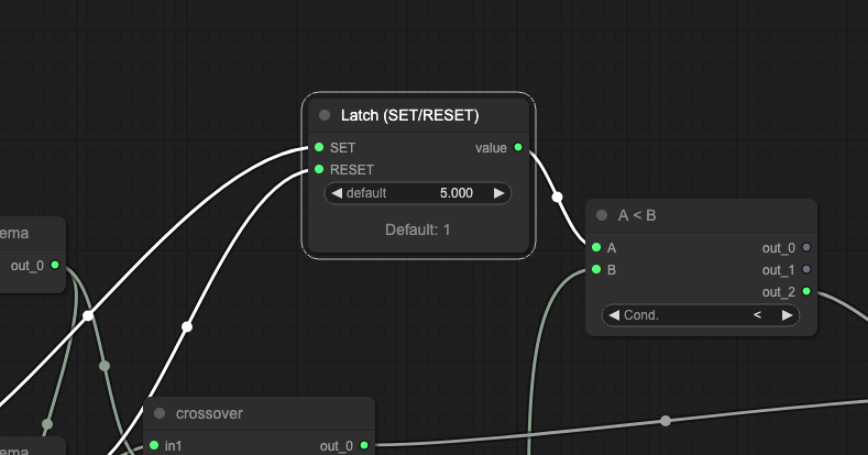
Signal persistence is one of the harder problems to solve in no-code strategy building. Most indicator blocks react to conditions bar by bar — the moment a condition turns off, the signal disappears. The Latch block solves this: it holds a signal state in place once triggered, keeping it active until a deliberate reset condition fires.
What Is a Latch Block?
A latch is a signal memory device. It takes two inputs — a set condition and a reset condition — and produces a single output that reflects the current latched state.
When the set input fires, the latch output switches to 1 (active). It stays at 1 regardless of what happens to the set input afterward. When the reset input fires, the output returns to 0 (inactive) and stays there until the set input fires again.
The result is a block that remembers. It carries a signal forward in time, bridging the gap between when a condition triggers and when something else explicitly cancels it.
How Does the Latch Block Work?
The Latch block operates as an SR latch — Set and Reset:
- Set input: Any binary signal — a crossover, a threshold comparison, a regime filter. When this input fires (goes to 1), the latch output sets to 1 and holds.
- Reset input: A separate binary signal. When this fires, the latch output drops back to 0 and holds until the set input fires again.
- Output: The current latched state — 1 (active) or 0 (inactive).
Neither the set nor reset input needs to stay active. A single pulse on the set input is enough to flip the latch to 1. A single pulse on the reset input is enough to flip it back to 0. Between those two events, the output is stable regardless of market conditions.
This is fundamentally different from using a condition block directly. A condition block outputs 1 only while its condition is true — the moment the condition turns false, the signal disappears. A latch holds the signal until you explicitly cancel it.
What Can You Build With a Latch Block?
One-shot entry signals: A breakout above a resistance level should trigger once — not repeatedly every bar the price stays above that level. Connect the breakout signal to the latch set input and a position exit signal to the reset input. The entry fires once. It stays active until the trade closes. The latch prevents the same entry from triggering multiple times on the same move.
Regime memory: Detecting a trend regime on one bar is straightforward. Staying in that regime until conditions clearly reverse is harder. Connect a trend detection signal (a moving average crossover, an ADX threshold) to the set input, and a clear reversal signal to the reset input. The strategy operates in trend mode until the reversal fires — not just for a single bar.
Sequential logic: Some strategies require multiple conditions to have occurred in sequence. Condition A must have happened before condition B triggers the entry. Use a latch to remember that condition A fired — the latch output feeds into the condition B entry check, so entries only occur when A has previously been set and B now fires. Without the latch, there is no memory of whether A happened.
Trade state tracking: Use a latch to maintain a simple flag for whether a trade is currently open. Set on entry, reset on exit. Feed this flag into other logic blocks to prevent conflicting signals while a position is active.
When Should Traders Use a Latch Block?
The latch is the right tool when:
- A signal should fire once and remain active — not repeat every bar the underlying condition is true.
- A strategy needs memory — the current bar’s logic depends on whether a past condition occurred.
- Two conditions must occur in order — the latch remembers whether the first condition has been met.
- A mode or regime should persist until deliberately changed, rather than reacting bar by bar.
If a strategy behaves erratically — entering and exiting on every bar a condition flips — a latch is often the fix. It stabilises the signal by removing the noise of momentary condition changes.
What Mistakes Lead to Latch Block Misuse?
Forgetting to define a reset: A latch with no reset condition stays permanently active once set. The strategy enters and never re-evaluates. Always define a meaningful reset — an exit signal, a stop condition, or a time-based reset — that cleanly cancels the latched state when appropriate.
Using latch when a simple condition suffices: Not every signal needs persistence. If the logic only needs to react to the current bar, a latch adds unnecessary complexity. Use a latch specifically when the current bar’s state depends on something that happened on a prior bar.
Double-triggering the set input: If the set condition fires repeatedly (e.g. every bar in a trend), the latch output stays at 1 throughout — which may be the intended behaviour. But if the goal is to capture only the first trigger, make sure the set input is itself a transition signal (a crossover, not a level comparison) so it only fires once per event.
How to Add a Latch Block to Your Strategy in Arrow Algo
Arrow Algo’s visual block builder includes the Latch block in the indicator library. To use it:
- Add a Latch block to the canvas.
- Connect a binary signal to the Set input — this is the condition that activates the latch.
- Connect a separate binary signal to the Reset input — this is the condition that deactivates it.
- Wire the Latch output to your entry, exit, or condition logic downstream.
- Backtest to confirm the latch fires and resets at the expected points — use the debug timeline to inspect bar-by-bar latch state.
The Latch block works especially well in combination with the Crossover block — crossovers produce clean one-bar pulses that make ideal set and reset inputs, since they fire once at the transition rather than holding high throughout the condition.
What Are the Key Takeaways?
- The Latch block holds a signal state once triggered — it does not reset automatically.
- It takes two inputs: Set (activates the latch) and Reset (deactivates it).
- Use it when a strategy needs signal memory — current logic depends on a prior condition.
- Key use cases: one-shot entry signals, regime memory, sequential logic, trade state tracking.
- Always define a meaningful reset condition — a latch with no reset stays active indefinitely.
- Pair with a Crossover block for clean single-bar set and reset pulses.
Disclaimer: This content is for educational purposes only and does not constitute financial advice. Trading involves significant risk and you should only trade with capital you can afford to lose. Past performance is not indicative of future results. Always conduct your own research before making any trading decisions.
Ready to build your own automated trading strategies without writing a single line of code? Start for free at Arrow Algo and join thousands of traders who’ve made the switch to systematic trading.