
Mesa Sine Wave (MSW): Complete Guide for Algorithmic Trading
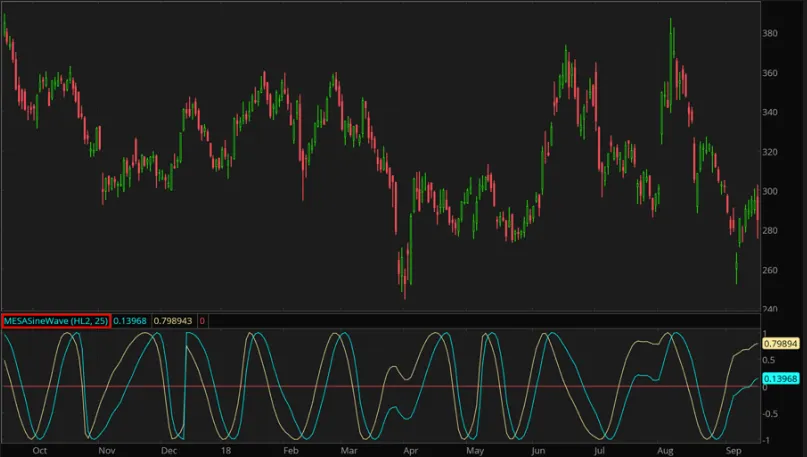
The Mesa Sine Wave (MSW) is a market regime indicator that detects whether a market is cycling — moving in a repeating oscillation — or trending in a sustained directional move. Developed by John Ehlers, it is one of the few indicators designed specifically to answer the question every systematic trader needs to answer first: what mode is the market in right now?
What Is the Mesa Sine Wave?
The Mesa Sine Wave outputs two lines: the Sine line and the Lead Sine line. In a cycling market — where price is oscillating back and forth without a clear directional trend — both lines move in smooth, wave-like patterns that visually resemble a sine wave. In a trending market, the lines flatten, lose their periodic shape, and stop cycling cleanly.
This distinction is what makes the MSW unique. Most indicators try to generate entry signals. The MSW tells you which type of entry signal to use. A momentum or trend-following strategy will underperform in a cycling market. A mean reversion strategy will get chopped up in a trend. The MSW helps you avoid deploying the wrong strategy in the wrong conditions.
The Lead Sine line is a phase-shifted version of the Sine line — it leads the Sine by approximately 45 degrees. This lead gives it an early warning quality: when the Lead Sine crosses the Sine line, it can signal a turning point in the cycle before price itself confirms it.
How Is the Mesa Sine Wave Calculated?
The MSW uses digital signal processing techniques — specifically concepts from the Hilbert Transform — to measure the dominant cycle length in price data. Rather than applying a fixed lookback period like most indicators, it adapts to the market’s own rhythm, identifying the period of the most prominent repeating price pattern.
Once the dominant cycle is identified, the indicator calculates where in that cycle the current bar sits — and expresses that position as a phase angle. The Sine line is the sine of that phase angle. The Lead Sine is the sine of the phase angle advanced by 45 degrees.
In plain terms: the indicator measures how long the market’s natural oscillation takes, then tracks whether price is currently following that oscillation or breaking away from it into a trend. If the Sine and Lead Sine are cycling cleanly, the market is in rhythm. If they are not, the market has shifted into trend mode.
How to Read Mesa Sine Wave Signals?
Reading the MSW comes down to two observations: the shape of the lines and the relationship between them.
Cycle mode vs trend mode: When both the Sine and Lead Sine lines are moving in smooth, regular waves — rising and falling in a consistent periodic pattern — the market is in cycle mode. This is the environment for mean reversion and oscillator-based strategies. When the lines flatten, move erratically, or stop their periodic behaviour, the market has transitioned to trend mode. Trend-following and momentum strategies perform better here.
Crossover signals within cycles: When the Lead Sine crosses below the Sine line, it suggests the cycle is approaching a bottom — a potential long entry in a mean reversion strategy. When the Lead Sine crosses above the Sine, the cycle may be approaching a top — a potential exit or short entry. These crossover signals are most reliable when the lines are clearly cycling. In trend mode, crossovers lose their meaning.
Regime transitions: The transition from cycle mode to trend mode — where the lines begin to flatten from a previously clean wave pattern — is itself an actionable signal. It suggests the mean reversion environment is ending and a directional move may be starting.
What Are the Best Mesa Sine Wave Trading Strategies?
1. Regime-Switching Strategy
Use the MSW to switch between two strategy modes. When the indicator confirms cycle mode — both lines moving in clean waves — activate a mean reversion approach that buys pullbacks and sells extensions. When the lines flatten into trend mode, switch to a trend-following approach that holds directional positions longer. This adaptive approach deploys the right strategy type for the current market environment rather than forcing one approach across all conditions.
2. Cycle Entry Timing
In confirmed cycle mode, use Lead Sine crossovers below the Sine line as entry triggers for long positions, and crossovers above the Sine as exit or short triggers. Pair this with a momentum confirmation — such as RSI turning from oversold — to filter out crossovers that occur on low-conviction price moves.
3. MSW as a Strategy Filter
Rather than using MSW for direct signals, use it as a binary on/off filter for an existing strategy. Only run a mean reversion strategy when the MSW confirms cycle mode. Pause it when trend mode is detected. This is one of the cleanest applications of the indicator — it does not change the strategy logic, it just determines when to apply it.
What Are Common Mesa Sine Wave Mistakes to Avoid?
Using mean reversion signals in trend mode. The most common MSW mistake is acting on Lead Sine crossovers when the lines are not clearly cycling. In trend mode, crossovers are noise — they do not represent cycle turning points because there is no cycle present. Always confirm cycle mode before using crossover signals.
Treating regime transitions as immediate entries. The shift from cycle to trend mode is a signal to change strategy type, not necessarily an immediate entry trigger. Confirm the transition with a few bars before switching approach — regime calls at the edge of a transition carry more uncertainty.
Using it on very short timeframes. The MSW’s cycle detection works best on timeframes where meaningful oscillations can form — typically 1-hour charts and above. On 1-minute or 5-minute charts, the dominant cycle is too short and noisy for the indicator to produce reliable regime readings.
Ignoring it after setup. Market regimes change. A market that was clearly cycling last week may have shifted to a trend today. The MSW needs to be evaluated continuously, not just at strategy setup. Build regime monitoring into your strategy logic rather than assuming the initial regime persists.
How to Build Mesa Sine Wave Strategies in Arrow Algo?
Arrow Algo’s visual builder includes the MSW block, which outputs both the Sine and Lead Sine lines. Connect the block to your canvas and route the two outputs into condition blocks to detect cycle mode and crossover signals.
To build a regime filter, compare the behaviour of the Sine and Lead Sine outputs over recent bars. In a cycling market, the lines will be moving in opposite directions relative to each other as they oscillate. Use this relationship to gate your mean reversion entry conditions — only allow the entry to fire when cycle mode is confirmed.
For a broader perspective on regime detection, see our guide on market regime detection, which covers multiple approaches to identifying the current market environment. The MSW is one of the most direct tools available for this purpose — purpose-built for the problem rather than repurposed from another use.
What Are the Key Takeaways?
- The Mesa Sine Wave detects whether a market is cycling (oscillating) or trending — the most fundamental regime question for systematic traders
- It outputs two lines: Sine and Lead Sine. Smooth, periodic waves = cycle mode. Flat or erratic lines = trend mode.
- Lead Sine crossovers signal potential turning points within cycles — most reliable in confirmed cycle mode only
- Best used as a regime filter: activate mean reversion strategies in cycle mode, trend-following in trend mode
- Avoid acting on crossover signals when cycle mode is not confirmed — crossovers in trend mode are noise
- Works best on 1-hour timeframes and above where meaningful cycles can develop
- Arrow Algo’s visual builder includes the MSW block with both Sine and Lead Sine outputs ready to connect
Disclaimer: The information provided in this article is for educational purposes only and does not constitute financial advice. Trading involves significant risk and you should only trade with capital you can afford to lose. Past performance is not indicative of future results. Always conduct your own research before making any trading decisions.
Ready to build your own automated trading strategies without writing a single line of code? Start for free at Arrow Algo and join thousands of traders who’ve made the switch to systematic trading.