
Price Action Trading: How to Automate It
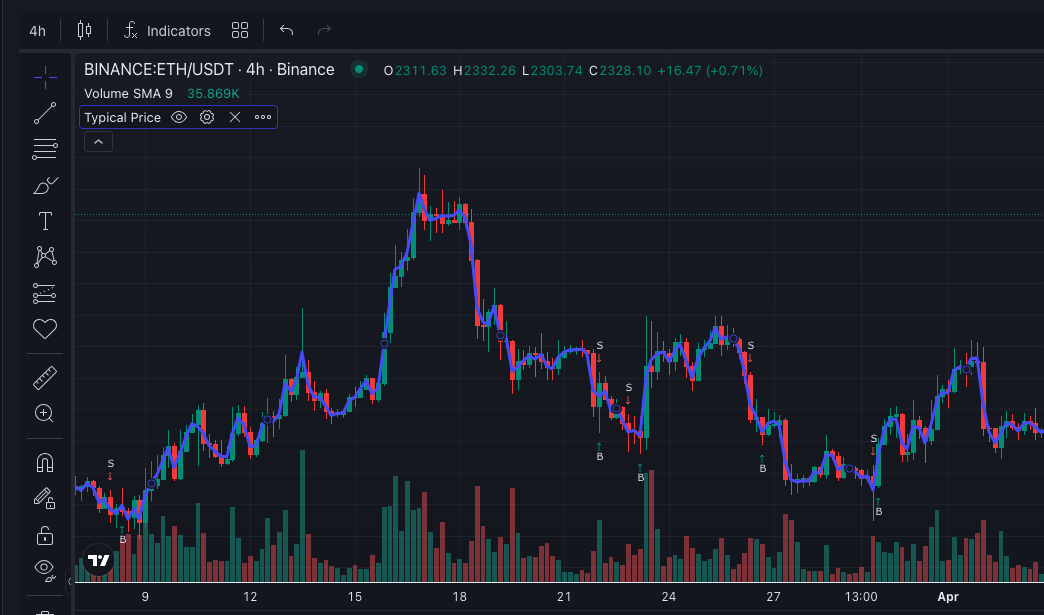
Price action trading is the practice of making trading decisions based purely on raw price movement — without relying on lagging indicators or external data. It is, in fact, one of the oldest and most widely used approaches in financial markets. And it can be fully automated.
What Is Price Action Trading?
Price action trading is a method of analysis and decision-making that uses the price chart itself as the primary input. Rather than calculating RSI, MACD, or Bollinger Bands and waiting for their signals, price action traders read the direct movement of price — candle shapes, range structure, highs and lows, and how price behaves at key levels. This approach is covered in depth in Investopedia’s guide to price action.
The core idea is that price reflects all available information. In other words, everything that is known about a market — fundamentals, sentiment, institutional positioning — is ultimately expressed as a price on a chart. As a result, reading that price directly, without the delay introduced by a moving average or oscillator, gives the trader a faster and cleaner signal.
Price action trading is, therefore, not a single strategy. It is a framework. Within it, traders use candlestick patterns, trend structure analysis, support and resistance levels, and breakout behaviour — all derived from price alone.
Why Price Action Trading Matters
Most technical indicators are derivatives of price. They take raw price data and run it through a calculation — a moving average, a momentum formula, a standard deviation — and output a smoothed or transformed version of what price already showed. As a result, that calculation introduces lag. The indicator tells you what price was doing, not what it is doing now.
Price action, by contrast, removes that lag entirely. A candlestick pattern forms and completes on the current bar. A support level holds or breaks in real time. A higher high or lower low prints immediately. The signal is, therefore, the price itself — unfiltered and immediate.
For algorithmic traders, this matters because faster signals mean earlier entries and tighter stops. Moreover, a trend-following strategy built on price structure can enter sooner and define its risk more precisely than one waiting for a slow-moving average to confirm.
What Price Action Signals Can Be Automated?
The common objection to automating price action is that it requires human judgment — reading a chart, recognising a pattern, assessing context. This is partly true for the most discretionary forms of price action. However, a large class of price action signals are rule-based and fully automatable.
Candlestick patterns are the most obvious example. A Hammer, a Shooting Star, a Bullish Engulfing — each has a precise mathematical definition based on the relationships between open, high, low, and close. As a result, an automated detection block evaluates these criteria bar by bar and fires a signal when the pattern appears.
Support and resistance levels can similarly be defined algorithmically. Pivot Points calculate key levels from the prior session’s high, low, and close. Donchian Channels, meanwhile, track the highest high and lowest low over a defined period, creating dynamic support and resistance boundaries.
Trend structure — the sequence of higher highs and higher lows in an uptrend, or lower highs and lower lows in a downtrend — can also be captured using price comparisons across periods. When price sets a new N-period high, it is in an uptrend structure. When it sets a new N-period low, it is in a downtrend.
Breakouts are among the simplest price action signals to automate. For example, when price closes above the highest close of the last 20 bars, a breakout has occurred. This single rule, combined with a volume confirmation, forms the basis of many systematic price action strategies.
What Are the Challenges of Automating Price Action?
The most discretionary aspects of price action — reading the quality of a move, assessing whether a candle looks convincing, judging whether a breakout has momentum — do not translate easily into rules. Experienced price action traders make these assessments intuitively after years of chart reading. That intuition, however, is not easily codified.
The solution is, therefore, not to try to automate judgment. Instead, focus on the rule-based subset of price action signals that have clear, testable criteria. Candlestick pattern detection, level-based entries, and structural breakouts are all fully automatable. Subjective reads on candle quality, on the other hand, are not — and attempts to automate them often produce over-fitted strategies.
The other challenge is context. A Hammer at a major support level after a 20-bar downtrend is, for instance, a very different signal to the same pattern in the middle of a range. As a result, automating the context layer — using trend filters, level proximity checks, and volume conditions — is how systematic price action traders capture this nuance.
How to Apply Price Action Trading in Arrow Algo
Arrow Algo’s visual builder includes all the building blocks for systematic price action strategies. The Candlestick Pattern Detection block automatically identifies bullish and bearish formations. Additionally, Pivot Point and Donchian Channel blocks define support and resistance levels. EMA blocks capture trend direction, while the Maximum and Minimum In Period blocks track structural highs and lows for breakout detection.
To build a basic price action strategy, start with a trend direction filter — an EMA above which you only consider longs. Then add a support level condition to identify where entries make structural sense. Next, connect a Candlestick Pattern Detection block as the entry trigger. Finally, define your exit with a trailing stop that adapts to volatility.
Each condition is a separate block. As a result, connecting them takes minutes. Backtesting the result then shows whether the logic has a real edge — before any capital is committed.
For a deeper look at how candlestick detection works in the visual builder, see our guide on Candlestick Pattern Detection.
What Are the Key Takeaways?
- Price action trading uses raw price movement as the primary signal — without indicator lag
- A large subset of price action signals — candlestick patterns, breakouts, level-based entries — are fully rule-based and automatable
- The most discretionary elements of price action do not automate well; focus on the rule-based subset
- Context layers — trend filters, level proximity, volume conditions — are how systematic traders capture the nuance of price action
- Arrow Algo’s visual builder includes all the core blocks needed to build systematic price action strategies without code
Disclaimer: The information provided in this article is for educational purposes only and does not constitute financial advice. Trading involves significant risk and you should only trade with capital you can afford to lose. Past performance is not indicative of future results. Always conduct your own research before making any trading decisions.
Ready to build your own automated trading strategies without writing a single line of code? Start for free at Arrow Algo and join thousands of traders who’ve made the switch to systematic trading.